Categories Finance
7 days
30 days
All time
Recent
Popular


Thread Best books recommendation by one of best investor I knew @insharebazaar (Virtually)
He grab many multibagger stocks and His style also unique(1st Seen interview in @TraderHarneet's YT Channel)
He follow Simple process
Young Intelligent Investor who also appeared in ET
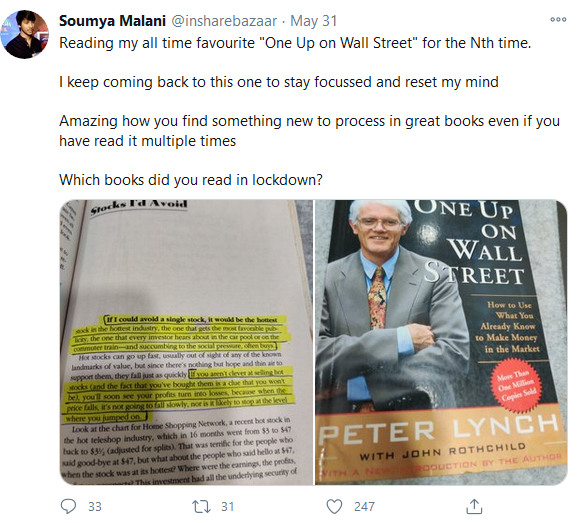
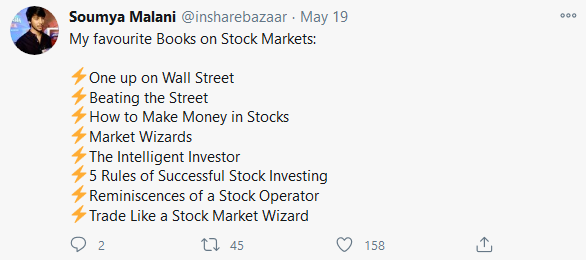
1. One Up On Wall Street
2. Rich Dad Poor Dad
Access here : https://t.co/UWOCF732z6
3. The Unusual Billionaires
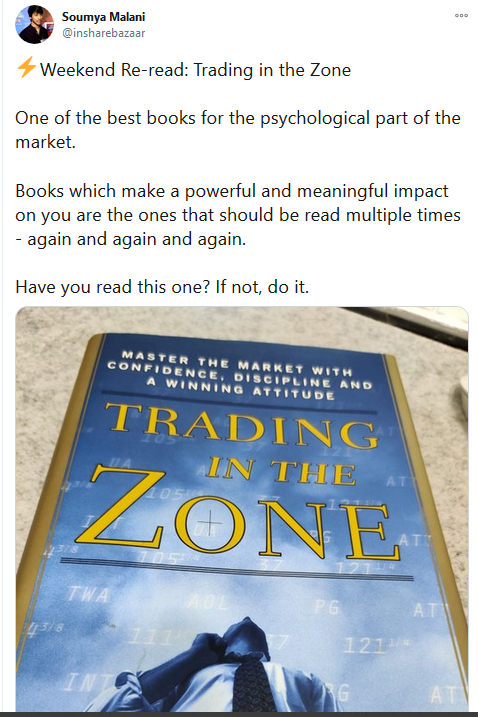
4. Trading in the Zone
https://t.co/G7mqVPtEM0
5. Market Wizards
6. The Intelligent Investor
https://t.co/yPKBzYyPAl
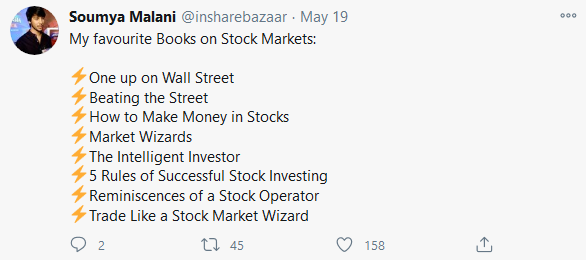
7. The Five Rules for Successful Stock Investing
8. Reminiscences of a Stock Operator
https://t.co/PiioB3hdHP
He grab many multibagger stocks and His style also unique(1st Seen interview in @TraderHarneet's YT Channel)
He follow Simple process
Young Intelligent Investor who also appeared in ET
1. One Up On Wall Street
2. Rich Dad Poor Dad
Access here : https://t.co/UWOCF732z6
3. The Unusual Billionaires
4. Trading in the Zone
https://t.co/G7mqVPtEM0
5. Market Wizards
6. The Intelligent Investor
https://t.co/yPKBzYyPAl
7. The Five Rules for Successful Stock Investing
8. Reminiscences of a Stock Operator
https://t.co/PiioB3hdHP


Two year back thread on MFI, someone liked this so came up in notifications . Rather than running around 100s of indicators, I have made this my go to indicator under any circumstances and have been using this for years
This thread actually had some great answers , one can learn a lot about the thought processes of different traders from the answers. Please go thru them
What do you think/use as the most robust leading indicator if following technical analysis ? Please answer with reason , I will provide my answer after 2 hours
— Subhadip Nandy (@SubhadipNandy16) August 12, 2019
( At Delhi airport , bored as hell )
This thread actually had some great answers , one can learn a lot about the thought processes of different traders from the answers. Please go thru them
Ok here is the explanation. Grab a cup of coffee and read on. If you have not read/noticed this, you will see intraday options movement in a new light.
Say we have two options, one 50 delta ATM options and another 30 delta OTM option. Normally for a 100 point move, the ATM option will move 50 points and the OTM option will move 30 points. But in a high volatile environment, the OTM option will also move nearly 50 points
To understand why this happens, first understand why an ATM option is 50 delta. An ATM option has the probability of 50% of expiring as ITM. The price just has to close a rupee above the strike for the CE to be ITM and vice versa for PEs
Now think of a highly volatile day like today. If someone is asked where the BNF will close for the day or expiry, no one can answer. BNF can close freakin anywhere, That makes every option of an equal probability of being ITM. So all options have a 50% probability of being ITM
Hence, when a huge volatile move starts, all OTM options behave like ATM options. This phenomenon was first observed in the Black Monday crash of 1987 at Wall Street, which also gave rise to the volatility skew/smirk
In a high IV environment or when the market is very volatile
— Subhadip Nandy (@SubhadipNandy16) January 21, 2022
" OTM options will behave like ATM options", one will get almost the same delta movement
Say we have two options, one 50 delta ATM options and another 30 delta OTM option. Normally for a 100 point move, the ATM option will move 50 points and the OTM option will move 30 points. But in a high volatile environment, the OTM option will also move nearly 50 points
To understand why this happens, first understand why an ATM option is 50 delta. An ATM option has the probability of 50% of expiring as ITM. The price just has to close a rupee above the strike for the CE to be ITM and vice versa for PEs
Now think of a highly volatile day like today. If someone is asked where the BNF will close for the day or expiry, no one can answer. BNF can close freakin anywhere, That makes every option of an equal probability of being ITM. So all options have a 50% probability of being ITM
Hence, when a huge volatile move starts, all OTM options behave like ATM options. This phenomenon was first observed in the Black Monday crash of 1987 at Wall Street, which also gave rise to the volatility skew/smirk


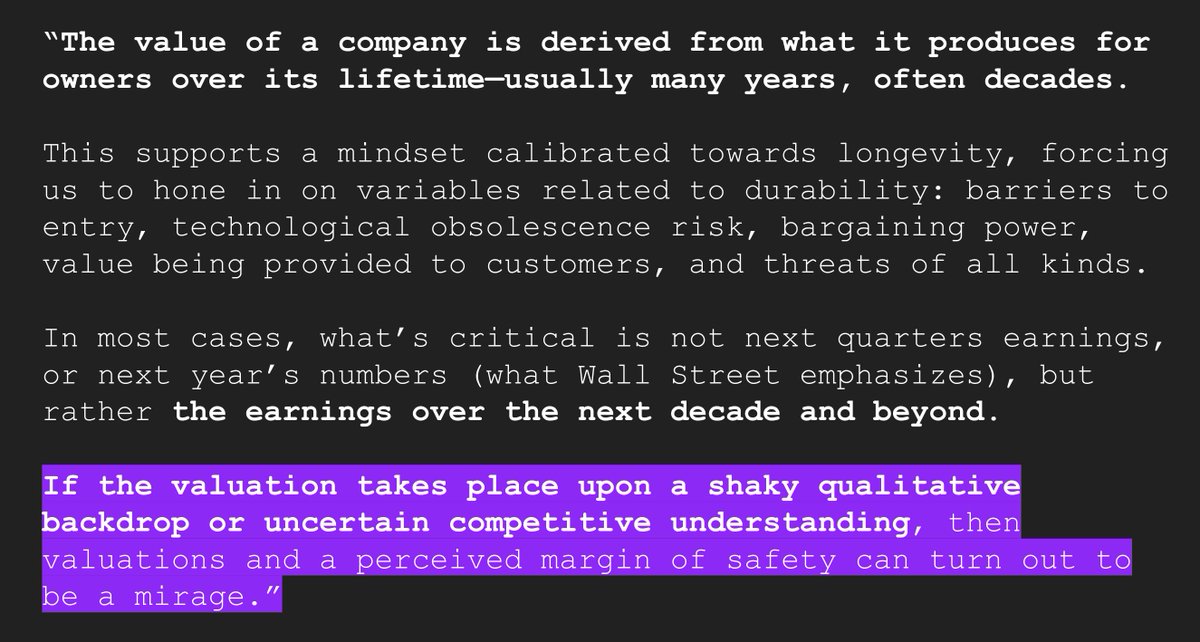


** MEGA THREAD ON Cryptocurrencies/Blockchain**
I wanted to know the best resources to learn about cryptocurrencies and blockchain for someone with zero knowledge. I asked Twitter, and Twitter answered.
This thread is a compilation of the best resources I was recommended. 👇👇
Let's start with ** BOOKS **
The first thing you should do before you pick up any book:
Learn about Bitcoin & Ethereum by reading the respective whitepapers.
- [Bitcoin white paper](https://t.co/cErOaFn6QL) by Satoshi Nakamoto
- [Ethereum White paper] (https://t.co/0g5kYCGJGq) by Vitalik Buterin
Even if you are not tech savvy, you can get a good grasp about how blockchain functions from these papers.
1) *The Basics of Bitcoins and Blockchains: An Introduction to Cryptocurrencies and the Technology that Powers Them* by Antony Lewis
This book covers topics such as the history of Bitcoin, the Bitcoin blockchain, and Bitcoin buying, selling, and mining.
It also answers how payments are made and how transactions are kept secure.
Other cryptocurrencies and cryptocurrency pricing are examined, answering how one puts a value on cryptocurrencies and digital tokens.
I wanted to know the best resources to learn about cryptocurrencies and blockchain for someone with zero knowledge. I asked Twitter, and Twitter answered.
This thread is a compilation of the best resources I was recommended. 👇👇
Let's start with ** BOOKS **
The first thing you should do before you pick up any book:
Learn about Bitcoin & Ethereum by reading the respective whitepapers.
- [Bitcoin white paper](https://t.co/cErOaFn6QL) by Satoshi Nakamoto
- [Ethereum White paper] (https://t.co/0g5kYCGJGq) by Vitalik Buterin
Even if you are not tech savvy, you can get a good grasp about how blockchain functions from these papers.
1) *The Basics of Bitcoins and Blockchains: An Introduction to Cryptocurrencies and the Technology that Powers Them* by Antony Lewis
This book covers topics such as the history of Bitcoin, the Bitcoin blockchain, and Bitcoin buying, selling, and mining.
It also answers how payments are made and how transactions are kept secure.
Other cryptocurrencies and cryptocurrency pricing are examined, answering how one puts a value on cryptocurrencies and digital tokens.


Today in mezz threads:
Finding collateral where there isn’t any ... aka, my most innovative idea (and I’m giving it to you for free)!

Let’s revisit this thread from my early (active) Twitter days. A few questions you might ask:
1) What was my collateral (why did I make this loan)?
2) Why did I have any leverage with the company at all (short of a foreclosure)?
3) Why did the “deep pockets” buy me out?
Let me pick up the story with two assumptions I had going in:
1) I didn’t trust the owner/operator (at all)
2) I knew the PE group (that had offered $200 M) well, and I knew who they were proposing to bring in to run the company had they bought it
#2 (plan B) made sense to me

The senior ($ZION) had the collateral locked up and controlled any formal foreclosure/bankruptcy.
The idea of a convertible had some appeal but you can’t really do anything with 5-10% of a business

My solution: “default conversion” at an unfair valuation
I negotiated a deal that if the company defaulted (and only if they didn’t cure the defaults) I had the option to convert into preferred stock representing a fully diluted 40% of the business

Finding collateral where there isn’t any ... aka, my most innovative idea (and I’m giving it to you for free)!
Let’s revisit this thread from my early (active) Twitter days. A few questions you might ask:
1) What was my collateral (why did I make this loan)?
2) Why did I have any leverage with the company at all (short of a foreclosure)?
3) Why did the “deep pockets” buy me out?
My typical mezz deals are to companies in 1/3 categories:
— Matt Willes (@SkolCapital) August 27, 2020
1) M&A
2) Growth Capital
3) Special Situations ...
Here\u2019s an example on #3:
Let me pick up the story with two assumptions I had going in:
1) I didn’t trust the owner/operator (at all)
2) I knew the PE group (that had offered $200 M) well, and I knew who they were proposing to bring in to run the company had they bought it
#2 (plan B) made sense to me
The senior ($ZION) had the collateral locked up and controlled any formal foreclosure/bankruptcy.
The idea of a convertible had some appeal but you can’t really do anything with 5-10% of a business
My solution: “default conversion” at an unfair valuation
I negotiated a deal that if the company defaulted (and only if they didn’t cure the defaults) I had the option to convert into preferred stock representing a fully diluted 40% of the business

💥This is a story about a supermarket chain.
- One of the largest employers in the U.S. (~193,000 employees)
- ~$38 B in revenue
- 1200+ locations in 7 states
- Employee owned with majority shares still owned by the Jenkins family members
It’s called PUBLIX
THREAD
1/
I deleted an earlier tweet because I started to quickly. Forgive me for jumping the gun.
It was about a story that came out today in the WSJ about a big Trump Donor helping fund the #EllipseRally in D.C.
Great reporting by @rebeccaballhaus @shalini @AlexandraBerzon
2/
https://t.co/ru13PVfTzp
Here’s that story
3/
The donor who gave the money to help fund the #EllipseRally in DC that led to domestic terrorists storming the capital was Julie Ansley Jenkins Fancelli.
Julie gave $300,000 to help fund that rally.
But this THREAD is also about PUBLIX.
4/
Julie is the daughter of George Jenkins, the original founder of PUBLIX. It began as one store in 1930 and grew to what it is today, despite the Great Depression and World Wars.
But that’s another story.
5/
- One of the largest employers in the U.S. (~193,000 employees)
- ~$38 B in revenue
- 1200+ locations in 7 states
- Employee owned with majority shares still owned by the Jenkins family members
It’s called PUBLIX
THREAD
1/
I deleted an earlier tweet because I started to quickly. Forgive me for jumping the gun.
It was about a story that came out today in the WSJ about a big Trump Donor helping fund the #EllipseRally in D.C.
Great reporting by @rebeccaballhaus @shalini @AlexandraBerzon
2/
https://t.co/ru13PVfTzp
Here’s that story
3/
The donor who gave the money to help fund the #EllipseRally in DC that led to domestic terrorists storming the capital was Julie Ansley Jenkins Fancelli.
Julie gave $300,000 to help fund that rally.
But this THREAD is also about PUBLIX.
4/
Julie is the daughter of George Jenkins, the original founder of PUBLIX. It began as one store in 1930 and grew to what it is today, despite the Great Depression and World Wars.
But that’s another story.
5/