This is value investor, Allan Mecham.

He dropped out of college at age 22 to start his fund, Arlington Value.

From 2008-2016, they did a CAGR of 30% over 8.5 years!

And in his fund letters, he shared his best frameworks for investing in companies.

Here's a breakdown of each:

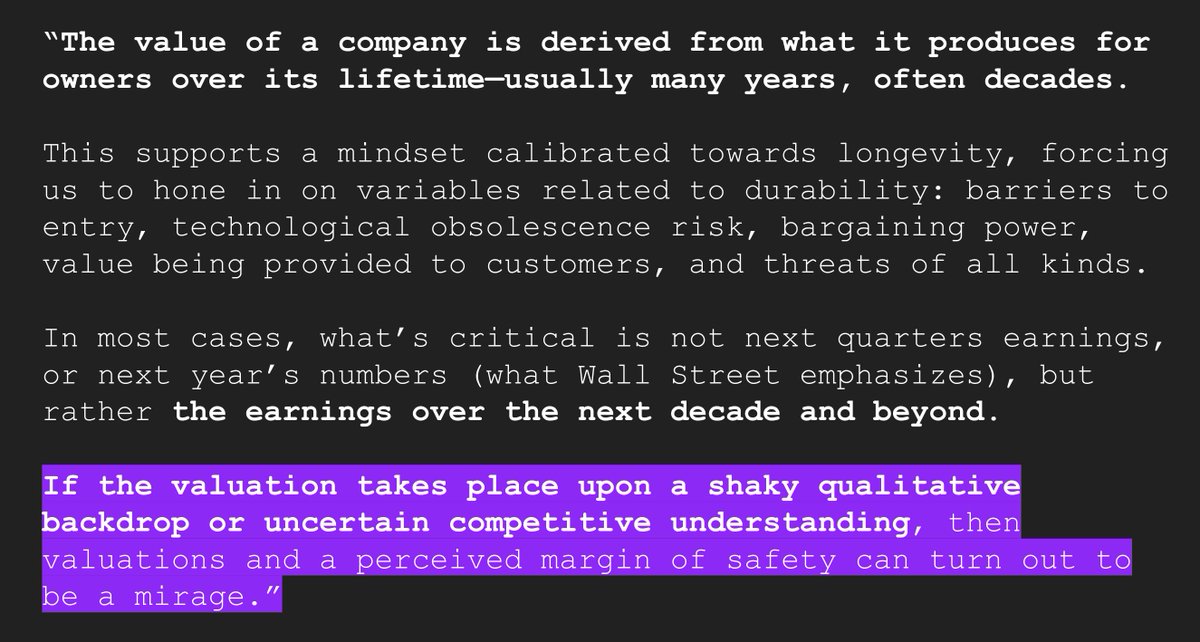
1. Adopt a mindset for longevity

He focuses on variables that affect a business' durability.

Stuff like valuation doesn't matter if the business quality is misjudged.

Since a company's value is determined by its future cash flows...

Hence evaluating its future is key
2. Stay within your circle of competence

Allan is aware that his CoC is tiny!

Thus, he rarely buys companies that he:

• Hasn't researched
• Hasn't followed for at least a few years.

Because the best way to study a business is to observe its execution overtime.
3. Embrace volatility as a gift

Public markets offer you amazing deals you will never get in the private markets!

It's all about being patient.

The underlying value of a business is much more stable than the stock.

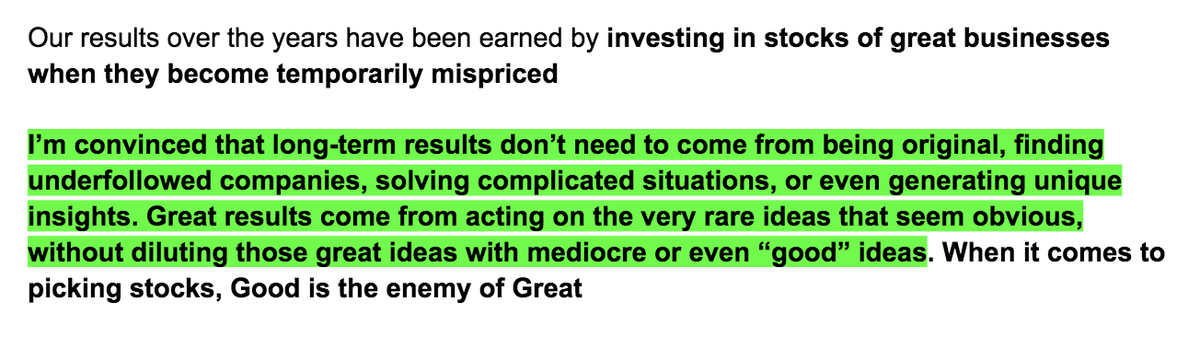
So you can buy great businesses that are mispriced!
4. Avoid noise and news

More information can give you a false sense of confidence.

It can create an illusion of "knowledge", and make you think many things are important.

The key is to know what are the 3-5 main variables in the company, and focus on those.

Ignore the rest.
5. Extend your time horizon to see what's truly important

When you look years out, instead of next quarter:

• You place less emphasis on hiccups and fluctuations.

• You don't focus on what 99% of other analysts look at (guidance, beats).

This helps you think more clearly.
6. Dig below the numbers

Not everything that is in numbers gives you the full story.

The real returns are made from great business quality.

Many factors like psychology and customer love are what determines the longevity of the business.

Look beyond the financial statements!
7. Mentally prepare for speed bumps and ugly numbers

Learn to discern between:

Short term speed bumps VS. fundamental problems in the business.

Franchise value can still be firmly intact, even if the company is going through a rough patch.
8. Pick the easy fights

He looks for layup type of investments, basically those that are easy.

Simple to understand.

In this business, there are no bonus points for doing backflips and somersaults in the air.

K.I.S.S!!!
RECAP:

1. Adopt a mindset for longevity
2. Stay within your circle of competence
3. Embrace volatility as a gift
4. Avoid noise and news
5. Extend your time horizon
6. Dig below the numbers
7. Mentally prepare for speed bumps
8. Pick the easy fights
If you like this, follow me here at @heymaxkoh

I share how I crossed 7 figures before age 30, and achieved my own version of financial freedom.

Stuff I tweet about:

• My investing strategy
• Books that inspire me
• How I built high income skills i.e. public speaking

More from Max Koh

I'm lucky to attain financial freedom before 30.

I credit Fintwit for my learnings.

Here's 10 key concepts every investor must know:

1. $$ needed to retire
2. Researching a business
3. Reading annual reports
4. Reading earnings calls
5. Criteria of a multi bagger

(Read on...)

6. Holding a multi bagger
7. Economic moats
8. When to buy a stock
9. Earnings vs cashflow
10. Traits of quality companies

Here's my 10 favourite threads on these concepts:

1. How much $$ do you need to retire

Before you start, you must know the end game.

To meet your retirement goals...

How much $$ do you need in your portfolio?

10-K Diver does a good job explaining what's a safe withdrawl rate.

Hint: It's NOT


2. Research a business

Your investment returns are a lagging indicator.

Instead, your research skills are the leading predictor of your results.

Conclusion?

To be a good investor, you must be a great business researcher.

Start with


3. Reading annual reports

This is the bread and butter of a good business analyst.

You cannot just listen to opinions from others.

You must learn to deep dive a business and make your own judgments.

Start with the 10k.

Ming Zhao explains it

More from Finance

If you want to become financially independent and don't know where to start, here is a thread that will help you get started

/THREAD/

1. Review your expenses and make a budget

It will help you see where you overspend, make a plan to save, pay down debt and start


2. Set your investing and retirement goals

How much do you need to support yourself in retirement and when do you want to


3. The earlier you start investing, the better.

Here's why and how time and compounding can become your


4. Invest in an index fund

It's easy, safe, cheap, and the best choice for a beginner in investing, with not much time for
Last week Hizbollah's finance institution Al Qard el Hasan was hacked by Spiderz. A group of people took that Data and tried to make sense out of it. Below are the findings

https://t.co/eGLqvb28o5


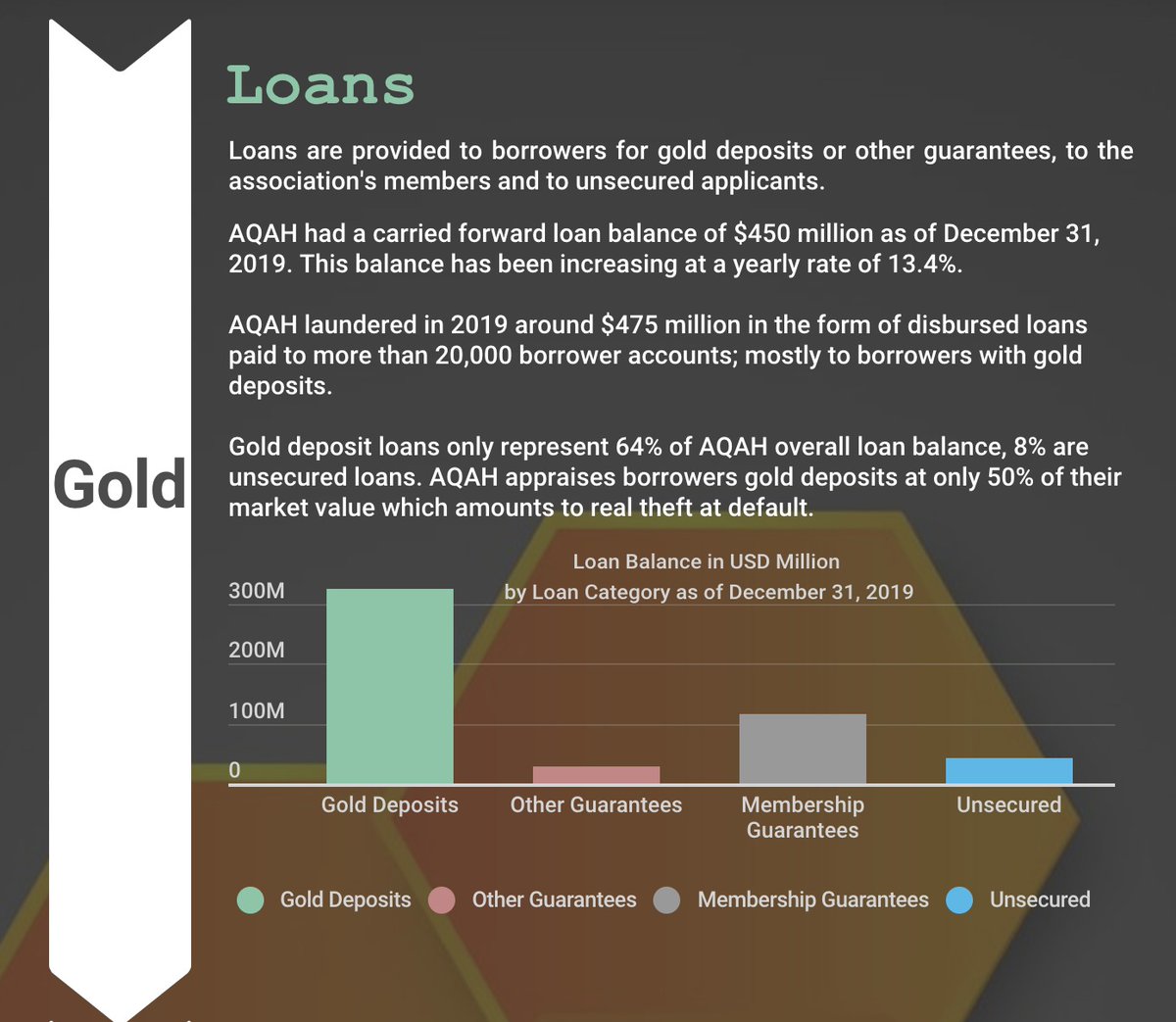
Loans are provided to borrowers for gold deposits or other guarantees, to the association's members and to unsecured applicants.

AQAH had a carried forward loan balance of $450 million as of December 31, 2019. This balance has been increasing at a yearly rate of 13.4%.


AQAH laundered around $475 million in 2019 in the form of disbursed loans paid to more than 20,000 borrower accounts; mostly to borrowers with gold deposits.

Deposits accounts have been offered to 307,000 members of the association, 83,000 contributors as well as to 600 companies. AQAH closed 2019 with an overall depositors accounts balance of around $500 million.

You May Also Like

I’m torn on how to approach the idea of luck. I’m the first to admit that I am one of the luckiest people on the planet. To be born into a prosperous American family in 1960 with smart parents is to start life on third base. The odds against my very existence are astronomical.


I’ve always felt that the luckiest people I know had a talent for recognizing circumstances, not of their own making, that were conducive to a favorable outcome and their ability to quickly take advantage of them.

In other words, dumb luck was just that, it required no awareness on the person’s part, whereas “smart” luck involved awareness followed by action before the circumstances changed.

So, was I “lucky” to be born when I was—nothing I had any control over—and that I came of age just as huge databases and computers were advancing to the point where I could use those tools to write “What Works on Wall Street?” Absolutely.

Was I lucky to start my stock market investments near the peak of interest rates which allowed me to spend the majority of my adult life in a falling rate environment? Yup.