CodyyyGardner's Categories
CodyyyGardner's Authors


Latest Saves







🧵 1/
Thinking about ways to translate what I am doing at school into everyday words, and wonder if anyone would be interested in me trying to tweet some of my readings this year?
— Heather Morgan (she/her)\U0001f469\u200d\U0001f9bc\U0001f3f3\ufe0f\u200d\U0001f308 \U0001f1e8\U0001f1e6 (@poweredbylove2) January 3, 2021
I don't I can get them into single tweets, but if folks were interested I'd try 4 short synoptic threads.
In the study of the theology of the church McGrath notes two ways of viewing the church, both of which are problematic if 'belonging' is our goal. The first view is of purity and the second an idea of a 'mixed body' of sinners and saints.
2/
In the purity model, cohesion/acceptance are based on a person's commitment to a narrowly prescribed list of rules/requirements. Succeed at keeping these rules and you can stay. Otherwise, you will need to be put 'out' because your failure risks the purity of the Church & u.
3/
Those churches most concerned with keeping out (LGBTQ, women in ministry, whatever) are most likely to adhere to a purity model of church (and although this goes beyond purity culture, it's part of where that idea comes from).
4/
The search/drive for purity creates evermore insular groups of individuals to the point where one church in our city is convinced that in a city of 74 churches the only Christian's in the city are the 17 that attend their church.
5/


Would love to know about some of yours.
@saxena_puru @BrianFeroldi @GavinSBaker @7Innovator @dhaval_kotecha @Gautam__Baid @richard_chu97 @10kdiver @FromValue @investing_city
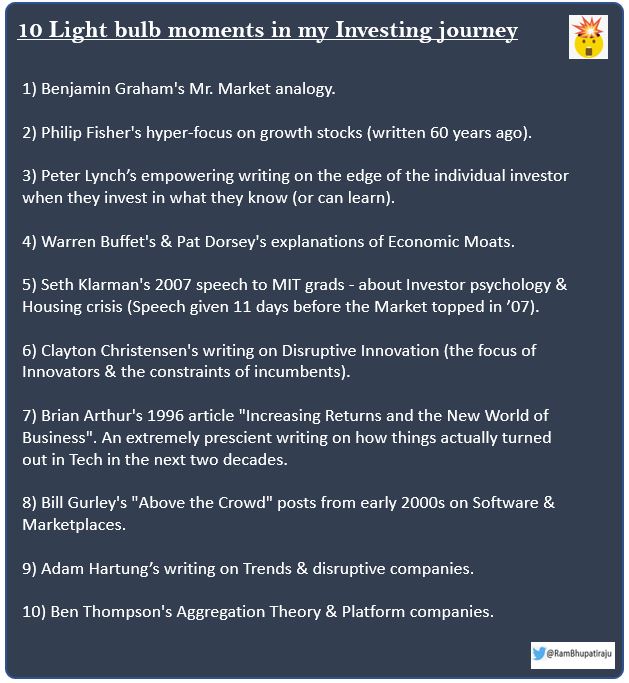
Below thread has the references to each of these 10 concepts.
Note : Many of these are my past Tweets related to these topics. Not trying to self promote them. Adding them only because they have the original links, added context and my highlights & fav pts.
Let's dive in. ⬇️⬇️
1⃣ Benjamin Graham's Mr. Market analogy.
An extremely useful concept, especially when
Market is panicking (& throwing out good Co's at bargain prices) & when
Market is too complacent (& awarding high valuations to hype and
Excellent compilation of quotes from Benjamin Graham's "The Intelligent Investor". \U0001f44f
— Ram Bhupatiraju (@RamBhupatiraju) May 25, 2020
cc: @dmuthuk @Gautam__Baidhttps://t.co/LNKNVXVj1b
2⃣ Philip Fisher's hyper-focus on growth stocks (written 60 years ago).
Very useful and mostly still applicable stuff on how to deeply analyze Growth Co's (except Stock based Compensation & Adjusted EBITDA of
Great summary of Philip Fisher's "Common Stocks and Uncommon Profits". It's no secret that this is one of THE BEST books for Individual investors but it's still enlightening to re-read the book or these summaries.\U0001f44d
— Ram Bhupatiraju (@RamBhupatiraju) June 4, 2020
cc:@saxena_puru @Gautam__Baid @dmuthukhttps://t.co/u16X3CKj8V
3⃣ Peter Lynch’s empowering writing on the edge of the individual investor when they invest in what they know (or can
Peter Lynch's "Use Your Edge" essay has some great lessons for individual investors. \U0001f44f
— Ram Bhupatiraju (@RamBhupatiraju) November 25, 2020
Solid advice at the end of the article (my fav points highlighted).\U0001f447https://t.co/nkUVDh0NVA pic.twitter.com/aQ1eFr2SGC






I've been thinking about Kansas 1854-59 for a while.
Let's be clear about what happens when political parties reject elections and democracy:
Violence & bloodshed.
Thread.
The die is cast for the Republican Party. It will be destroyed on January 6th in much the same way the Whig party was destroyed by the passage of the Kansas-Nebraska Act in 1854. The act unraveled the Missouri compromise and allowed for the westward expansion of slavery. 1/
— Steve Schmidt (@SteveSchmidtSES) January 3, 2021
2/ The Compromise of 1850 & the Kansas-Nebraska Act of 1854 undid the Missouri Compromise (see map), leaving the question of slave state/free state to voters in the territories, leading to local violence, disputed elections, & ultimately the Civil
3/ The Kansas-Nebraska Act opened what would become Kansas, Nebraska, the Dakotas, Wyoming, and Montana to a territory-by-territory vote on slavery vs. freedom.
Pro-slavery Missourians moved west into Kansas to vote for the westward expansion of
4/ Soon after 1854, Kansas became a local preview and a microcosm of the coming Civil War. Violence, intimidation & murder preceded these slave v. free local elections, mostly from the pro-slavery side, and pro-slavery forces used fraud to win.
5/ Missouri organized pro-slavery "Border Ruffians" to cross into Kansas, use violence and vote illegally. One estimate is that they added 5,000 illegal votes to the pro-slavery side to swing the elections. Congress investigated and found massive vote fraud.


Honestly, I think the answer is that the rationales for these rulings are not likely to unreasonably harm meritorious progressive OR conservative challenges.
Any merit to the notion that the rationales for some of these rulings will harm progressive challenges in future elections?
— Andrew Broering (@AndrewBroering) January 3, 2021
One says laches, another moot, another standing, sometimes with almost the same type of plaintiff.
The first thing to keep in mind is that, by design, challenges to the outcomes of elections are supposed to be heard by state courts, through the process set out in state law.
That happened this year, and the majority of those challenges were heard on the merits.
The couple of cases where laches determined the outcome of state election challenges were ones where it was pretty clear that the challenges were brought in bad faith - where ballots cast in good faith in reliance on laws that had been in force for some time were challenged.
The PA challenge to Act 77 is one example. The challengers, some of whom had voted for passage of the bill, didn't make use of the initial, direct-to-PA-SCt challenge built into the law or sue pre-election; they waited until post-election.
The WI case is another. That one had a challenge to ballots cast using a form that had been in use for a literal decade.
Those are cases where laches is clear - particularly the prejudice element.


