That happened this year, and the majority of those challenges were heard on the merits.
This is an excellent question, and it's something that I've thought about some over the last couple of months.
Honestly, I think the answer is that the rationales for these rulings are not likely to unreasonably harm meritorious progressive OR conservative challenges.
Any merit to the notion that the rationales for some of these rulings will harm progressive challenges in future elections?
— Andrew Broering (@AndrewBroering) January 3, 2021
One says laches, another moot, another standing, sometimes with almost the same type of plaintiff.
That happened this year, and the majority of those challenges were heard on the merits.
Those are cases where laches is clear - particularly the prejudice element.
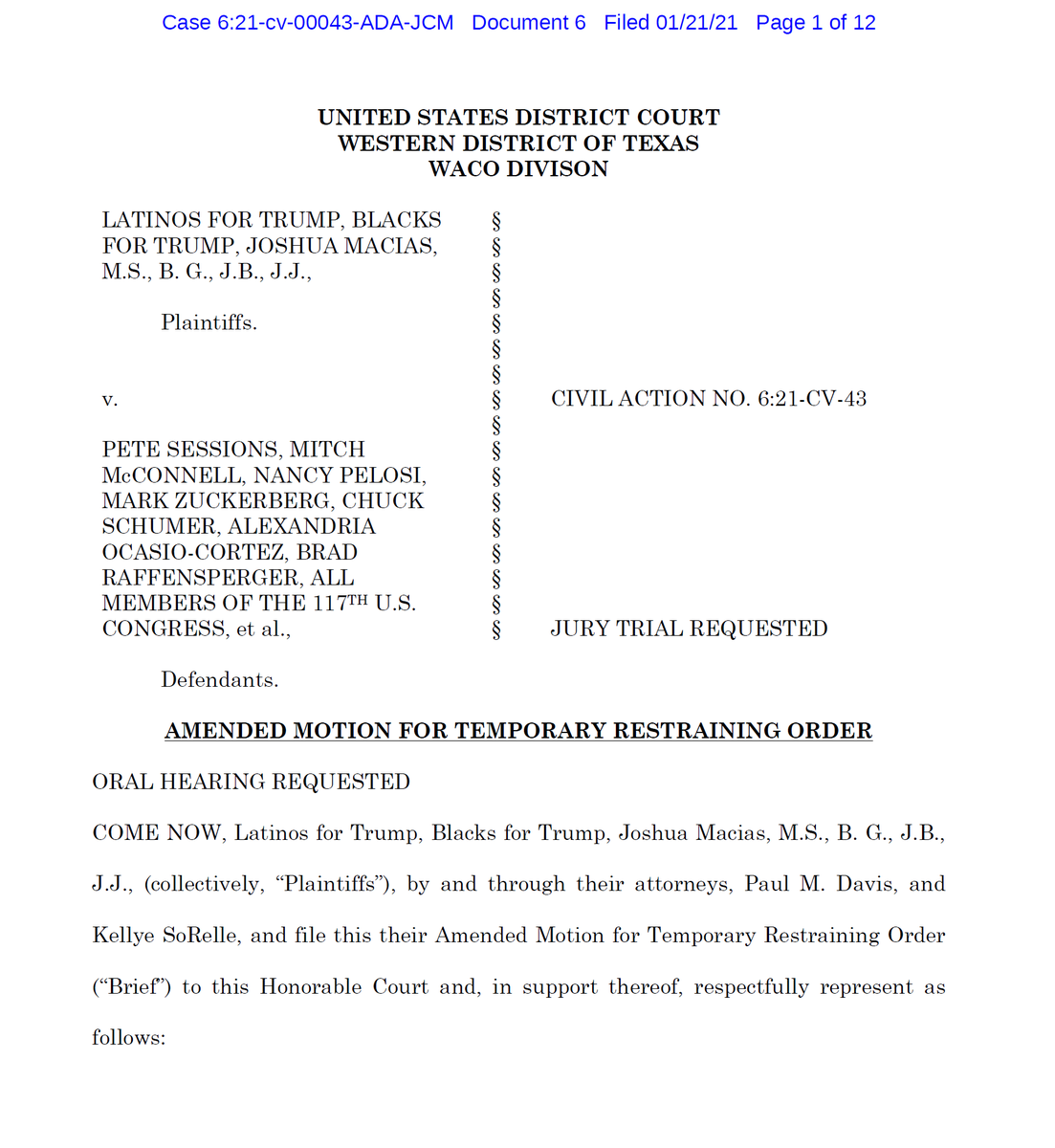
The theory Trump was advancing was that any deviation from state election law could be litigated in federal courts.
More from Mike Dunford
I've been trying to think that through - not just legally, but judicially.
The more thinking I do the less serious - and more ludicrous - the entire thing looks. And the more obvious it becomes that this is the proposal of deeply unwell individuals who are not thinking clearly.
On the legal side, I read through the list of emergency powers - the whole list - that was assembled by the Brennan Center. Nothing on that list fits. Nothing comes even
It seems extraordinarily unlikely that any executive order along the lines of what has been discussed would be legal. In this case, it can be taken as a given that one or more targeted jurisdictions would dash right off to the courthouse.
Standing would not, it should go without saying, be likely to be an issue. I doubt redressability would either. I think it's very likely that restraining orders and injunctions would be swiftly issued.
That's the legal side, to the extent it's possible to speculate on that at all at this point. Basically, there's no readily apparent legal basis for such a thing, so it probably wouldn't be legal.
That's the easy part. Now for the nuttier side - the logistics.
The more thinking I do the less serious - and more ludicrous - the entire thing looks. And the more obvious it becomes that this is the proposal of deeply unwell individuals who are not thinking clearly.
Can you game out where it would go it theoretically Trump did enact some EO demanding the impounding of voting machines? As that\u2019s clearly the game. Like he signs it, then what? Do marshals listen or refuse? Do states sue and get an emergency injunction and that\u2019s the end?
— Bryan Duva (@duva60) December 21, 2020
On the legal side, I read through the list of emergency powers - the whole list - that was assembled by the Brennan Center. Nothing on that list fits. Nothing comes even
It seems extraordinarily unlikely that any executive order along the lines of what has been discussed would be legal. In this case, it can be taken as a given that one or more targeted jurisdictions would dash right off to the courthouse.
Standing would not, it should go without saying, be likely to be an issue. I doubt redressability would either. I think it's very likely that restraining orders and injunctions would be swiftly issued.
That's the legal side, to the extent it's possible to speculate on that at all at this point. Basically, there's no readily apparent legal basis for such a thing, so it probably wouldn't be legal.
That's the easy part. Now for the nuttier side - the logistics.
I went over the dismissal on my stream, but a few thoughts on where things are at:
1: The Notice of Appeal doesn't shock me; I figured Louie would be this dumb.
2: As was the case with the case at the District Court, it doesn't really matter how vigorously Pence defends this.
3: The lack of standing is so spectacularly, glaringly obvious that it doesn't really matter whether Pence raised certain arguments; they will get noticed by the court.
4: That's because federal courts have an independent duty to ensure they have jurisdiction.
5: Standing is a jurisdictional requirement; no standing means no case.
6: The rules for standing are clear and nothing in the opinion dismissing the case was the least bit controversial in any universe except the alternate one inhabited by Louie and the Arizonan cosplayers.
7: "But it's the 5th Circuit" will be raised both by Trumpistians and those who are exceptionally nervous. There is exactly as much reason to be concerned about the 5th as there was the trial court: ie none at all.
So - my expectations:
Given the timeline, I suspect that Louie will be granted an expedited appeal and will lose on an expedited basis. I also expect that he will appeal to SCOTUS and the appeal there will not be expedited.
1: The Notice of Appeal doesn't shock me; I figured Louie would be this dumb.
2: As was the case with the case at the District Court, it doesn't really matter how vigorously Pence defends this.
And the appeal has been noticed. pic.twitter.com/o4g4ES1wrU
— Kyle Cheney (@kyledcheney) January 2, 2021
3: The lack of standing is so spectacularly, glaringly obvious that it doesn't really matter whether Pence raised certain arguments; they will get noticed by the court.
4: That's because federal courts have an independent duty to ensure they have jurisdiction.
5: Standing is a jurisdictional requirement; no standing means no case.
6: The rules for standing are clear and nothing in the opinion dismissing the case was the least bit controversial in any universe except the alternate one inhabited by Louie and the Arizonan cosplayers.
7: "But it's the 5th Circuit" will be raised both by Trumpistians and those who are exceptionally nervous. There is exactly as much reason to be concerned about the 5th as there was the trial court: ie none at all.
So - my expectations:
Given the timeline, I suspect that Louie will be granted an expedited appeal and will lose on an expedited basis. I also expect that he will appeal to SCOTUS and the appeal there will not be expedited.


More from Government






You May Also Like


Great article from @AsheSchow. I lived thru the 'Satanic Panic' of the 1980's/early 1990's asking myself "Has eveyrbody lost their GODDAMN MINDS?!"
The 3 big things that made the 1980's/early 1990's surreal for me.
1) Satanic Panic - satanism in the day cares ahhhh!
2) "Repressed memory" syndrome
3) Facilitated Communication [FC]
All 3 led to massive abuse.
"Therapists" -and I use the term to describe these quacks loosely - would hypnotize people & convince they they were 'reliving' past memories of Mom & Dad killing babies in Satanic rituals in the basement while they were growing up.
Other 'therapists' would badger kids until they invented stories about watching alligators eat babies dropped into a lake from a hot air balloon. Kids would deny anything happened for hours until the therapist 'broke through' and 'found' the 'truth'.
FC was a movement that started with the claim severely handicapped individuals were able to 'type' legible sentences & communicate if a 'helper' guided their hands over a keyboard.
For three years I have wanted to write an article on moral panics. I have collected anecdotes and similarities between today\u2019s moral panic and those of the past - particularly the Satanic Panic of the 80s.
— Ashe Schow (@AsheSchow) September 29, 2018
This is my finished product: https://t.co/otcM1uuUDk
The 3 big things that made the 1980's/early 1990's surreal for me.
1) Satanic Panic - satanism in the day cares ahhhh!
2) "Repressed memory" syndrome
3) Facilitated Communication [FC]
All 3 led to massive abuse.
"Therapists" -and I use the term to describe these quacks loosely - would hypnotize people & convince they they were 'reliving' past memories of Mom & Dad killing babies in Satanic rituals in the basement while they were growing up.
Other 'therapists' would badger kids until they invented stories about watching alligators eat babies dropped into a lake from a hot air balloon. Kids would deny anything happened for hours until the therapist 'broke through' and 'found' the 'truth'.
FC was a movement that started with the claim severely handicapped individuals were able to 'type' legible sentences & communicate if a 'helper' guided their hands over a keyboard.