1/3

No one has called the entire crypto market cap hitting an all-time high, I think it is time to call it.

Total crypto market cap is now over $750B. In 2018 market cap briefly eclipsed $800B, but BTC dominance was below 35%, the market was illiquid garbage.

2/4

On January 7th 20118 - the proclaimed market cap ATH, Bitconnect had a market cap of $2.3B and Dentacoin $1.8B (and was up 930% on the week, lol). Coins like Ardor had market caps of $1.8B with $5M in daily volume. Bitcoin Gold was at $5B mcap

These assets were not liquid
3/4

I mean look at this garbage, New York Coin at $125M market cap on $4M volume and Electra $176M market cap on $45K volume.
4/4

Today Bitcoin's market cap dominance is sitting around 70% on tens of billions in daily trading volume, and total crypto market cap is at $750B. While garbage remains, much has been wiped out and the market is starting to mature.

This is the new all-time high for crypto.

More from Crypto

Excited to share our 2020 #Bitcoin review.

2020 will be remembered as the year the long fabled institutions finally arrived and #Bitcoin became a bonafide macroeconomic asset.

Below are the top highlights of each month for Bitcoin’s historic year.

1/


Bitcoin is now at all-time highs capping off an extremely successful year.

But it was by no means stable ride up.

2020 was a historically volatile year.

@YoungCryptoPM and I provided a detailed overview of every month of 2020 in all its

Jan.

3 days into the new year the US assassinated Iran’s top general Soleimani.

BTC surprisingly reacted to the events behaving like a safe haven as the risk of war increased.

The events provided the first hints of BTC potentially having graduated to a legitimate macro asset.


Feb.

COVID-19 reached a tipping point causing markets to crash.

BTC’s correlation with the S&P 500 reached an ATH in the following weeks.

This is when everyone learned BTC was not a recession hedge, it was a hedge against inflation and loss of confidence in fiat currencies.
https://t.co/JB7dJ3qp6M


Mar.

Financial markets in free fall.

The liquidity crisis was so severe BTC experienced one of it’s worst days ever.

Now known as Black Thursday, on March 12, BTC plummeted as much as 50% to below $4,000 at its lowest point on the day.

BTC closed the day down 40%
Out of curiosity I dug into how NFT's actually reference the media you're "buying" and my eyebrows are now orbiting the moon

Short version:

The NFT token you bought either points to a URL on the internet, or an IPFS hash. In most circumstances it references an IPFS gateway on the internet run by the startup you bought the NFT from.

Oh, and that URL is not the media. That URL is a JSON metadata file

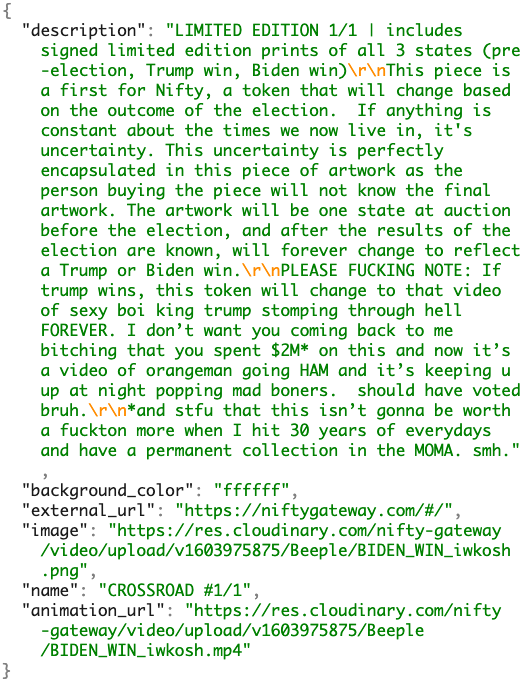
Here's an example. This artwork is by Beeple and sold via Nifty:

https://t.co/TlJKH8kAew

The NFT token is for this JSON file hosted directly on Nifty's servers:

https://t.co/GQUaCnObvX


THAT file refers to the actual media you just "bought". Which in this case is hosted via a @cloudinary CDN, served by Nifty's servers again.

So if Nifty goes bust, your token is now worthless. It refers to nothing. This can't be changed.

"But you said some use IPFS!"

Let's look at the $65m Beeple, sold by Christies. Fancy.

https://t.co/1G9nCAdetk

That NFT token refers directly to an IPFS hash (https://t.co/QUdtdgtssH). We can take that IPFS hash and fetch the JSON metadata using a public gateway:

https://t.co/CoML7psBhF

You May Also Like