@HypeBillion @MycolePawket If the whole world settled on one stablecoin, I'd agree with you. But stablecoins are always going to be tied to jurisdictions and counter-parties too. So it is unlikely one winner will emerge.
More from Crypto



2020 was a game changer for Ethereum.
The vast majority of its success was fueled by #DeFi.
Here's what happened in 5 Tweets 🔽
1) Governance Tokens 🪙
Projects gave complete ownership of billion dollar protocols to their users, often using retroactive airdrops.
Early adopters earned tokens for past usage, and token-based voting now dictates all technical
2) Liquidity Mining ⛏️
Power users were the first to earn on-going distribution by providing liquidity.
$COMP sparked the wave, with $BAL coining the term a few weeks
3) Yield Faming 🌾
Projects coupled liquidity mining and governance tokens to boost 'yields' by combining lending rates with an incentive layer.
APYs peaked as high as 1M% during 'DeFi summer', leading to a 'food coin' craze like $YAM and
4) Fair Launches ✅
Who needs investment when you can launch using yield farming?
@iearnfinance debuted $YFI with no formal funding, seeding a community treasury for self-sustainability.
The notion of a core team and community became one and the
The vast majority of its success was fueled by #DeFi.
Here's what happened in 5 Tweets 🔽
1) Governance Tokens 🪙
Projects gave complete ownership of billion dollar protocols to their users, often using retroactive airdrops.
Early adopters earned tokens for past usage, and token-based voting now dictates all technical
It pays to be a web3 power user.
— Coopahtroopa \U0001f525_\U0001f525 (@Cooopahtroopa) December 9, 2020
Five networks that issued retroactive airdrops to value added actors \U0001f4dd
2) Liquidity Mining ⛏️
Power users were the first to earn on-going distribution by providing liquidity.
$COMP sparked the wave, with $BAL coining the term a few weeks
BAL is live!
— Balancer Labs (@BalancerLabs) June 23, 2020
The 435k BAL for liquidity providers of the first three weeks of liquidity mining (145k per week) have just been sent out to the wallets used to provide liquidity on Balancer.https://t.co/pkXFzwzPVC
3) Yield Faming 🌾
Projects coupled liquidity mining and governance tokens to boost 'yields' by combining lending rates with an incentive layer.
APYs peaked as high as 1M% during 'DeFi summer', leading to a 'food coin' craze like $YAM and
Check out @Cooopahtroopa's latest post for all the #DeFi farmers out there \U0001f468\u200d\U0001f33e
— Zerion \U0001f3e6 (@zerion_io) June 26, 2020
Turns out @synthetix_io & @CurveFinance were ploughing the fields long before $COMP & $BAL came along.
Learn how to put your #crypto to work with this #yieldfarming 101 \U0001f4b8
\U0001f449 https://t.co/zYUKtqx3BK
4) Fair Launches ✅
Who needs investment when you can launch using yield farming?
@iearnfinance debuted $YFI with no formal funding, seeding a community treasury for self-sustainability.
The notion of a core team and community became one and the
2/ What is a Fair Launch?
— fair launch capital (@fairlaunchcap) August 26, 2020
A FL enables founders to bootstrap new crypto networks that are earned, owned, and governed by their community from the outset.
In this dynamic, everyone participates on equal footing\u2014there is no early access, pre-mine, or allocation of tokens.





You May Also Like


I hate when I learn something new (to me) & stunning about the Jeff Epstein network (h/t MoodyKnowsNada.)
Where to begin?
So our new Secretary of State Anthony Blinken's stepfather, Samuel Pisar, was "longtime lawyer and confidant of...Robert Maxwell," Ghislaine Maxwell's Dad.
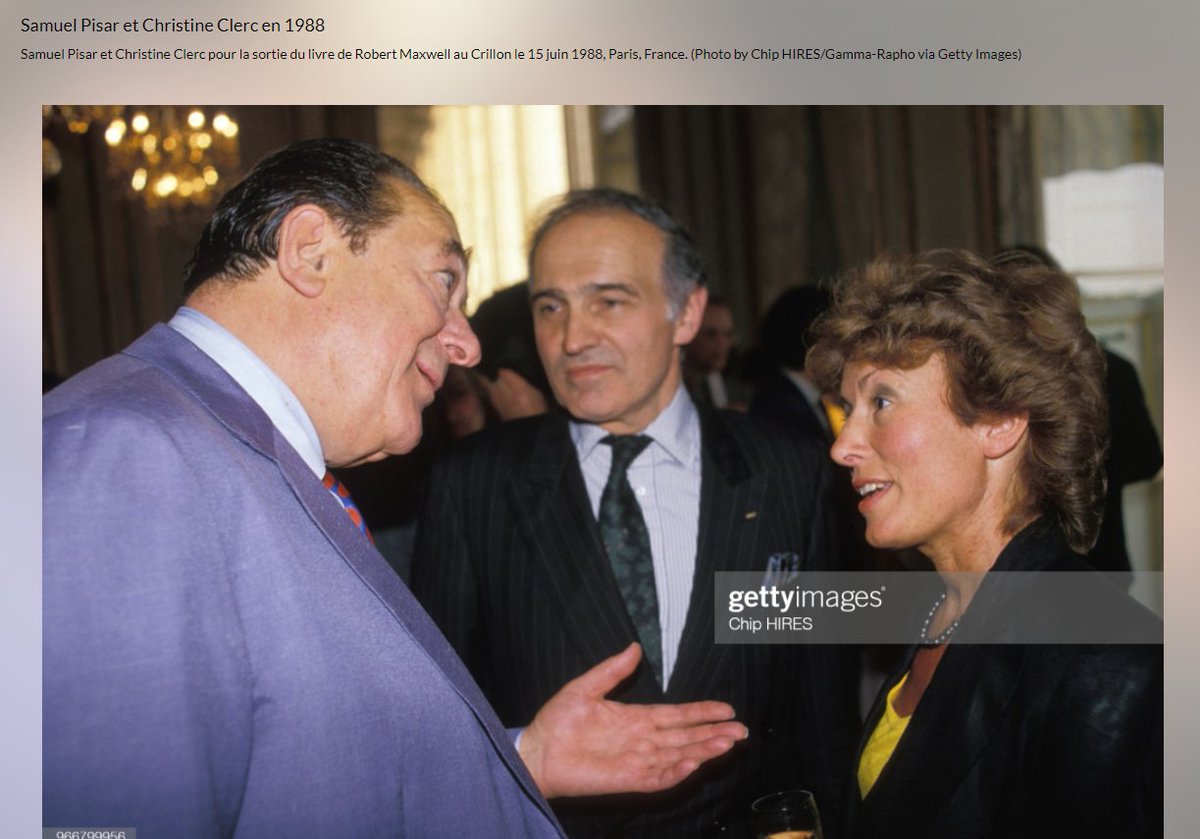
"Pisar was one of the last people to speak to Maxwell, by phone, probably an hour before the chairman of Mirror Group Newspapers fell off his luxury yacht the Lady Ghislaine on 5 November, 1991." https://t.co/DAEgchNyTP

OK, so that's just a coincidence. Moving on, Anthony Blinken "attended the prestigious Dalton School in New York City"...wait, what? https://t.co/DnE6AvHmJg
Dalton School...Dalton School...rings a
Oh that's right.
The dad of the U.S. Attorney General under both George W. Bush & Donald Trump, William Barr, was headmaster of the Dalton School.
Donald Barr was also quite a
I'm not going to even mention that Blinken's stepdad Sam Pisar's name was in Epstein's "black book."
Lots of names in that book. I mean, for example, Cuomo, Trump, Clinton, Prince Andrew, Bill Cosby, Woody Allen - all in that book, and their reputations are spotless.
Where to begin?
So our new Secretary of State Anthony Blinken's stepfather, Samuel Pisar, was "longtime lawyer and confidant of...Robert Maxwell," Ghislaine Maxwell's Dad.
"Pisar was one of the last people to speak to Maxwell, by phone, probably an hour before the chairman of Mirror Group Newspapers fell off his luxury yacht the Lady Ghislaine on 5 November, 1991." https://t.co/DAEgchNyTP
OK, so that's just a coincidence. Moving on, Anthony Blinken "attended the prestigious Dalton School in New York City"...wait, what? https://t.co/DnE6AvHmJg
Dalton School...Dalton School...rings a
Oh that's right.
The dad of the U.S. Attorney General under both George W. Bush & Donald Trump, William Barr, was headmaster of the Dalton School.
Donald Barr was also quite a
Donald Barr had a way with words. pic.twitter.com/JdRBwXPhJn
— Rudy Havenstein, listening to Nas all day. (@RudyHavenstein) September 17, 2020
I'm not going to even mention that Blinken's stepdad Sam Pisar's name was in Epstein's "black book."
Lots of names in that book. I mean, for example, Cuomo, Trump, Clinton, Prince Andrew, Bill Cosby, Woody Allen - all in that book, and their reputations are spotless.