Categories Brexit


Important story on what a “tariff-free” deal means in practice and why it’s not enough for two economies as closely integrated.
Tariffs are removed on goods that meet rules of origin. This is a complex and nuanced area of customs.
/1
\U0001f6a8\U0001f6a8\U0001f6a8\U0001f1ea\U0001f1fa\U0001f1ec\U0001f1e7\U0001f69b\U0001f692\U0001f1ea\U0001f1fa\U0001f1ec\U0001f1e7\U0001f6a8\U0001f6a8\U0001f6a8 serious #brexit story alert - companies now starting to see penny drop on what rules of origin does to supply chains (food for example) but Brussels seems deaf to both EU & U.K. pleading. A bellwether? \U0001f62c Stay with me. 1/
— Peter Foster (@pmdfoster) January 6, 2021
https://t.co/HoDSDxhKaL
Important to remember that trade deals (FTAs) weren't designed with such a high degree of economic integration in mind.
So some of the standard RoO provisions will seem incredibly restrictive under the UK-EU deal.
/2
Minimal operations or insufficient processing is a standard part of an FTA. Most, if not all FTAs, include a provision on minimal processing – processing not considered sufficient to confer originating status even if rules of origin have been met.
/3
It is standard procedure not to apply cumulation when goods have only been subject to minimal processing.
To be able to cumulate origin and consider the final product of UK origin, the processing carried out in the UK needs to exceed minimal operations.
/4
The level of integration between the UK and the EU means that this will have significant consequences for a number of industries.
For example, in supply chains where goods are brought into the UK from the EU and reassembled, sorted or repackaged and re-exported to ROI.
/5


/1 https://t.co/N5dDcbH7u7

Brief rules of origin guidance now available - doesn't cover the easements or retrospective claims - just the basic information: the two ways of certifying origin under the UK-EU deal and how to put the claim through via CHIEF and CDS https://t.co/14Up1y44OI
— Dr Anna Jerzewska (@AnnaJerzewska) December 28, 2020
Claiming origin.
Two ways for traders to claim origin under the EU-UK deal:
1⃣ Self-certification by the exporter (standard) – normally requires an authorisation, I’m hearing that might not be needed for UK-EU trade – waiting for guidance or more info
/2
2⃣ Self-certification by the importer (new(ish), in the EU-Japan deal and some continuity deals). UK importers have little experience with this one, but helpful guidance available given initial uncertainty around using this form of certification
/3
Retrospective claims.
For up to 3 years under each side’s domestic regulation – conditions, circumstances to be determined by both sides.
Careful here cause you might be required to have a good justification for why it wasn’t submitted at the time of import. Guidance needed
/4
Additional easements
On the UK side, this is part of the 6 months phase-in period– if you’re deferring a customs declaration you’re also deferring submitting an origin claim. If you're not deferring than origin documentation required at the time of import.
/5
Michael Gove: "Outside the EU, with a good trade deal in place, we can tackle the injustices and inequalities that have held Britain back."
— Jennifer Rankin (@JenniferMerode) December 26, 2020
The UK did not need to leave the EU to tackle injustices and inequalities at home. Not a new point, but true.https://t.co/fE4glUAylc
There has never been level playing field content like this in a trade deal. The idea it is any kind of UK win, when the UK's opening position was no enforceable commitments whatsoever, is ridiculous.
For the lawyers. Night. pic.twitter.com/5XvFMhcaeE
— Sam Lowe (@SamuelMarcLowe) December 25, 2020
The EU can take retaliatory action against the UK if we weaken labour standards, weaken pretty firm climate change targets, unfairly subsidise, or just in general seem to be out of line. There are processes to follow, but it looks like the PM did it again...
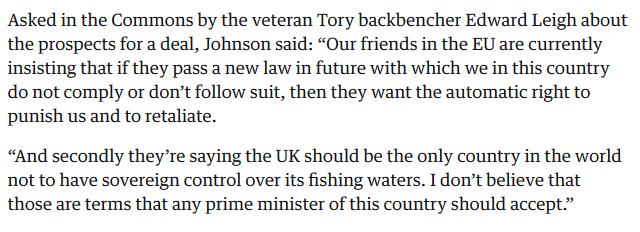
Final one for now. Quite how Labour gets itself in such a fuss about whether to support a deal with the strongest labour and environment commitments ever seen in a trade deal is a sign of just how far it hasn't moved on from leaving.
PS well... (sorry DAG). It certainly didn't have a good effect. And I think if we had settled LPF issues with the EU much earlier there is a good chance the conditions would have been far less stringent. By making an issue, we made it much worse.
As a lay person is it fair to say that the \u201cthreat\u201d to break international law in Ireland was possibly a strategic blunder that has now determined the future trajectory of the UK for the next 20 years? I can imagine most countries will study what\u2019s baked into this and replicate?
— Meister 1 (@blueelmacho) December 26, 2020
