There are a lot of Brexiters in the media this week making points about sovereignty, and about how the EU has not come to terms with the UK's independence.
I have some questions, which it might well be fruitful to ask them. 1/9
One of the root causes of the Govt's Brexit difficulties is that it has overpromised.
— Phil Syrpis (@syrpis) December 7, 2020
We can, it is said, reclaim our sovereignty, with the freedom to make our own rules, and, at the same time, retain many of the advantages of EU membership. 1/14
More from Brexit


So. The hunt is on in Whitehall for #brexit dividends...to show some clear value in the freedoms given by Brexit.
As we report today one area being looked at is workers' rights...but it is politically difficult territory.
No cabinet decisions have been taken, but per sources, three potential areas been identified in Business Dept...
- the 48 Hour Week
- holiday pay/overtime calculations
- new EU rules on reporting hours worked...
All potentially possible post #brexit /2
The government says it has no intention of “lowering” workers’ rights....and notes that UK has actually gold-plated many EU regulations...BUT (think of government saying it won't "lower" animal welfare standards)...the devil will all be in the detail, if and when it comes /3
So the government likes to talk about ensuring workers’ rights are protected but ALSO making sure businesses has freedoms and flexibility to grow...so one man's reduction in rights is another freedom to get richer/work harder/be more prosperous. It depends how you sell it. /4
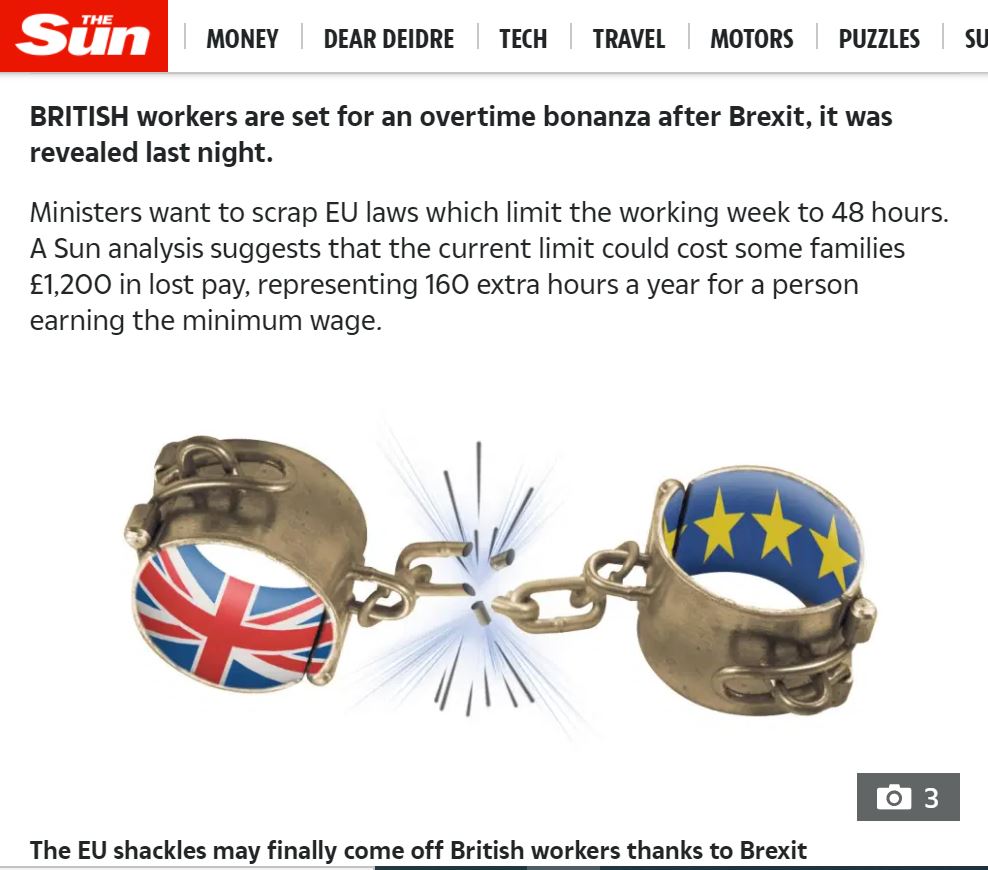
So take this 2017 story from The Sun on the cash bonanza that will be rained down on hardworking families by Brexiteers' (long standing) desire to scrap the 48-hour week. Overtime booooom..../5
https://t.co/QLqQ7rCzkv
As we report today one area being looked at is workers' rights...but it is politically difficult territory.
No cabinet decisions have been taken, but per sources, three potential areas been identified in Business Dept...
- the 48 Hour Week
- holiday pay/overtime calculations
- new EU rules on reporting hours worked...
All potentially possible post #brexit /2
The government says it has no intention of “lowering” workers’ rights....and notes that UK has actually gold-plated many EU regulations...BUT (think of government saying it won't "lower" animal welfare standards)...the devil will all be in the detail, if and when it comes /3
So the government likes to talk about ensuring workers’ rights are protected but ALSO making sure businesses has freedoms and flexibility to grow...so one man's reduction in rights is another freedom to get richer/work harder/be more prosperous. It depends how you sell it. /4
So take this 2017 story from The Sun on the cash bonanza that will be rained down on hardworking families by Brexiteers' (long standing) desire to scrap the 48-hour week. Overtime booooom..../5
https://t.co/QLqQ7rCzkv

On this, I think it’s highly unlikely to occur in the timeframe given. For several reasons, I don’t think it’s realistic for Scotland to secede, and then join the EU, in 9 years.
For that, thanks goes to Brexit.
A thread because why not...
Two important dates: March 2016 and January 1st 2021.
Firstly, prior to the 2014 referendum, the Nationalists proposed a date of March 2016 to secede.
Secondly, today - the end completion of Brexit five-and-a-half years after Cameron’s majority in 2015.
Brexit has demonstrated many things, primarily that splitting unions is not easy. The UKs membership of the EU was 47 years and by the end it was not at the heart of the EU. The Union has existed for over 300 as a unitary state.
Dividing a unitary state, like the UK, will not be easy. Frankly, it will make Brexit look simple. Questions of debt, currency, defence, and more will need to be resolved ... something not addressed with Brexit.
Starting with debt. Scotland will end up with its proportionate share of the UKs national debt. It’s not credible to suggest otherwise. Negotiating what is proportionate won’t be easy when both sides disagree.
It’s importance will be seen shortly.
For that, thanks goes to Brexit.
A thread because why not...
On the current trajectory, I think this is likely to be the map of Europe of 2030. pic.twitter.com/65i1A8CiP8
— Ben Judah (@b_judah) January 1, 2021
Two important dates: March 2016 and January 1st 2021.
Firstly, prior to the 2014 referendum, the Nationalists proposed a date of March 2016 to secede.
Secondly, today - the end completion of Brexit five-and-a-half years after Cameron’s majority in 2015.
Brexit has demonstrated many things, primarily that splitting unions is not easy. The UKs membership of the EU was 47 years and by the end it was not at the heart of the EU. The Union has existed for over 300 as a unitary state.
Dividing a unitary state, like the UK, will not be easy. Frankly, it will make Brexit look simple. Questions of debt, currency, defence, and more will need to be resolved ... something not addressed with Brexit.
Starting with debt. Scotland will end up with its proportionate share of the UKs national debt. It’s not credible to suggest otherwise. Negotiating what is proportionate won’t be easy when both sides disagree.
It’s importance will be seen shortly.