Ten days in and it seems the government's post-Brexit economic policy is to ignore reality, priority and choice, and just claim with no evidence that everything is going to be great. This, needless to say, is dangerous territory. Exhibit 1... 1/
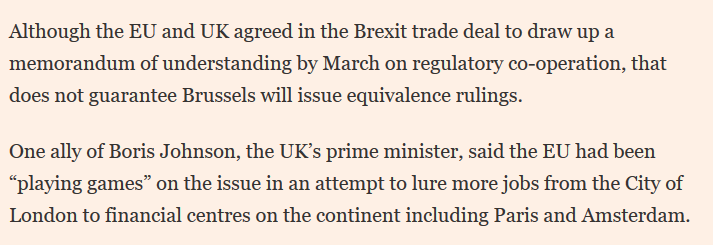
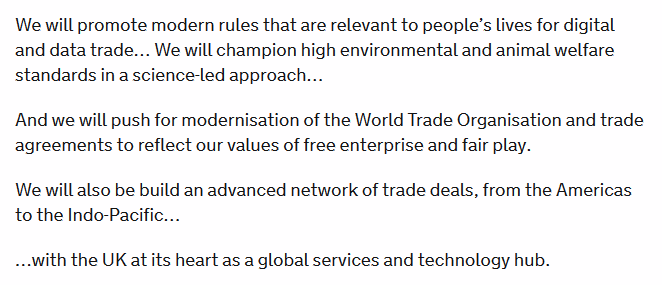
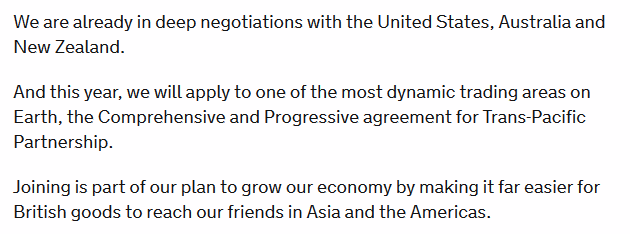
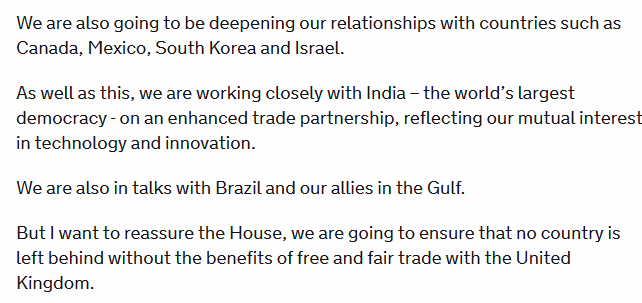
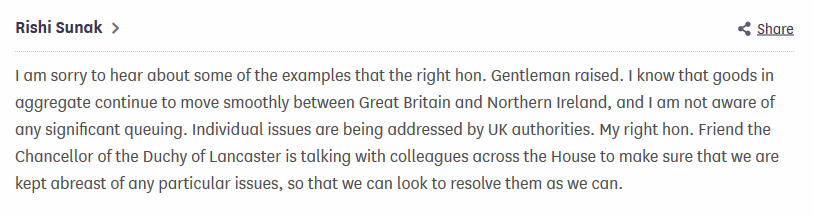
Right now they don't. Big talk, little reality. Tough world. 12/ end
No US deal yet, instead we have the usual warm words about being deep in talks, and the CPTPP. But for what? If we get deals with Australia and NZ we'll have deals with 10 of 12 CPTPP countries. How will joining then help goods trade? And why goods, not services? 7/ pic.twitter.com/NaiUXr1y4f
— David Henig (@DavidHenigUK) January 12, 2021
More from David Henig
Morning. And its Groundhog Day today. https://t.co/gRs4Dc8RH2

Some useful threads will follow, first on the Northern Ireland protocol, where unfettered is still being defined...
And on fish and level playing field. The latter seems, has always seemed, the most problematic, because the UK has apparently ruled out any compromise on shared minumum levels even if not automatic. That would be a deal breaker, but seems... unnecessary.
Your reminder closing complex deals is never easy. But there are ways to facilitate and EU is good at doing this if you meet their red lines. But still the biggest concern that the UK never understood level playing field terms are fundamental to the EU.
In the UK, one man's decision. Allegedly backed by a Cabinet who in reality will be quite happy to blame the PM either way. The temptation to send Michael Gove to seal the deal and end his leadership ambitions must be there...
Source say Michel Barnier has told EU ambassadors that there has been no breakthrough on the fisheries question, and that reports to that effect were \u201ccompletely untrue\u201d
— Tony Connelly (@tconnellyRTE) December 7, 2020
Some useful threads will follow, first on the Northern Ireland protocol, where unfettered is still being defined...
The trouble with \u2018unfettered access\u2019...
— JPCampbellBiz - Wash your hands keep your distance (@JP_Biz) December 6, 2020
And on fish and level playing field. The latter seems, has always seemed, the most problematic, because the UK has apparently ruled out any compromise on shared minumum levels even if not automatic. That would be a deal breaker, but seems... unnecessary.
1/ On fish, both sides are far apart, but it sounds like the UK wants the EU to jump first before it, in turn, shows flexibility. The UK is offering a three year phase in but with an upfront payment of \u20ac300m in demersal fish (ie, out of the \u20ac650m EU boats catch in UK waters)
— Tony Connelly (@tconnellyRTE) December 6, 2020
Your reminder closing complex deals is never easy. But there are ways to facilitate and EU is good at doing this if you meet their red lines. But still the biggest concern that the UK never understood level playing field terms are fundamental to the EU.
In case it wasn't obvious the final choreography of a complex trade deal is complex. The big issues, and potentially some smallprint / related matters of relevance to both sides (for example I wonder if soon after a deal we hear about data or financial services equivalence?)
— David Henig (@DavidHenigUK) December 6, 2020
In the UK, one man's decision. Allegedly backed by a Cabinet who in reality will be quite happy to blame the PM either way. The temptation to send Michael Gove to seal the deal and end his leadership ambitions must be there...
Fact is: EU objectives/focus unlikely to change much in remaining 24-48 hours: fish, non-regression & ability to retaliate across sectors/entire agreement in case of systematic divergence by HMG
— Mujtaba Rahman (@Mij_Europe) December 7, 2020
Most in Cabinet want a deal. @BorisJohnson has big decision he now needs to make https://t.co/mJ49WLt3Qd
Not the easiest to follow, but for those interested in the big picture of trade relations between US, EU and China this exchange between @alanbeattie and @IanaDreyer is an essential read. Real debate on key issues, and good points on both sides.
Also reading this from @gideonrachman on EU-China. My view (cynically?) - that EU-China is a deal that makes a lot of sense given a probably unresolvable trade policy superpower triangle with the US, and best for the EU to move while China will.
The US and EU roughly agree on China that it should do some things differently, but not really the details of what those are. Meanwhile the EU and US have long standing trade policy differences, which neither (or their key stakeholders) prioritise resolving.
For the EU, the China deal has sent a message to the new US administration, you can't just tell us what to do. And delivered some (probably marginal in reality) benefits to business. For China, this is the 3rd deal with EU or US in 12 months. Pretty clear strategy there.
The key assumption that lies at the heart of too much writing on EU-US relations is that the two should cooperate on trade. After 25 years of largely failing to do so, I'd suggest we might want to question that a bit more deeply.
V good points but overall I stick with the conclusion that this is a v risky deal.
— Alan Beattie (@alanbeattie) January 5, 2021
1. It\u2019s overstating it to say that COM now has final say over investment. FDI screening remains a MS competency. COM has had to take a v secondary supporting role over Huawei and 5G.
1/n https://t.co/RVg2jnoFgK
Also reading this from @gideonrachman on EU-China. My view (cynically?) - that EU-China is a deal that makes a lot of sense given a probably unresolvable trade policy superpower triangle with the US, and best for the EU to move while China will.
The US and EU roughly agree on China that it should do some things differently, but not really the details of what those are. Meanwhile the EU and US have long standing trade policy differences, which neither (or their key stakeholders) prioritise resolving.
For the EU, the China deal has sent a message to the new US administration, you can't just tell us what to do. And delivered some (probably marginal in reality) benefits to business. For China, this is the 3rd deal with EU or US in 12 months. Pretty clear strategy there.
The key assumption that lies at the heart of too much writing on EU-US relations is that the two should cooperate on trade. After 25 years of largely failing to do so, I'd suggest we might want to question that a bit more deeply.
More from Brexit





You May Also Like



I just finished Eric Adler's The Battle of the Classics, and wanted to say something about Joel Christiansen's review linked below. I am not sure what motivates the review (I speculate a bit below), but it gives a very misleading impression of the book. 1/x
The meat of the criticism is that the history Adler gives is insufficiently critical. Adler describes a few figures who had a great influence on how the modern US university was formed. It's certainly critical: it focuses on the social Darwinism of these figures. 2/x
Other insinuations and suggestions in the review seem wildly off the mark, distorted, or inappropriate-- for example, that the book is clickbaity (it is scholarly) or conservative (hardly) or connected to the events at the Capitol (give me a break). 3/x
The core question: in what sense is classics inherently racist? Classics is old. On Adler's account, it begins in ancient Rome and is revived in the Renaissance. Slavery (Christiansen's primary concern) is also very old. Let's say classics is an education for slaveowners. 4/x
It's worth remembering that literacy itself is elite throughout most of this history. Literacy is, then, also the education of slaveowners. We can honor oral and musical traditions without denying that literacy is, generally, good. 5/x
As someone\u2019s who\u2019s read the book, this review strikes me as tremendously unfair. It mostly faults Adler for not writing the book the reviewer wishes he had! https://t.co/pqpt5Ziivj
— Teresa M. Bejan (@tmbejan) January 12, 2021
The meat of the criticism is that the history Adler gives is insufficiently critical. Adler describes a few figures who had a great influence on how the modern US university was formed. It's certainly critical: it focuses on the social Darwinism of these figures. 2/x
Other insinuations and suggestions in the review seem wildly off the mark, distorted, or inappropriate-- for example, that the book is clickbaity (it is scholarly) or conservative (hardly) or connected to the events at the Capitol (give me a break). 3/x
The core question: in what sense is classics inherently racist? Classics is old. On Adler's account, it begins in ancient Rome and is revived in the Renaissance. Slavery (Christiansen's primary concern) is also very old. Let's say classics is an education for slaveowners. 4/x
It's worth remembering that literacy itself is elite throughout most of this history. Literacy is, then, also the education of slaveowners. We can honor oral and musical traditions without denying that literacy is, generally, good. 5/x