
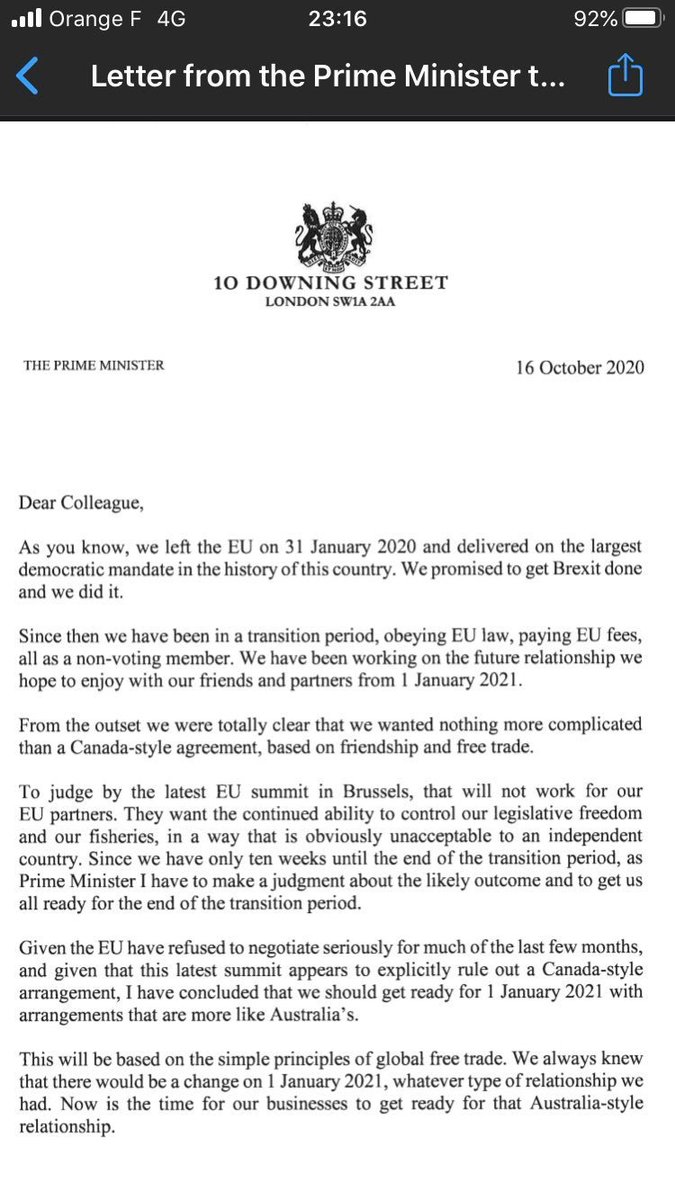
Brexit. UK-EU talks. Let's try to explain why we're in such a state, of increased risk of no deal, moving away from the fish and playing fields which are the detail but not the answer, to differing philosophies and divorce parallels that might just help... 1/
More from David Henig
So many stories of new barriers to trade between UK and EU, but you might be thinking at some point these will run out. The government is certainly hoping so. Well they may slow down, but trade relations and regulations are not static, and changes will lead to further problems.
The likelihood of continued trade problems for a £650 bn trade relationship is why there should be a huge cross-government effort led by the Foreign Office and Department for International Trade to put in place the necessary resources to seek best results.
There isn't.
So the UK's relationship with the EU currently consists of two not particularly good deals and no consistent effort to manage current problems or prevent future ones. Joint committees are a second order problem to putting in place the right internal structures.
But that's been the consistent UK problem in relations with the EU since 2016. Lack of focus on getting the right internal structures, people, asks, strategy, too much attention on being tough and a single leader.
News just in. This doesn't necessarily mean the right structure being put into UK-EU relations. I suspect Frost's main role is to ensure no renegotiations with the EU.
Also, wonder what this says about the PM's trust in Michael Gove?
The likelihood of continued trade problems for a £650 bn trade relationship is why there should be a huge cross-government effort led by the Foreign Office and Department for International Trade to put in place the necessary resources to seek best results.
There isn't.
So the UK's relationship with the EU currently consists of two not particularly good deals and no consistent effort to manage current problems or prevent future ones. Joint committees are a second order problem to putting in place the right internal structures.
But that's been the consistent UK problem in relations with the EU since 2016. Lack of focus on getting the right internal structures, people, asks, strategy, too much attention on being tough and a single leader.
News just in. This doesn't necessarily mean the right structure being put into UK-EU relations. I suspect Frost's main role is to ensure no renegotiations with the EU.
Also, wonder what this says about the PM's trust in Michael Gove?
NEW: David Frost is joining Boris Johnson\u2019s Cabinet! The peer has been appointed a minister at the Cabinet Office, effective March 1.
— Sebastian Payne (@SebastianEPayne) February 17, 2021
Frost will also chair the partnership council overseeing the UK-EU trade deal and oversee reform to "maximise on the opportunities of Brexit"
Not the easiest to follow, but for those interested in the big picture of trade relations between US, EU and China this exchange between @alanbeattie and @IanaDreyer is an essential read. Real debate on key issues, and good points on both sides.
Also reading this from @gideonrachman on EU-China. My view (cynically?) - that EU-China is a deal that makes a lot of sense given a probably unresolvable trade policy superpower triangle with the US, and best for the EU to move while China will.
The US and EU roughly agree on China that it should do some things differently, but not really the details of what those are. Meanwhile the EU and US have long standing trade policy differences, which neither (or their key stakeholders) prioritise resolving.
For the EU, the China deal has sent a message to the new US administration, you can't just tell us what to do. And delivered some (probably marginal in reality) benefits to business. For China, this is the 3rd deal with EU or US in 12 months. Pretty clear strategy there.
The key assumption that lies at the heart of too much writing on EU-US relations is that the two should cooperate on trade. After 25 years of largely failing to do so, I'd suggest we might want to question that a bit more deeply.
V good points but overall I stick with the conclusion that this is a v risky deal.
— Alan Beattie (@alanbeattie) January 5, 2021
1. It\u2019s overstating it to say that COM now has final say over investment. FDI screening remains a MS competency. COM has had to take a v secondary supporting role over Huawei and 5G.
1/n https://t.co/RVg2jnoFgK
Also reading this from @gideonrachman on EU-China. My view (cynically?) - that EU-China is a deal that makes a lot of sense given a probably unresolvable trade policy superpower triangle with the US, and best for the EU to move while China will.
The US and EU roughly agree on China that it should do some things differently, but not really the details of what those are. Meanwhile the EU and US have long standing trade policy differences, which neither (or their key stakeholders) prioritise resolving.
For the EU, the China deal has sent a message to the new US administration, you can't just tell us what to do. And delivered some (probably marginal in reality) benefits to business. For China, this is the 3rd deal with EU or US in 12 months. Pretty clear strategy there.
The key assumption that lies at the heart of too much writing on EU-US relations is that the two should cooperate on trade. After 25 years of largely failing to do so, I'd suggest we might want to question that a bit more deeply.
More from Brexit


This very short article by Jeremy Cliffe is the best thing I have ever read on Brexit and the EU. It pivots on the contrast between Delors’ and Thatcher’s authentically provincial Christian visions and suggests the battle in Britain between the two is not over.
Thatcher: Protestant believer in the totally free market and absolutely sovereign centralised nation state. Delors: Catholic believer in third way personalism, corporatism and federalism. Individualism versus relational love. Heterodoxy versus Orthodoxy.
The article useful gives the lie to the idea that the Catholic vision of the EU has altogether vanished even though it is weakened. Delors wanted a social dimension to the free market and single currency and yet lexiteers laughably insist the EU is more neoliberal than the U.K.!
Subsidiary federalism is a doctrine of democracy and human fraternity. State sovereignty is a doctrine of naked power. It is a face of Antichrist. Leviathan.
Those combined that democracy can only be inside a single state fail to power just how much of private law and evermore so is necessarily international. Thus if political institutions don’t extend over borders there can be no democracy.
The rupture between Margaret Thatcher and Jacques Delors lives on in Brexit https://t.co/r3YiyPoSFB
— john milbank (@johnmilbank3) January 9, 2021
Thatcher: Protestant believer in the totally free market and absolutely sovereign centralised nation state. Delors: Catholic believer in third way personalism, corporatism and federalism. Individualism versus relational love. Heterodoxy versus Orthodoxy.
The article useful gives the lie to the idea that the Catholic vision of the EU has altogether vanished even though it is weakened. Delors wanted a social dimension to the free market and single currency and yet lexiteers laughably insist the EU is more neoliberal than the U.K.!
Subsidiary federalism is a doctrine of democracy and human fraternity. State sovereignty is a doctrine of naked power. It is a face of Antichrist. Leviathan.
Those combined that democracy can only be inside a single state fail to power just how much of private law and evermore so is necessarily international. Thus if political institutions don’t extend over borders there can be no democracy.




You May Also Like

Speech Delay is most common in children nowadays
In ancient times, our grandparents used to follow typical natural way of caring the needs of a child. All they used were more of natural products than chemical based for the growth of child.

One of major step followed was to feed Gurbach Jadd/ Vasa Kommu/ Acorus Calamus for initiating good speech ability in a child. This stem was needed to babies on Tuesdays and Sundays in mother's milk.
Vasa is feed to baby after the 1st bath on 12th day in week. Weekly only thrice it is fed and named as :
Budhwar - Budhi Vasa
Mangalwar - Vaak Vasa
Ravi Vaar - Aayush Vasa
This stem is burnt and rubbed against the grinding stone in mother's milk or warm water to get a paste
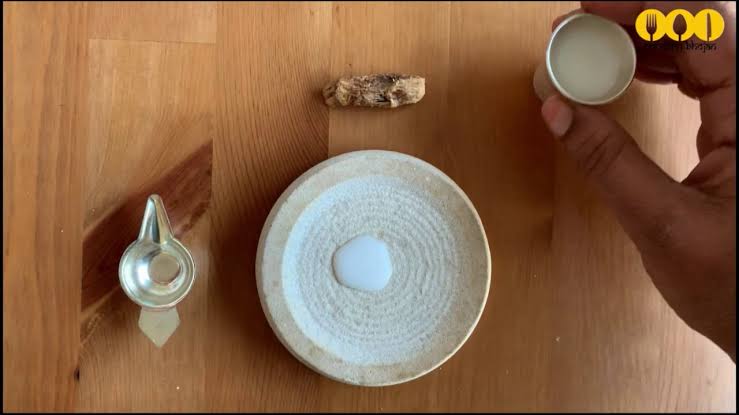
The procedure to make it is in the link
https://t.co/uo4sGp7mUm
It should not be given daily to the child. Other main benefits are
1. It clears the phlegm in child's throat caused due to continuous milk intake. It clears the tracts and breathing is effortless.
2. Digestion
For children who haven't got their speech and is delayed than usual should feed this vasa on these days in week atleast for 6months. Don't get carried away with this dialogue
"Some gain speech little late"
In ancient times, our grandparents used to follow typical natural way of caring the needs of a child. All they used were more of natural products than chemical based for the growth of child.
One of major step followed was to feed Gurbach Jadd/ Vasa Kommu/ Acorus Calamus for initiating good speech ability in a child. This stem was needed to babies on Tuesdays and Sundays in mother's milk.
Vasa is feed to baby after the 1st bath on 12th day in week. Weekly only thrice it is fed and named as :
Budhwar - Budhi Vasa
Mangalwar - Vaak Vasa
Ravi Vaar - Aayush Vasa
This stem is burnt and rubbed against the grinding stone in mother's milk or warm water to get a paste
The procedure to make it is in the link
https://t.co/uo4sGp7mUm
It should not be given daily to the child. Other main benefits are
1. It clears the phlegm in child's throat caused due to continuous milk intake. It clears the tracts and breathing is effortless.
2. Digestion
For children who haven't got their speech and is delayed than usual should feed this vasa on these days in week atleast for 6months. Don't get carried away with this dialogue
"Some gain speech little late"

"I lied about my basic beliefs in order to keep a prestigious job. Now that it will be zero-cost to me, I have a few things to say."
We know that elite institutions like the one Flier was in (partial) charge of rely on irrelevant status markers like private school education, whiteness, legacy, and ability to charm an old white guy at an interview.
Harvard's discriminatory policies are becoming increasingly well known, across the political spectrum (see, e.g., the recent lawsuit on discrimination against East Asian applications.)
It's refreshing to hear a senior administrator admits to personally opposing policies that attempt to remedy these basic flaws. These are flaws that harm his institution's ability to do cutting-edge research and to serve the public.
Harvard is being eclipsed by institutions that have different ideas about how to run a 21st Century institution. Stanford, for one; the UC system; the "public Ivys".
As a dean of a major academic institution, I could not have said this. But I will now. Requiring such statements in applications for appointments and promotions is an affront to academic freedom, and diminishes the true value of diversity, equity of inclusion by trivializing it. https://t.co/NfcI5VLODi
— Jeffrey Flier (@jflier) November 10, 2018
We know that elite institutions like the one Flier was in (partial) charge of rely on irrelevant status markers like private school education, whiteness, legacy, and ability to charm an old white guy at an interview.
Harvard's discriminatory policies are becoming increasingly well known, across the political spectrum (see, e.g., the recent lawsuit on discrimination against East Asian applications.)
It's refreshing to hear a senior administrator admits to personally opposing policies that attempt to remedy these basic flaws. These are flaws that harm his institution's ability to do cutting-edge research and to serve the public.
Harvard is being eclipsed by institutions that have different ideas about how to run a 21st Century institution. Stanford, for one; the UC system; the "public Ivys".


And here they are...
THE WINNERS OF THE 24 HOUR STARTUP CHALLENGE
Remember, this money is just fun. If you launched a product (or even attempted a launch) - you did something worth MUCH more than $1,000.
#24hrstartup
The winners 👇
#10
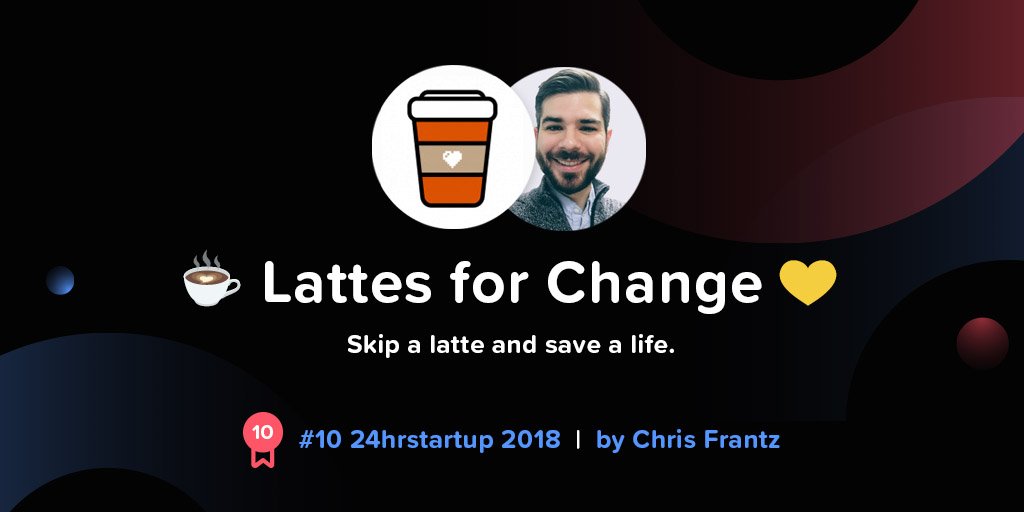
Lattes For Change - Skip a latte and save a life.
https://t.co/M75RAirZzs
@frantzfries built a platform where you can see how skipping your morning latte could do for the world.
A great product for a great cause.
Congrats Chris on winning $250!
#9
Instaland - Create amazing landing pages for your followers.
https://t.co/5KkveJTAsy
A team project! @bpmct and @BaileyPumfleet built a tool for social media influencers to create simple "swipe up" landing pages for followers.
Really impressive for 24 hours. Congrats!
#8
SayHenlo - Chat without distractions
https://t.co/og0B7gmkW6
Built by @DaltonEdwards, it's a platform for combatting conversation overload. This product was also coded exclusively from an iPad 😲
Dalton is a beast. I'm so excited he placed in the top 10.
#7
CoderStory - Learn to code from developers across the globe!
https://t.co/86Ay6nF4AY
Built by @jesswallaceuk, the project is focused on highlighting the experience of developers and people learning to code.
I wish this existed when I learned to code! Congrats on $250!!
THE WINNERS OF THE 24 HOUR STARTUP CHALLENGE
Remember, this money is just fun. If you launched a product (or even attempted a launch) - you did something worth MUCH more than $1,000.
#24hrstartup
The winners 👇
#10
Lattes For Change - Skip a latte and save a life.
https://t.co/M75RAirZzs
@frantzfries built a platform where you can see how skipping your morning latte could do for the world.
A great product for a great cause.
Congrats Chris on winning $250!
#9
Instaland - Create amazing landing pages for your followers.
https://t.co/5KkveJTAsy
A team project! @bpmct and @BaileyPumfleet built a tool for social media influencers to create simple "swipe up" landing pages for followers.
Really impressive for 24 hours. Congrats!
#8
SayHenlo - Chat without distractions
https://t.co/og0B7gmkW6
Built by @DaltonEdwards, it's a platform for combatting conversation overload. This product was also coded exclusively from an iPad 😲
Dalton is a beast. I'm so excited he placed in the top 10.
#7
CoderStory - Learn to code from developers across the globe!
https://t.co/86Ay6nF4AY
Built by @jesswallaceuk, the project is focused on highlighting the experience of developers and people learning to code.
I wish this existed when I learned to code! Congrats on $250!!