2/
Your regular reminder that Brexit is going badly because the UK has still to decide what the purpose of leaving the EU is
1/
2/
A touchstone of dissent, if you will (h/t @PaulAdamTaggart)
3/
"Vote for us and everything will be dandy" is not a plan
4/
All very majoritarian, as per
5/
Cue fudging and obfuscation. And battles over dominance that were (again) more about being top dog than any sense of where the UK might be going
6/
However, that someone was Johnson, someone not given to strategic vision, but instead to rolling with the good times
7/
And maybe not even from the subjective tropes of 'taking back control'
It's a choice from various problematic options
8/
Crisis management isn't it
10/
11/
But also for a less obvious reason
12/
So it's still there for the picking
And you might not like who is doing that picking
13/
14/
More from Brexit


What's in the EU-UK Brexit deal on energy?
It may be Boxing day, but I've had a quick look
Title VIII: Energy is the key section (page 156 onwards)
▶️ Standard stuff on commitment to competition, unbundling and customer choice
▶️ UK Capacity Market no longer needs to try to integrate overseas Capacity providers & vice versa
(Article ENER.6, Clause 3, page. 160)
2/

▶️ Existing "exemptions" for selected interconnectors will continue to apply.
This means that these interconnectors can continue to sell capacity rights ahead of time, rather than all through close to real-time markets.
(Article ENER.11, page 162)
3/

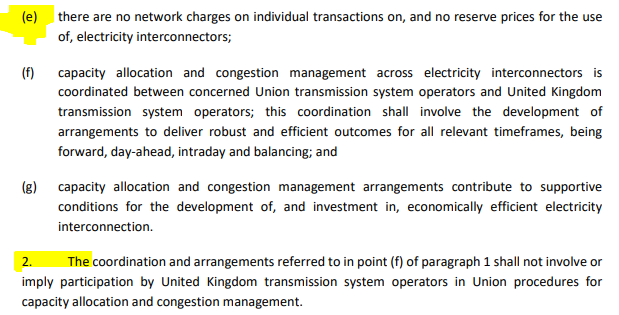
▶️ No network charges on individual interconnector transactions (as now)
▶️ But, UK cannot participate in EU procedures for capacity allocation and congestion management (more on this later)
(Article ENER.13, page 163)
4/
Gas trading: looks like the UK stays in the existing PRISMA gas trading platform.
Not my specialist area, but is this because PRISMA isn't an EU institution (unlike electricity market coupling)?
https://t.co/5GQJtZDpTa
(Article ENER. 15, page 164)
5/
It may be Boxing day, but I've had a quick look
Title VIII: Energy is the key section (page 156 onwards)
▶️ Standard stuff on commitment to competition, unbundling and customer choice
▶️ UK Capacity Market no longer needs to try to integrate overseas Capacity providers & vice versa
(Article ENER.6, Clause 3, page. 160)
2/
▶️ Existing "exemptions" for selected interconnectors will continue to apply.
This means that these interconnectors can continue to sell capacity rights ahead of time, rather than all through close to real-time markets.
(Article ENER.11, page 162)
3/
▶️ No network charges on individual interconnector transactions (as now)
▶️ But, UK cannot participate in EU procedures for capacity allocation and congestion management (more on this later)
(Article ENER.13, page 163)
4/
Gas trading: looks like the UK stays in the existing PRISMA gas trading platform.
Not my specialist area, but is this because PRISMA isn't an EU institution (unlike electricity market coupling)?
https://t.co/5GQJtZDpTa
(Article ENER. 15, page 164)
5/

This very short article by Jeremy Cliffe is the best thing I have ever read on Brexit and the EU. It pivots on the contrast between Delors’ and Thatcher’s authentically provincial Christian visions and suggests the battle in Britain between the two is not over.
Thatcher: Protestant believer in the totally free market and absolutely sovereign centralised nation state. Delors: Catholic believer in third way personalism, corporatism and federalism. Individualism versus relational love. Heterodoxy versus Orthodoxy.
The article useful gives the lie to the idea that the Catholic vision of the EU has altogether vanished even though it is weakened. Delors wanted a social dimension to the free market and single currency and yet lexiteers laughably insist the EU is more neoliberal than the U.K.!
Subsidiary federalism is a doctrine of democracy and human fraternity. State sovereignty is a doctrine of naked power. It is a face of Antichrist. Leviathan.
Those combined that democracy can only be inside a single state fail to power just how much of private law and evermore so is necessarily international. Thus if political institutions don’t extend over borders there can be no democracy.
The rupture between Margaret Thatcher and Jacques Delors lives on in Brexit https://t.co/r3YiyPoSFB
— john milbank (@johnmilbank3) January 9, 2021
Thatcher: Protestant believer in the totally free market and absolutely sovereign centralised nation state. Delors: Catholic believer in third way personalism, corporatism and federalism. Individualism versus relational love. Heterodoxy versus Orthodoxy.
The article useful gives the lie to the idea that the Catholic vision of the EU has altogether vanished even though it is weakened. Delors wanted a social dimension to the free market and single currency and yet lexiteers laughably insist the EU is more neoliberal than the U.K.!
Subsidiary federalism is a doctrine of democracy and human fraternity. State sovereignty is a doctrine of naked power. It is a face of Antichrist. Leviathan.
Those combined that democracy can only be inside a single state fail to power just how much of private law and evermore so is necessarily international. Thus if political institutions don’t extend over borders there can be no democracy.


You May Also Like

Facebook originally a CIA program called "LifeLog".
LifeLog, via DARPA, terminated on Feb 4th, 2004.
Facebook was launched on Feb 4th, 2004.
Many of the LifeLog team became execs at FB.
Zuckerberg is a figurehead.
CIA allowed Cambridge to help Trump win
https://t.co/enzOXDCogV

Pentagon Kills LifeLog
LifeLog, via DARPA, terminated on Feb 4th, 2004.
Facebook was launched on Feb 4th, 2004.
Many of the LifeLog team became execs at FB.
Zuckerberg is a figurehead.
CIA allowed Cambridge to help Trump win
https://t.co/enzOXDCogV
Project: Lifelog
— Robert Horan (@Robby12692) December 13, 2018
Started by DARPA in 1999, the goal of Lifelog was to create a database on civilians without their knowledge, and track everything they do.
The project "ended" on Feb 4th, 2004.
Facebook began the exact same day.
The CIA funneled tens of millions into Facebook. pic.twitter.com/r7hwF0v9kh
Pentagon Kills LifeLog