On March 17, the Netherlands will have general elections.

Two parties - PVV & FVD - want a Nexit, a departure from the EU, in line with Brexit.

As the reality of the EU-UK trade agreement kicks in, let's take a look at what these parties

Firstly, good to note, here is their recent polling,

PVV: 14% - 23 seats (currently 20 seats)
FVD: 2.5% - 4 seats (currently 2 seats)

A government needs 76 seats to govern.

Give or take, these parties appeal to about 20% of the electorate.

/2
FVD wants a so-called "intelligent Nexit" because - arguably - they think the UK's departure was not-so-intelligent.

"Intelligent" Nexit. Lots of nodding

But FVD doesn't want to leave the EU, they want an end to the EU.

/3
They want a "different cooperation model among sovereign states" based around free trade, conveniently assuming that the EU will automatically cease to exist once the Dutch vote 'Leave'.

And EFTA should be the basis for the new model.

/4
It's full-on 'magical thinking'.

If you want to join EFTA, sure, make the case.

But be truthful about what it means.

The FVD decides to disregard the EEA agreement, which governs trade between the EFTA-4 and the EU27, and the EU rules and regs that EFTA countries follow.

/5
It's like FVD thinks it can strike bilateral deals with European countries once it has left the EU, because the EU will then have magically disappeared. (David Davis klaxon!)

It also thinks NL won't be in the EU-26's regulatory orbit, ...because EFTA countries aren't???🤦‍♂️

/6
I don't have time to go through all inconsistencies in their reasoning (yet).

Safe to say, this is not an "intelligent Nexit" but a "unicorn Nexit".

Here's the text: https://t.co/dGDNw3aajw

Unfortunately, people might actually fall for this.

Anyway, on to the PVV.

/7
PVV published its party programme yesterday.

They want to leave the EU because:

- EU fisheries policy
- unelected Eurocrats/ politically corrupt
- no control of our borders
- "we want control over our own money, migration policy & laws"

I see a theme!🧐

/8
Now I remember where I heard those points before!

And there you have it, in the party programme the PVV writes: "What the Brits can do, we can do too!"

/9
Ofcourse, here too, no ideas about the type of deal that the Netherlands could strike with the EU after departure, or what this means for rules & regulations, NTBs, tariffs, or economic effects.

It's all about the sovereignty, baby.

/10
I guess the PVV is right, "what the Brits did, we can do too." I'm just not sure the rest of the country thinks we should.

Looking back at the past four years in British politics, I don't think many in NL will say "yes doctor, give me some of that medicine, please".

/11
But I cd be wrong.
And that's why media, biz, politicians, thinktanks have a duty to ask for clarification.
Ask PVV & FVD to spell out their plan, what happens after Nexit?
Because, what they have now, is wafer-thin and has more holes than Swiss cheese (and they're in EFTA).
/n


More from Brexit

Two excellent questions at the end of a very sensible thread summarising the post-Brexit UK FP debate. My own take at attempting to offer an answer - ahead of the IR is as follow:


1. The two versions have a converging point: a tilt to the Indo-pacific doesn’t preclude a role as a convening power on global issues;
2. On the contrary, it underwrites the credibility for leadership on global issues, by seeking to strike two points:

A. Engaging with a part of the world in which world order and global issues are central to security, prosperity, and - not least - values;
B. Propelling the UK towards a more diversified set of economic, political, and security ties;

3. The tilt towards the Indo-Pacific whilst structurally based on a realist perception of the world, it is also deeply multilateral. Central to it is the notion of a Britain that is a convening power.
4. It is as a result a notion that stands on the ability to renew diplomacy;

5. It puts in relation to this a premium on under-utilised formats such as FPDA, 5Eyes, and indeed the Commonwealth - especially South Pacific islands;
6. It equally puts a premium on exploring new bilateral and multilateral formats. On former, Japan, Australia. On latter, Quad;
Been waiting for 👇 🚨

Important story on what a “tariff-free” deal means in practice and why it’s not enough for two economies as closely integrated.

Tariffs are removed on goods that meet rules of origin. This is a complex and nuanced area of customs.

/1


Important to remember that trade deals (FTAs) weren't designed with such a high degree of economic integration in mind.

So some of the standard RoO provisions will seem incredibly restrictive under the UK-EU deal.

/2

Minimal operations or insufficient processing is a standard part of an FTA. Most, if not all FTAs, include a provision on minimal processing – processing not considered sufficient to confer originating status even if rules of origin have been met.

/3

It is standard procedure not to apply cumulation when goods have only been subject to minimal processing.

To be able to cumulate origin and consider the final product of UK origin, the processing carried out in the UK needs to exceed minimal operations.

/4

The level of integration between the UK and the EU means that this will have significant consequences for a number of industries.

For example, in supply chains where goods are brought into the UK from the EU and reassembled, sorted or repackaged and re-exported to ROI.

/5
A not-so-little thread on how post-Brexit work permit regulations will apply in Scottish football and why it’s, broadly, not a good thing...

1) Work permit calculations are based on the points formula from this site -
https://t.co/sjqx8Df7Zg

As things stand, while this article deals with England, the system applies to Scotland also.

The goal is 15 points and the article shows various ways to get there. Essentially, play regularly internationally or in a top 5 league and you’re in. But read the article because it’s a bit trickier than that.

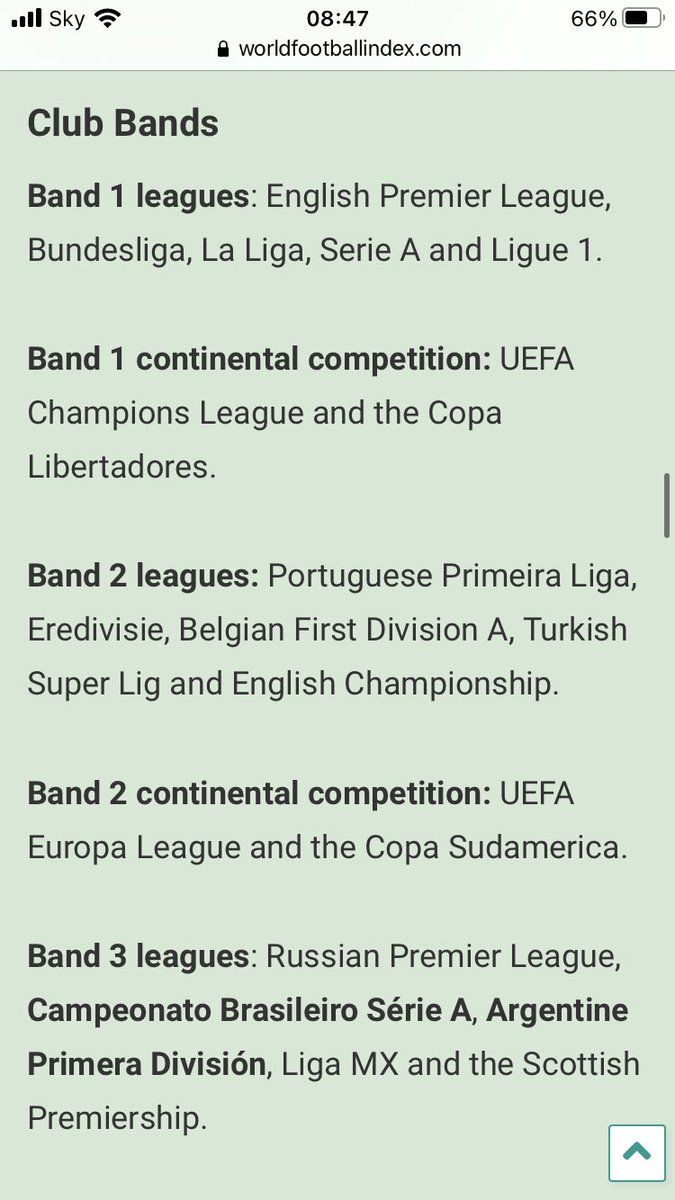
2) There are elements of this I’d dispute. For example, here’s the banding of leagues and, lower down, it’s an absolute mess - Denmark (ranked 14 in coefficient table) and Serbia (16) banded lower than Croatia (20), Greece (18) and Czechs (19)? It’s wholly random.


I get the point that leagues should be banded, but there doesn’t seem to have been loads of sense applied to how these things are actually banded, rather they’ve just shoved a bunch of leagues together and hoped for the best.

You May Also Like