BC TA

Moving Averages is a common indicator which most of us (novice/professional) use in the stock market for trading and investment.

This learning thread would be on
"๐™๐™จ๐™š๐™จ ๐™ค๐™› ๐™ˆ๐™ค๐™ซ๐™ž๐™ฃ๐™œ ๐˜ผ๐™ซ๐™š๐™ง๐™–๐™œ๐™š"

Like๐Ÿ‘ & Retweet๐Ÿ”„ for wider reach and more such learning thread.

1/10

Basics of the moving average:

It takes average of the price for the duration we want.

So 10 days moving average means an average price of 10 days closing price.

Common types of Moving Average:
Simple, Exponential, Weighted.

Use only one type in your trading setup.

2/10
Different uses:

1โƒฃ Moving Average Crossovers:

Common strategy used by positional traders and investor in finding multibagger or good returns stocks.

Common crossover used is for 50 & 200 Moving Average.

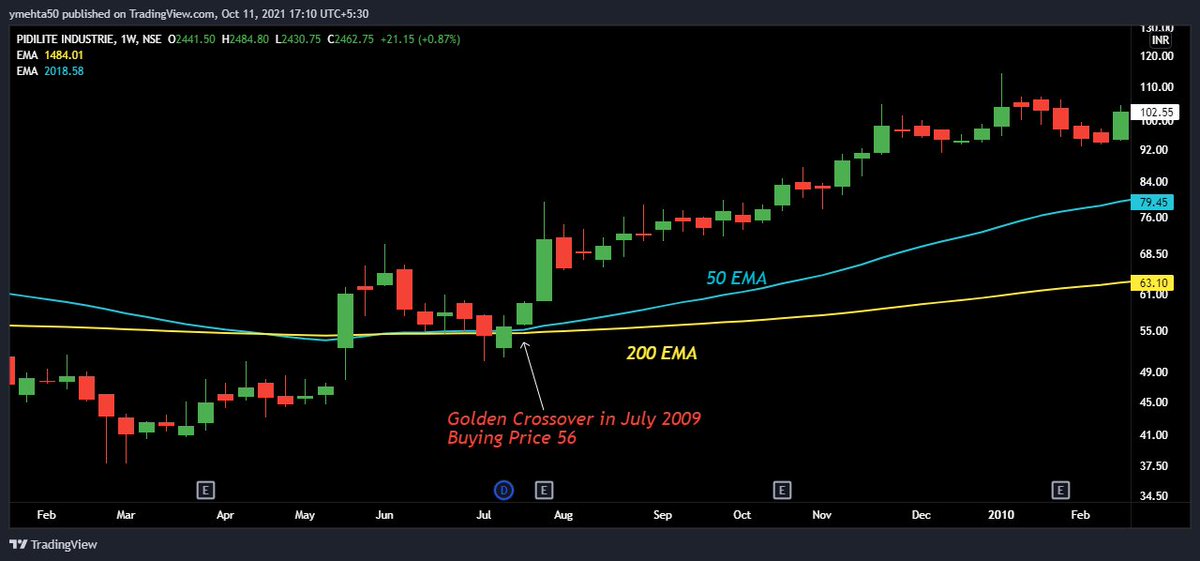
Also, this is called as "๐—š๐—ผ๐—น๐—ฑ๐—ฒ๐—ป ๐—–๐—ฟ๐—ผ๐˜€๐˜€๐—ผ๐˜ƒ๐—ฒ๐—ฟ"

3/10
In this buy signal is initiated when lower MA (50 EMA) crosses above higher MA (200 EMA).
And exit or sell signal is intiated when lower MA (50 EMA) crosses below higher MA (200 EMA).

4/10
Let's see an example:
Pidilite Industries

Buying Price was 56 in 2009 and CMP is 2462 and still there is no selling signal.

44 times Multibagger or 4300% returns.

In lower time frame, it will give more whipsaw and more number of trades.

5/10
Setup looks easy, but is not that easy.

Sometimes stock stays in consolidation and it gives frequent buy and sell signal as seen in Airtel.

One way to avoid this noise is to use price action and look for the breakouts and then trade.

6/10
2โƒฃ Support or Resistance

Moving averages can act as support or resistance to stocks.

Let's look at an example where it acted as a support.

In #IEX chart, 100 Days EMA acted as a support multiple times.
Also, a live trade was shared on IEX:
https://t.co/CXa5CM4pnP

7/10
Let's look at an example where it acted as a Resistance.

Suzlon:

Stock faced resistance at 100 days EMA and it kept going down after EMA level.

Stock went down from 105 to 20 in two years.
8/10
3โƒฃ Finally Moving Average can be used as a Stoplosses.

~ For a buyer, if price closes below a crucial moving average, then buy position is closed in stocks.

~ For a seller, if price closes above a crucial moving average, then short position is closed in stocks.

9/10
I hope everyone got a taste of how moving average can be used.

These are not a universal rules one must follow. One can create their rule or follow someone else rules.

Only important thing is one must follow a fix rule instead of tweaking or changing setup frequently.

10/10

More from Yash Mehta

#RSI is a common indicator which most of us use in the stock market.

This learning thread would be on
"๐™๐™จ๐™š๐™จ ๐™ค๐™› ๐™๐™Ž๐™„"

Like๐Ÿ‘ & Retweet๐Ÿ”„ for wider reach and for more such learning thread in the future.

Also, an investment strategy is shared using RSI in the end.

1/16

Setup 1:

RSI- commonly used to show whether price is overbought or oversold.

General rule:
๐‘๐’๐ˆ > ๐Ÿ•๐ŸŽ -- ๐Ž๐ฏ๐ž๐ซ๐›๐จ๐ฎ๐ ๐ก๐ญ
๐‘๐’๐ˆ < ๐Ÿ‘๐ŸŽ -- ๐Ž๐ฏ๐ž๐ซ๐ฌ๐จ๐ฅ๐

One becomes cautious once price becomes overbought and optimistic when price becomes oversold.

2/16

Let's understand this with an example of Laurus Labs:

1. It was in overbought zone and after a few days when a small dip was seen from 693 to 588 (15% downside)

2. It was in oversold zone and after a few days when a small rally was seen from 59 to 107 (82% upside)

3/16


Well, this looks very easy, but it is not.

When a price is in overbought zone and is in momentum, then it can move up without taking a dip and exiting or shorting stock would prove wrong.

When IRCTC was in overbought zone, price went up from 2718 to 6396 (135% rally).

4/16


Similarly, for oversold stock.

When a price is in oversold zone and is crashing, then it can move down without taking an upmove and buying stock would prove wrong.

When DHFL was in oversold zone, price went down from 126 to 11 (91% crash).

5/16

More from Ta

Moving Averages ๐Ÿ“š

๐Ÿ’ŽSECRET INFO inside

๐Ÿง Great for both beginners & advanced traders

โ–ช๏ธ What are they?
โ–ช๏ธ Types of MAs
โ–ช๏ธ Why are they such a powerful tool?
โ–ช๏ธ How to properly use them?
โ–ช๏ธ My best SECRET EMA value?
โ–ช๏ธ Which Timeframe to use?
โ–ช๏ธ Advanced EMA technique?

1/20


โ–ช๏ธ What are they?

Moving average is nothing more than an average price of the last (value) of candles.

If we are gonna use an example of MA(50) it is gonna be the mean price of the last 50 candles

General rule:
Price above = Bullish ๐Ÿ‚
Price below = Bearish ๐Ÿป

2/20


โ–ช๏ธ Types of Moving Averages

1) Simple Moving Average - SMA
2) Exponential Moving Average - EMA
3) Smoothed Moving Average - SMMA
4) Volume Weighted Average Price - VWAP

There are a few more but these are the most important in my opinion.

3/20


I won't be going that much into detail about each of them in this thread but more so covering MAs in general.

The important takeaway is there are many methods of calculations and each offers bit different pros & cons

I'll leave experimenting with each of them up to you

4/20

โ–ช๏ธ Why are they such a powerful tool?

Because they help everyone, even newbies, that are just starting out, to easily & visually clearly identify trends without understanding the advanced Market Structure techniques.

Price above = ๐Ÿ‚

5/20

https://t.co/g5SneLNPh5

You May Also Like