
Some wed night thoughts on investor “value add”:
1) At the end of the day, money is a commodity. That mere fact should make every vc shudder.
It is amazing how many ppl (incl myself) clamor to get into a commodity business!
But the reality is - all of my founders would’ve figured out how to get that intro or that piece of advice w out me
Entrepreneurship is such a lonely road. And often as ceo or the founders you hit so many rough patches and you can’t / don’t really tell anyone
Later, you make progress, but morale often drops. And you have more than you started. Why?
More from Elizabeth Yin
Today's thread is on the affiliate business model. Many years ago, I used to be an affiliate marketer. If there is any way to get schooled in marketing, becoming an affiliate marketer is probably the best way.
What is affiliate marketing and why should you care?
Read on >>
1) Affiliate marketing is selling products or generating leads on behalf of other companies and getting paid a commission for those products.
2) Some notable examples you've seen before:
NerdWallet - you read their articles on best credit cards. You click on a link to one of those cards. You fill out an application. They get paid for delivering that lead to the cc company.
3) In https://t.co/kSfWS69ybp - same thing. Any of their financial products -- you fill out an application, and https://t.co/mCrBT43mOj gets paid for that.
But the affiliate revenue model applies beyond financial services products.
4) Wirecutter -- you see a neat product they review or talk about. You click through and buy.
Wirecutter gets a cut of that transaction.
What is affiliate marketing and why should you care?
Read on >>
1) Affiliate marketing is selling products or generating leads on behalf of other companies and getting paid a commission for those products.
2) Some notable examples you've seen before:
NerdWallet - you read their articles on best credit cards. You click on a link to one of those cards. You fill out an application. They get paid for delivering that lead to the cc company.
3) In https://t.co/kSfWS69ybp - same thing. Any of their financial products -- you fill out an application, and https://t.co/mCrBT43mOj gets paid for that.
But the affiliate revenue model applies beyond financial services products.
4) Wirecutter -- you see a neat product they review or talk about. You click through and buy.
Wirecutter gets a cut of that transaction.
More from Startups


💪 And we're down to the last 48 hours until the biggest live-streamed startup event hosted by @thepatwalls & @shipstreams kicks off!
With this, let's get motivated with some curated readings & posts by fellow #24hrstartup participants & indie makers. Check them out below!
✍️ Andrew Parrish wrote - "Why I'm Participating in the 24 Hour Startup Challenge".
@makersup's takeaway - Makers love possibilities, the joy of building. Any aspiring maker should experience the end of lurking on forums & reading @wip's to-dos.
Read:
👩💻 @anthilemoon created a list of @women_make_ members participating in the #24hrstartup challenge. Do let her know if she missed anyone!
More at: https://t.co/zYKVZEq8aq

😺 We can't forget one of the key platforms in shipping indie, can we, @ProductHunt?
Check out @ProductHunt's guide to launching at: https://t.co/VB6WgGx6sa.
In addition, it would be wise to prepare for the launch. Fine tune your assets and post at
🚢 Well, we definitely can't leave out the man behind all of this, @thepatwalls!
Launching isn't easy, but know what you'll be facing even before coding. Check out @thepatwalls' "words of shipping" at:
With this, let's get motivated with some curated readings & posts by fellow #24hrstartup participants & indie makers. Check them out below!
✍️ Andrew Parrish wrote - "Why I'm Participating in the 24 Hour Startup Challenge".
@makersup's takeaway - Makers love possibilities, the joy of building. Any aspiring maker should experience the end of lurking on forums & reading @wip's to-dos.
Read:
👩💻 @anthilemoon created a list of @women_make_ members participating in the #24hrstartup challenge. Do let her know if she missed anyone!
More at: https://t.co/zYKVZEq8aq
Creating a list of @women_make_ members participating in the #24hrstartup challenge this weekend \u2013 please let me know if I missed anyone! \U0001f469\u200d\U0001f4bb #womenmake pic.twitter.com/Kh7O7fKv7h
— \U0001d400\U0001d427\U0001d427\U0001d41e-\U0001d40b\U0001d41a\U0001d42e\U0001d42b\U0001d41e \U0001d40b\U0001d41e \U0001d402\U0001d42e\U0001d427\U0001d41f\U0001d41f (@anthilemoon) November 14, 2018
😺 We can't forget one of the key platforms in shipping indie, can we, @ProductHunt?
Check out @ProductHunt's guide to launching at: https://t.co/VB6WgGx6sa.
In addition, it would be wise to prepare for the launch. Fine tune your assets and post at
🚢 Well, we definitely can't leave out the man behind all of this, @thepatwalls!
Launching isn't easy, but know what you'll be facing even before coding. Check out @thepatwalls' "words of shipping" at:


You May Also Like

These 10 threads will teach you more than reading 100 books
Five billionaires share their top lessons on startups, life and entrepreneurship (1/10)
10 competitive advantages that will trump talent (2/10)
Some harsh truths you probably don’t want to hear (3/10)
10 significant lies you’re told about the world (4/10)
Five billionaires share their top lessons on startups, life and entrepreneurship (1/10)
I interviewed 5 billionaires this week
— GREG ISENBERG (@gregisenberg) January 23, 2021
I asked them to share their lessons learned on startups, life and entrepreneurship:
Here's what they told me:
10 competitive advantages that will trump talent (2/10)
To outperform, you need serious competitive advantages.
— Sahil Bloom (@SahilBloom) March 20, 2021
But contrary to what you have been told, most of them don't require talent.
10 competitive advantages that you can start developing today:
Some harsh truths you probably don’t want to hear (3/10)
I\u2019ve gotten a lot of bad advice in my career and I see even more of it here on Twitter.
— Nick Huber (@sweatystartup) January 3, 2021
Time for a stiff drink and some truth you probably dont want to hear.
\U0001f447\U0001f447
10 significant lies you’re told about the world (4/10)
THREAD: 10 significant lies you're told about the world.
— Julian Shapiro (@Julian) January 9, 2021
On startups, writing, and your career:


✨📱 iOS 12.1 📱✨
🗓 Release date: October 30, 2018
📝 New Emojis: 158
https://t.co/bx8XjhiCiB

New in iOS 12.1: 🥰 Smiling Face With 3 Hearts https://t.co/6eajdvueip

New in iOS 12.1: 🥵 Hot Face https://t.co/jhTv1elltB

New in iOS 12.1: 🥶 Cold Face https://t.co/EIjyl6yZrF

New in iOS 12.1: 🥳 Partying Face https://t.co/p8FDNEQ3LJ

🗓 Release date: October 30, 2018
📝 New Emojis: 158
https://t.co/bx8XjhiCiB
New in iOS 12.1: 🥰 Smiling Face With 3 Hearts https://t.co/6eajdvueip
New in iOS 12.1: 🥵 Hot Face https://t.co/jhTv1elltB
New in iOS 12.1: 🥶 Cold Face https://t.co/EIjyl6yZrF
New in iOS 12.1: 🥳 Partying Face https://t.co/p8FDNEQ3LJ


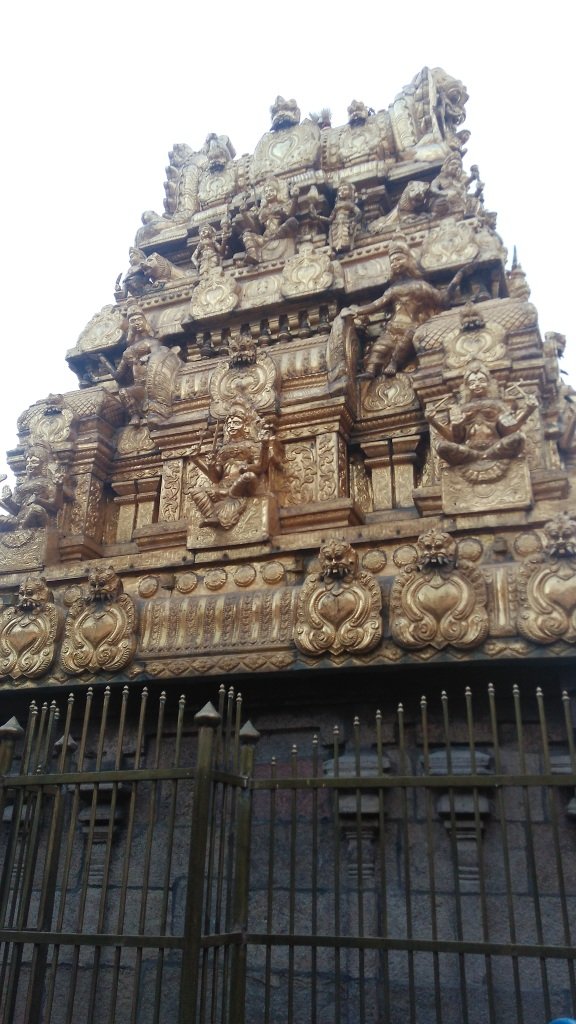


🌿𝑻𝒉𝒆 𝒔𝒕𝒐𝒓𝒚 𝒐𝒇 𝒂 𝑺𝒕𝒂𝒓 : 𝑫𝒉𝒓𝒖𝒗𝒂 & 𝑽𝒊𝒔𝒉𝒏𝒖
Once upon a time there was a Raja named Uttānapāda born of Svayambhuva Manu,1st man on earth.He had 2 beautiful wives - Suniti & Suruchi & two sons were born of them Dhruva & Uttama respectively.
#talesofkrishna https://t.co/E85MTPkF9W
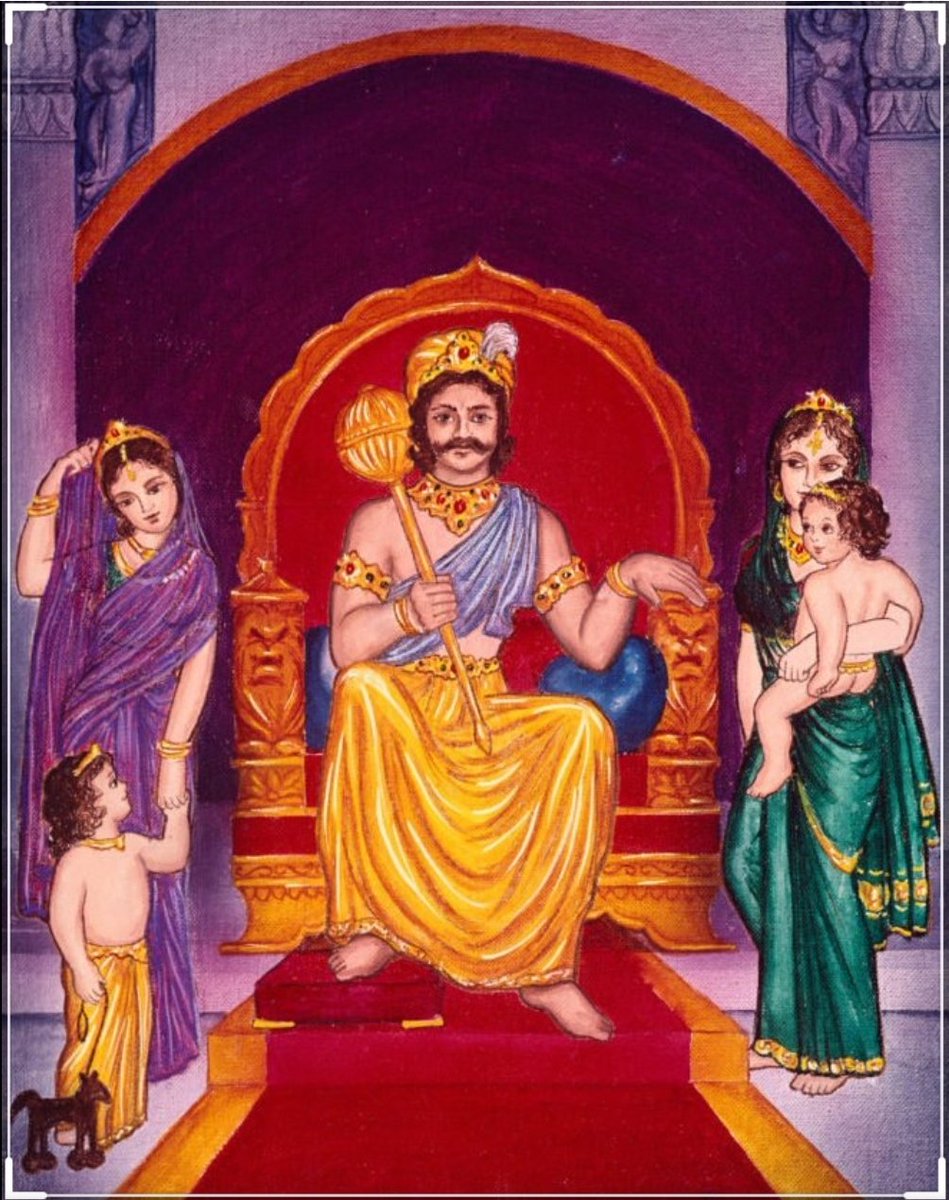
Now Suniti was the daughter of a tribal chief while Suruchi was the daughter of a rich king. Hence Suruchi was always favored the most by Raja while Suniti was ignored. But while Suniti was gentle & kind hearted by nature Suruchi was venomous inside.
#KrishnaLeela
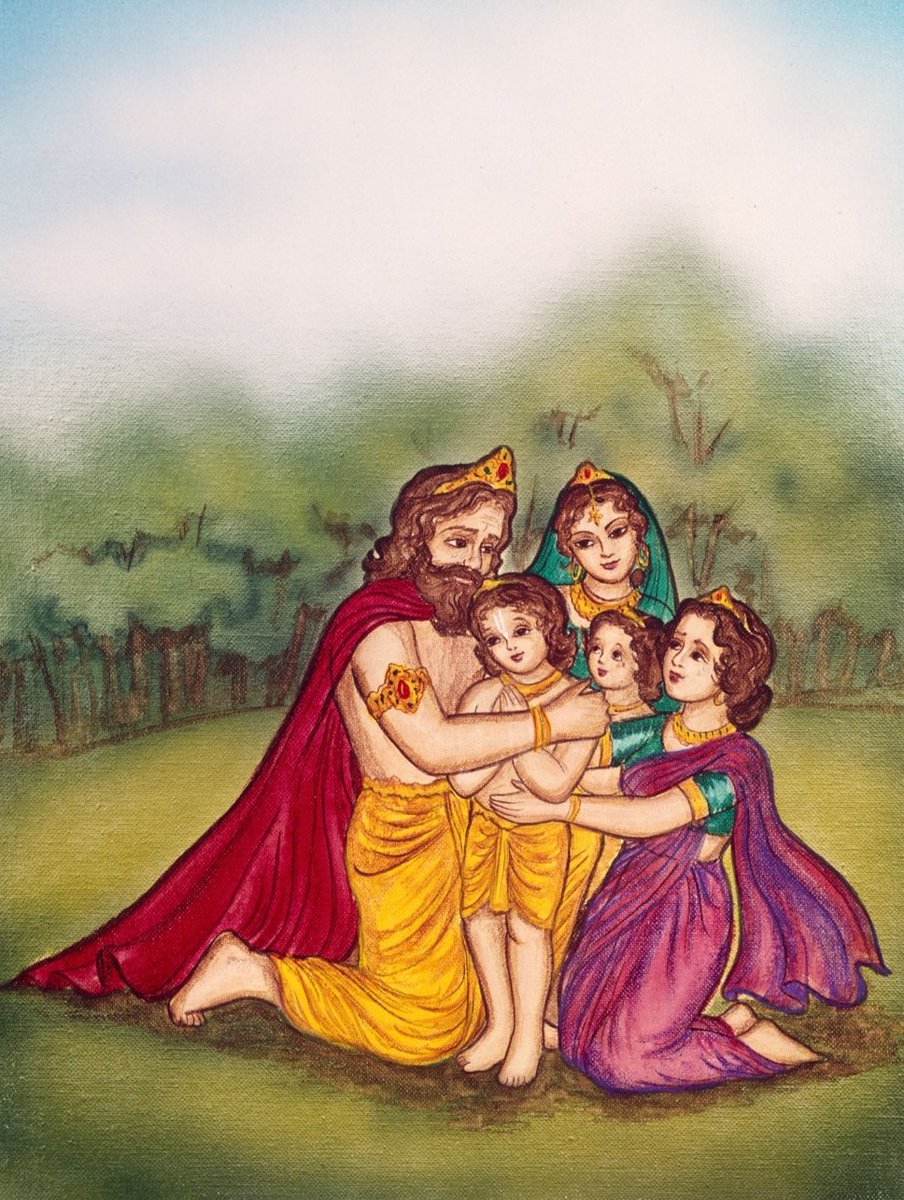
The story is of a time when ideally the eldest son of the king becomes the heir to the throne. Hence the sinhasan of the Raja belonged to Dhruva.This is why Suruchi who was the 2nd wife nourished poison in her heart for Dhruva as she knew her son will never get the throne.
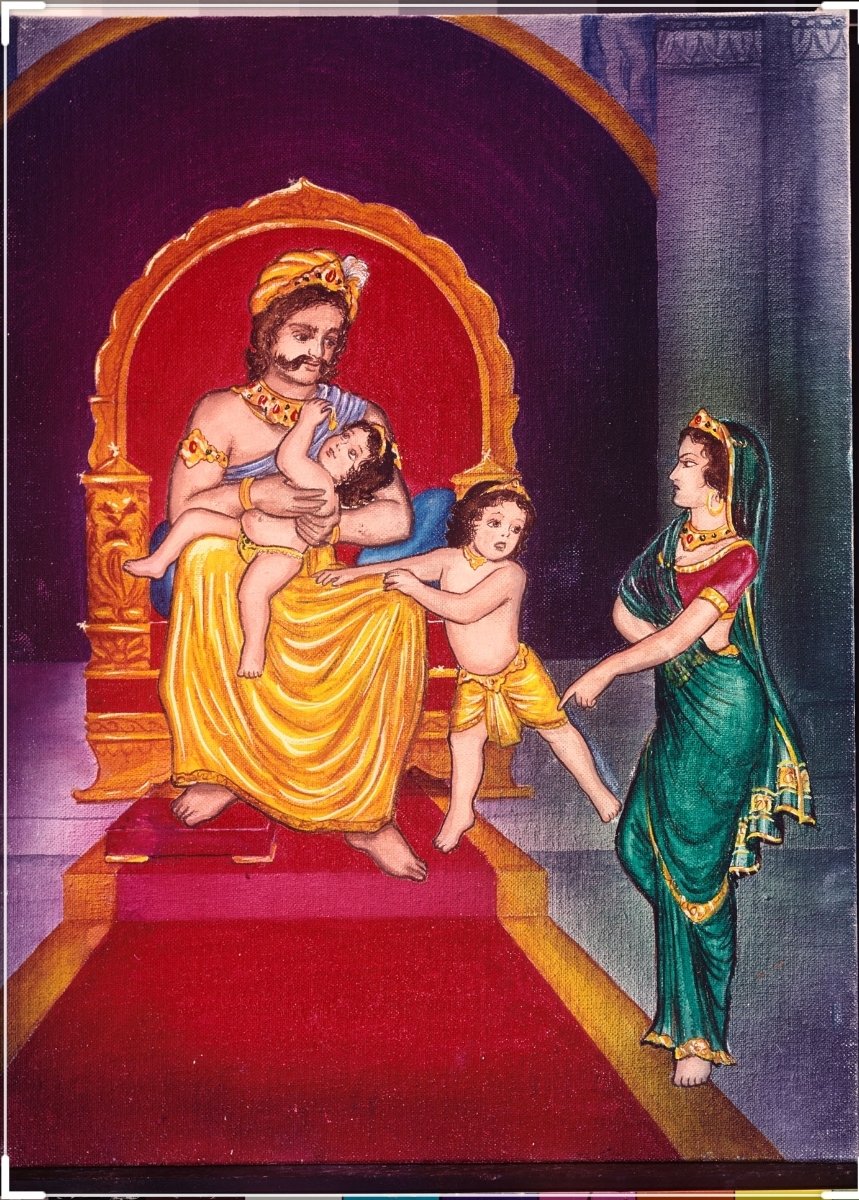
One day when Dhruva was just 5 years old he went on to sit on his father's lap. Suruchi, the jealous queen, got enraged and shoved him away from Raja as she never wanted Raja to shower Dhruva with his fatherly affection.
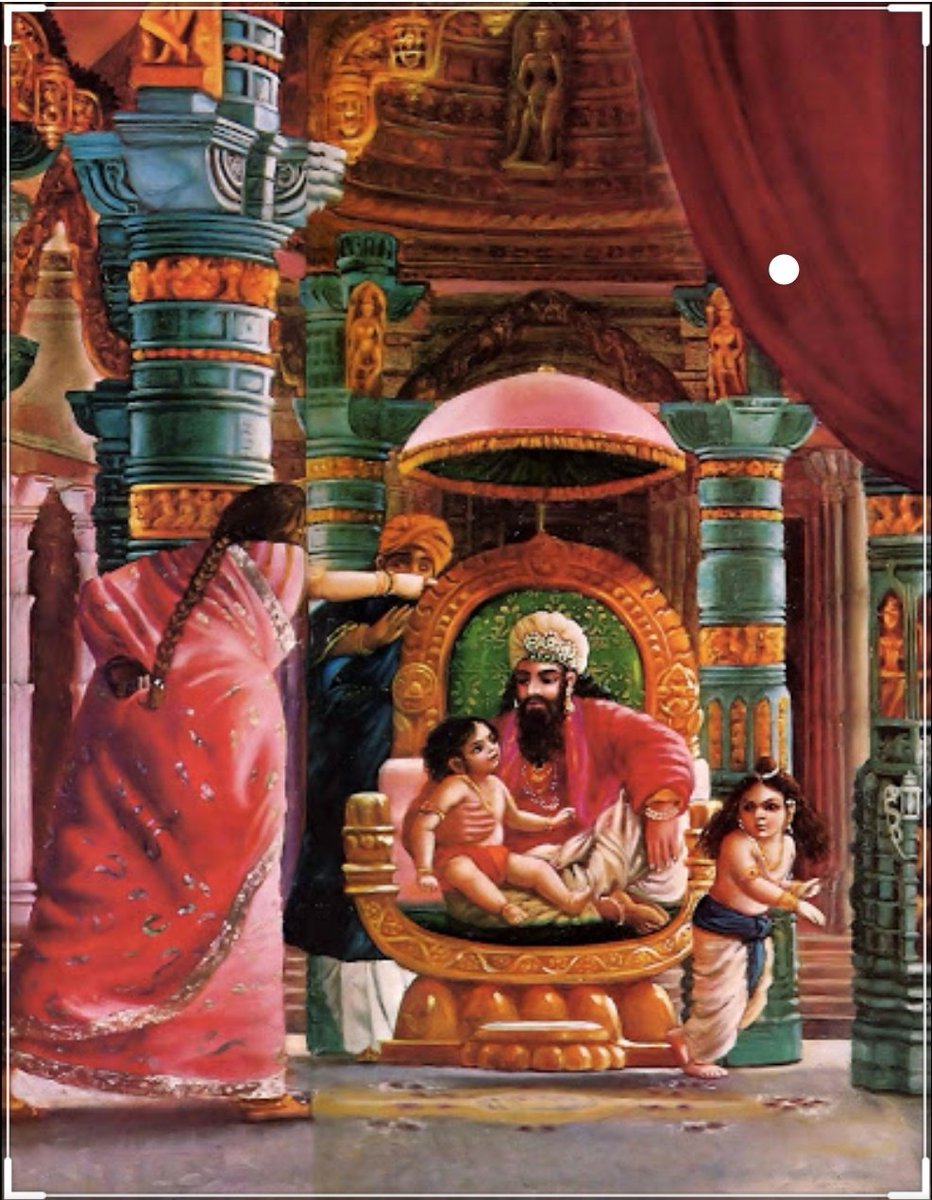
Dhruva protested questioning his step mother "why can't i sit on my own father's lap?" A furious Suruchi berated him saying "only God can allow him that privilege. Go ask him"
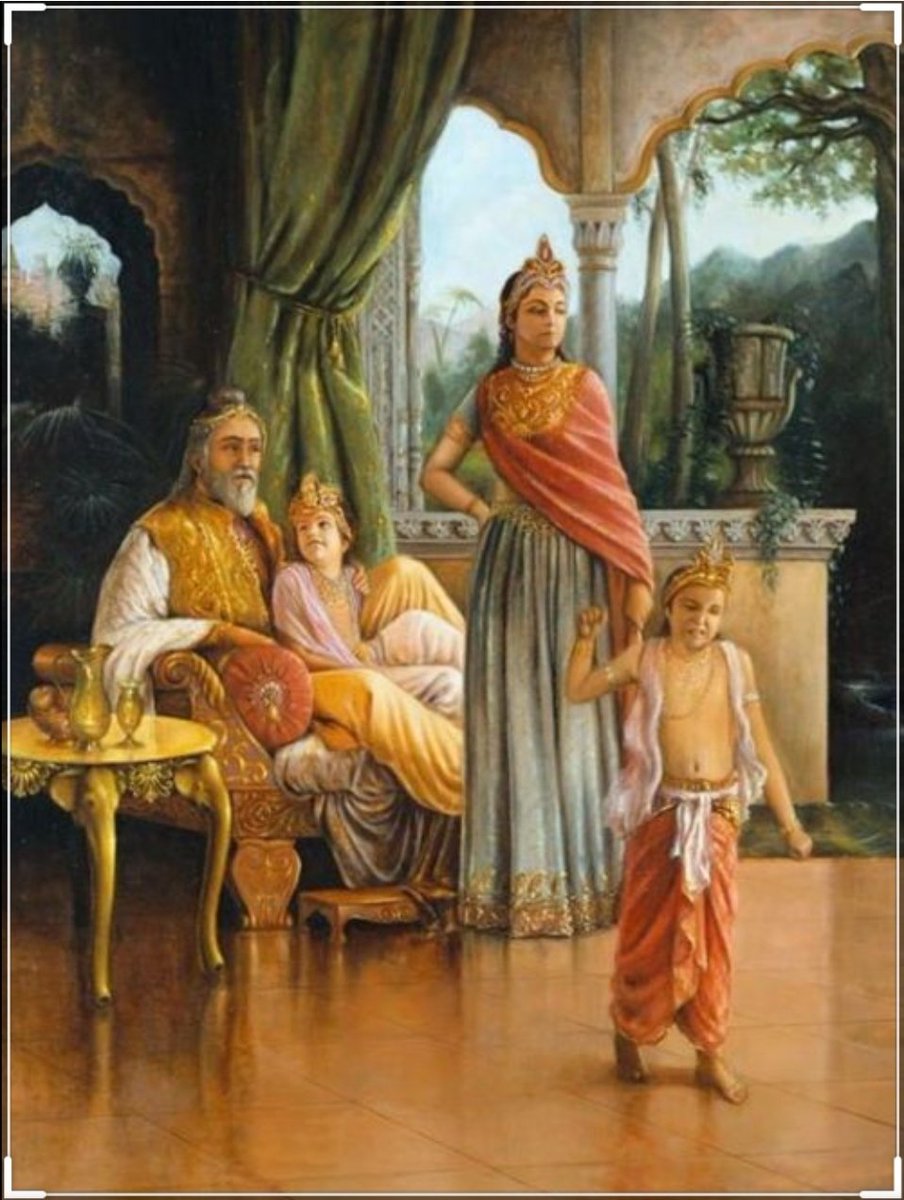
Once upon a time there was a Raja named Uttānapāda born of Svayambhuva Manu,1st man on earth.He had 2 beautiful wives - Suniti & Suruchi & two sons were born of them Dhruva & Uttama respectively.
#talesofkrishna https://t.co/E85MTPkF9W
Prabhu says i reside in the heart of my bhakt.
— Right Singh (@rightwingchora) December 21, 2020
Guess the event. pic.twitter.com/yFUmbfe5KL
Now Suniti was the daughter of a tribal chief while Suruchi was the daughter of a rich king. Hence Suruchi was always favored the most by Raja while Suniti was ignored. But while Suniti was gentle & kind hearted by nature Suruchi was venomous inside.
#KrishnaLeela
The story is of a time when ideally the eldest son of the king becomes the heir to the throne. Hence the sinhasan of the Raja belonged to Dhruva.This is why Suruchi who was the 2nd wife nourished poison in her heart for Dhruva as she knew her son will never get the throne.
One day when Dhruva was just 5 years old he went on to sit on his father's lap. Suruchi, the jealous queen, got enraged and shoved him away from Raja as she never wanted Raja to shower Dhruva with his fatherly affection.
Dhruva protested questioning his step mother "why can't i sit on my own father's lap?" A furious Suruchi berated him saying "only God can allow him that privilege. Go ask him"