
Last talk about Securing Democracy at #enigma2021: @jackhcable speaking about "THE FULL STACK PROBLEM OF ELECTION
Georgia did a full recount on paper ballots and it very much didn't stop people from doubting the election!
No! Have to focus on the whole stack, from election infrastructure to campaigns to people and mis/dis-informaton
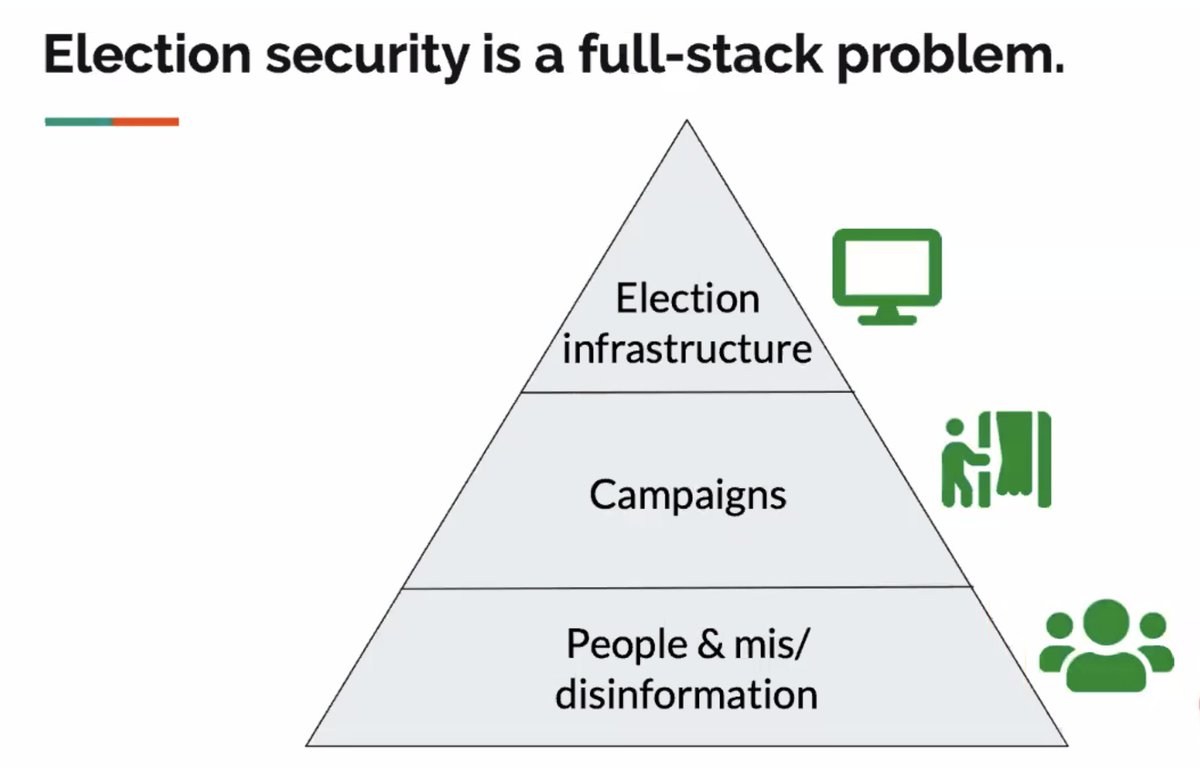
* significant advances in recent years (e.g. paper ballots, risk-limiting audits, end-to-end verifiability)
* research needed in integrating these technologies
* expanding to mail-in voting?
* we can't do it securely today [oh no voatz reference]
* we have to combat malware, authentication etc.
* if we could solve them, that would be great. But in the meantime voting has to be successful for everyone
* less researched. Probably because they look boring
* Voter registration databases aren't working. Russians breached at least 2 states, targeted all 50 states
* little to no public scrutiny of these systems
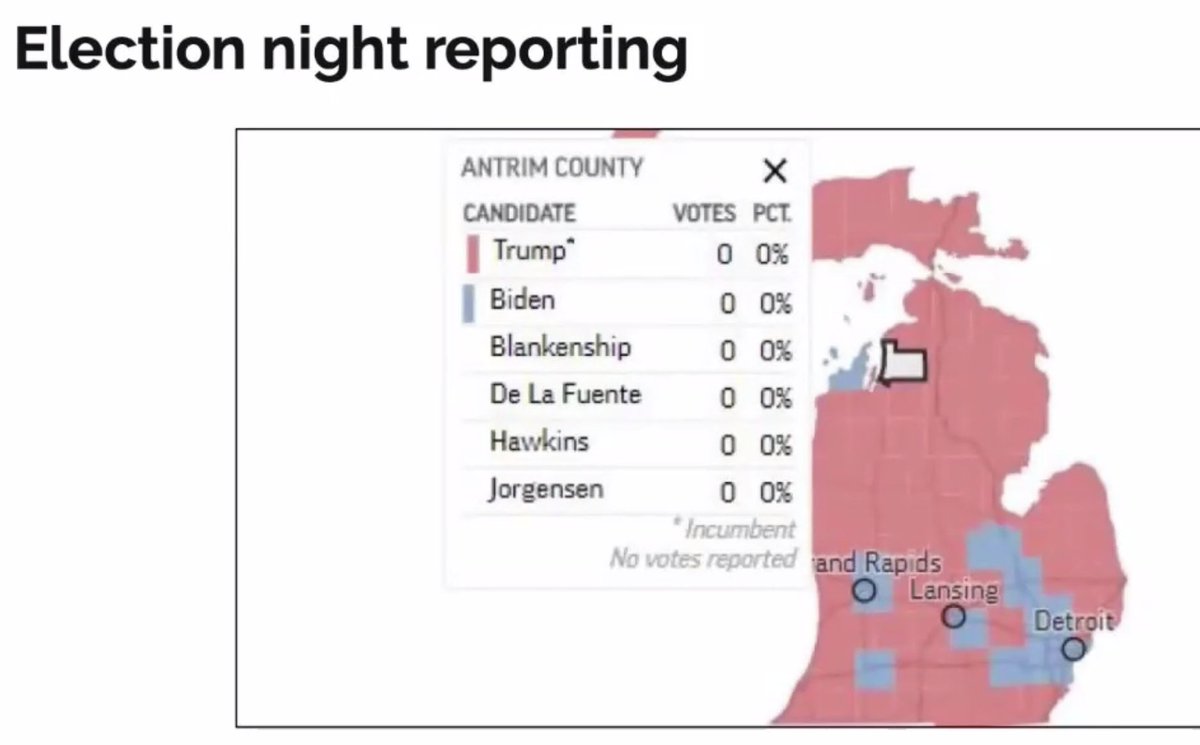
* biggest unknown (see Sunny Consolvo's talk!)
* we must view campaign security as non-partisan and increase resources and services available
* major damage from domestic actors
* widespread mis/dis-information
* technical election security measures helps to debunk rumours floating around
* platforms: downranking and deplatforming
* trusted institutions
* debunking & fact checks
* media literacy
* increased civics education
[ Also note that @katestarbird will be giving a talk on misinformation don't miss it: https://t.co/a0PutRnHaI]
More from Lea Kissner


More from Politics


We’ve been getting calls and outreach from Queens residents all day about this.
The community’s response? Outrage.
Amazon is a billion-dollar company. The idea that it will receive hundreds of millions of dollars in tax breaks at a time when our subway is crumbling and our communities need MORE investment, not less, is extremely concerning to residents here.
When we talk about bringing jobs to the community, we need to dig deep:
- Has the company promised to hire in the existing community?
- What’s the quality of jobs + how many are promised? Are these jobs low-wage or high wage? Are there benefits? Can people collectively bargain?
Displacement is not community development. Investing in luxury condos is not the same thing as investing in people and families.
Shuffling working class people out of a community does not improve their quality of life.
We need to focus on good healthcare, living wages, affordable rent. Corporations that offer none of those things should be met w/ skepticism.
It’s possible to establish economic partnerships w/ real opportunities for working families, instead of a race-to-the-bottom competition.
The community’s response? Outrage.
Amazon will divide its second headquarters evenly between New York's Long Island City and Arlington County's Crystal City neighborhoods. Other cities may also receive major sites. https://t.co/c1lKmeQinX
— The Wall Street Journal (@WSJ) November 13, 2018
Amazon is a billion-dollar company. The idea that it will receive hundreds of millions of dollars in tax breaks at a time when our subway is crumbling and our communities need MORE investment, not less, is extremely concerning to residents here.
When we talk about bringing jobs to the community, we need to dig deep:
- Has the company promised to hire in the existing community?
- What’s the quality of jobs + how many are promised? Are these jobs low-wage or high wage? Are there benefits? Can people collectively bargain?
Displacement is not community development. Investing in luxury condos is not the same thing as investing in people and families.
Shuffling working class people out of a community does not improve their quality of life.
We need to focus on good healthcare, living wages, affordable rent. Corporations that offer none of those things should be met w/ skepticism.
It’s possible to establish economic partnerships w/ real opportunities for working families, instead of a race-to-the-bottom competition.


You May Also Like


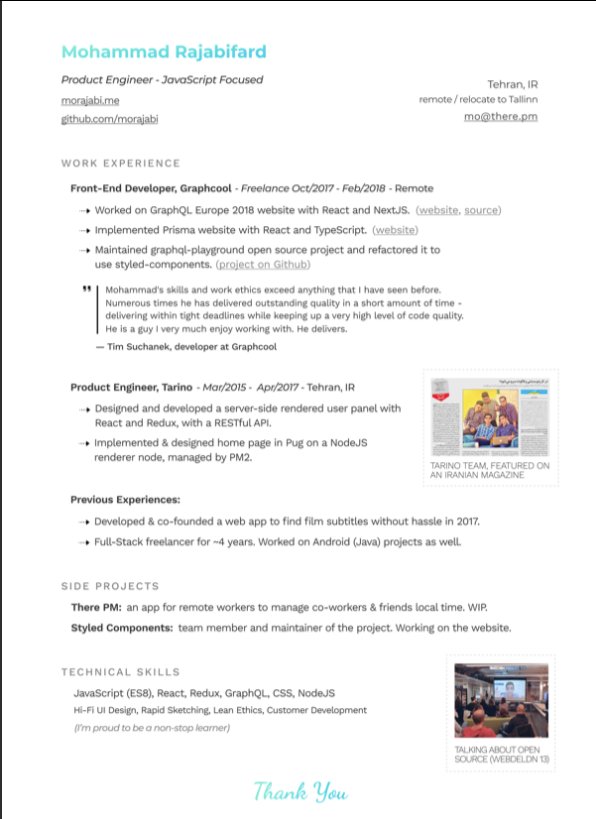
👨💻 Last resume I sent to a startup one year ago, sharing with you to get ideas:
- Forget what you don't have, make your strength bold
- Pick one work experience and explain what you did in detail w/ bullet points
- Write it towards the role you apply
- Give social proof
/thread
"But I got no work experience..."
Make a open source lib, make a small side project for yourself, do freelance work, ask friends to work with them, no friends? Find friends on Github, and Twitter.
Bonus points:
- Show you care about the company: I used the company's brand font and gradient for in the resume for my name and "Thank You" note.
- Don't list 15 things and libraries you worked with, pick the most related ones to the role you're applying.
-🙅♂️"copy cover letter"
"I got no firends, no work"
One practical way is to reach out to conferences and offer to make their website for free. But make sure to do it good. You'll get:
- a project for portfolio
- new friends
- work experience
- learnt new stuff
- new thing for Twitter bio
If you don't even have the skills yet, why not try your chance for @LambdaSchool? No? @freeCodeCamp. Still not? Pick something from here and learn https://t.co/7NPS1zbLTi
You'll feel very overwhelmed, no escape, just acknowledge it and keep pushing.
- Forget what you don't have, make your strength bold
- Pick one work experience and explain what you did in detail w/ bullet points
- Write it towards the role you apply
- Give social proof
/thread
"But I got no work experience..."
Make a open source lib, make a small side project for yourself, do freelance work, ask friends to work with them, no friends? Find friends on Github, and Twitter.
Bonus points:
- Show you care about the company: I used the company's brand font and gradient for in the resume for my name and "Thank You" note.
- Don't list 15 things and libraries you worked with, pick the most related ones to the role you're applying.
-🙅♂️"copy cover letter"
"I got no firends, no work"
One practical way is to reach out to conferences and offer to make their website for free. But make sure to do it good. You'll get:
- a project for portfolio
- new friends
- work experience
- learnt new stuff
- new thing for Twitter bio
If you don't even have the skills yet, why not try your chance for @LambdaSchool? No? @freeCodeCamp. Still not? Pick something from here and learn https://t.co/7NPS1zbLTi
You'll feel very overwhelmed, no escape, just acknowledge it and keep pushing.
