It's not. The conditions that make up the responsibility is what determines whether it should be upheld or not.
Men need to know when to take responsibility.
They also need to know when to refuse it.
Thread.
It's not. The conditions that make up the responsibility is what determines whether it should be upheld or not.
If its family, unless they reached a level of disownment, responsibility meets no conditions.
It's a mans duty to carry as much as responsibility to alleviate his family's burden.
1. An incentive
2. Authority
3. Leverage
Ideally you want responsibility to beget all three. Most of the time, you start off with only one.
You might learn a thing or two, which can be valuable, but overall, it is value exchanged for nothing.
If it doesn't, then you're not disagreeable enough to negotiate conditions that fairly exchanges value.
Authority is valuable. It turns you into a leader.
And you should reject it. Being exploited in this way is a good indicator that you're too agreeable,
and people end up easily extracting value out of you.
If the responsibility given, is very valuable in of itself, & can be leveraged against the person giving it.
This is the cunning method that forces a return in value.
See thread ⬇️
Any responsibility delegated to you by your boss without a pay rise,
— \u1d1c\u0274\u1d0d\u1d0f\u1d05\u1d07\u0280\u0274 (@UnmodernM) October 20, 2020
takes you one step closer in becoming an inseparable part of his business,
to which you can infinitely leverage against him later & get what you want.
Be patient. Then leverage to a chokehold.
Thread.
More from ᴜɴᴍᴏᴅᴇʀɴ
More from Life






You May Also Like
@EricTopol @NBA @StephenKissler @yhgrad B.1.1.7 reveals clearly that SARS-CoV-2 is reverting to its original pre-outbreak condition, i.e. adapted to transgenic hACE2 mice (either Baric's BALB/c ones or others used at WIV labs during chimeric bat coronavirus experiments aimed at developing a pan betacoronavirus vaccine)
@NBA @StephenKissler @yhgrad 1. From Day 1, SARS-COV-2 was very well adapted to humans .....and transgenic hACE2 Mice
@NBA @StephenKissler @yhgrad 2. High Probability of serial passaging in Transgenic Mice expressing hACE2 in genesis of SARS-COV-2
@NBA @StephenKissler @yhgrad B.1.1.7 has an unusually large number of genetic changes, ... found to date in mouse-adapted SARS-CoV2 and is also seen in ferret infections.
https://t.co/9Z4oJmkcKj

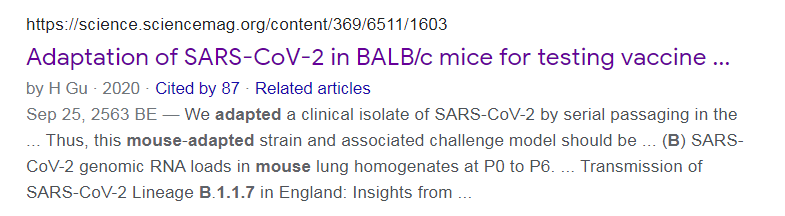
@NBA @StephenKissler @yhgrad We adapted a clinical isolate of SARS-CoV-2 by serial passaging in the ... Thus, this mouse-adapted strain and associated challenge model should be ... (B) SARS-CoV-2 genomic RNA loads in mouse lung homogenates at P0 to P6.
https://t.co/I90OOCJg7o
@NBA @StephenKissler @yhgrad 1. From Day 1, SARS-COV-2 was very well adapted to humans .....and transgenic hACE2 Mice
1. From Day 1, SARS-COV-2 was very well adapted to humans .....and transgenic hACE2 Mice
— Billy Bostickson \U0001f3f4\U0001f441&\U0001f441 \U0001f193 (@BillyBostickson) January 30, 2021
"we generated a mouse model expressing hACE2 by using CRISPR/Cas9 knockin technology. In comparison with wild-type C57BL/6 mice, both young & aged hACE2 mice sustained high viral loads... pic.twitter.com/j94XtSkscj
@NBA @StephenKissler @yhgrad 2. High Probability of serial passaging in Transgenic Mice expressing hACE2 in genesis of SARS-COV-2
1. High Probability of serial passaging in Transgenic Mice expressing hACE2 in genesis of SARS-COV-2!
— Billy Bostickson \U0001f3f4\U0001f441&\U0001f441 \U0001f193 (@BillyBostickson) January 2, 2021
2 papers:
Human\u2013viral molecular mimicryhttps://t.co/irfH0Zgrve
Molecular Mimicryhttps://t.co/yLQoUtfS6s https://t.co/lsCv2iMEQz
@NBA @StephenKissler @yhgrad B.1.1.7 has an unusually large number of genetic changes, ... found to date in mouse-adapted SARS-CoV2 and is also seen in ferret infections.
https://t.co/9Z4oJmkcKj
@NBA @StephenKissler @yhgrad We adapted a clinical isolate of SARS-CoV-2 by serial passaging in the ... Thus, this mouse-adapted strain and associated challenge model should be ... (B) SARS-CoV-2 genomic RNA loads in mouse lung homogenates at P0 to P6.
https://t.co/I90OOCJg7o