Session begins.
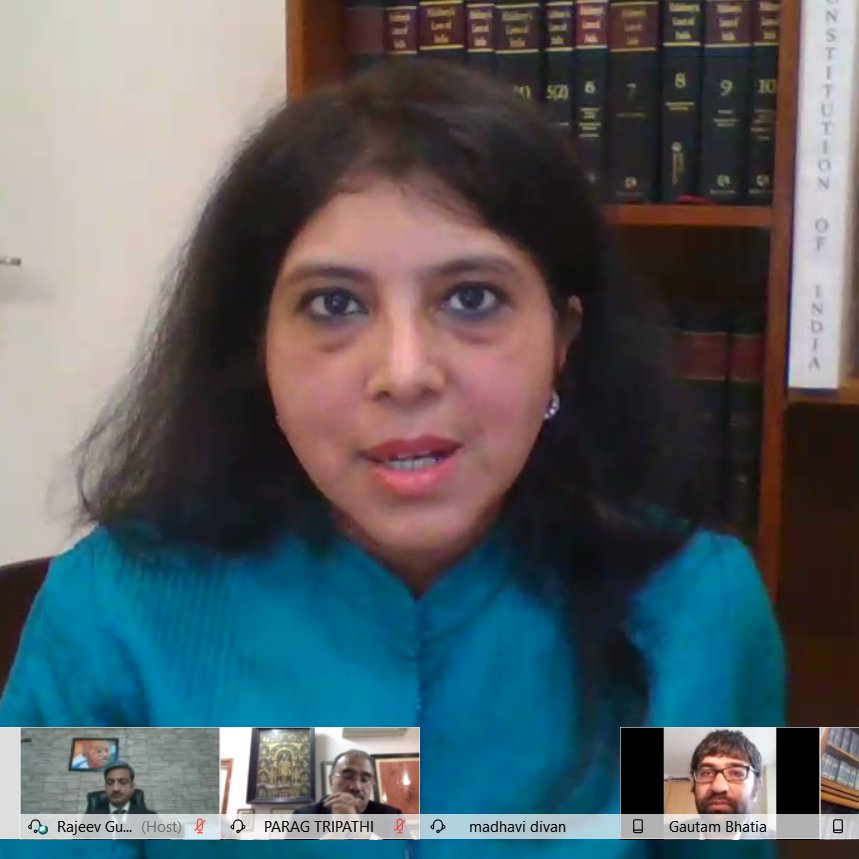
Rajeev Gupta, Director of J&K Judicial Academy introduces the guests.
@gautambhatia88 now takes over.
He speaks of how the pandemic and social media has taken the Court out of the Courtroom into the public realm.
With platforms such as
@LiveLawIndia and
@barandbench giving a blow-by-blow account of court proceedings, interest in constitutional law has grown, he says.
He adds that many constitutional lawyers do not start out wanting to practise constitutional laws as such.
Senior Madhavi Divan begins speaking.
She narrates her journey from a law office that was predominantly handled commercial matters.
She opines that it is important to have a multi-faceted grounding in diverse streams of law before specialising in one.
Constitutional law speaks to various realms of practice, Gautam Bhatia agrees.
Senior Advocate Neelam Tripathi shares with the audience that she had qualified as a chartered accountant. Meeting her life partner sparked her interest in law.
Clients are satisfied if their lawyers are able to answer all their questions, not just those from one area, she adds
However, a grounding in constitutional law is important when you argue matters pertaining to writ jurisdiction of constitutional courts: Senior Adv Neelima Tripathi says.
Senior Advocate Parag Tripathi agrees with the other panellists and says that Indian law does not follow a 'silo' approach, and the laws weave into each other.
@gautambhatia88 asks Senior Advocate Tripathi a question about whether there is an overlap with administrative and constitutional law in the recent past.
Most administrative law principles are grounded in constitutional law principles, he explains
Senior Advocate Shyam Divan is speaking now.
He says that a person who intends to practise law needs to be a 'generalist' at some point.
If a person intends to devote a career to constitutional law, s/he could consider a career in academia, he opines.
Another good introduction to constitutional laws could be by starting law practice with a lawyer in the High Courts or Supreme Court: Senior Advocate Shyam Divan
He recounts that there are two books in every lawyer's library - a D.D. Basu 'Shorter Constitution of India' and Seervai's Treatise on Constitutional Law.
While the latter was mostly untouched, DD Basu was widely used by busy lawyers being more concise, Senior Adv Divan says.
@gautambhatia88 speaks about how the Constitution of India has often become synonymous with Part - 3 (Part on fundamental rights)
He asks the panellists to talk about the diversity of Constitutional Law practice beyond Part 3, for instance inter State-Centre commerce & tax.
Senior Advocate Shyam Divan speaks about his initial foray into constitutional law practice through early maritime disputes.
These were before alternative forms of disputes became popular, he adds.
Senior Advocate Parag Tripathi emphasizes that legislative competence to enact laws is another important area in constitutional practice that needs to be mastered.
Constitutional lawyers see what others do not, and then bring it to the Court's notice.
He illustrates using the basic structure doctrine, which is not expressly provided for anywhere, but is obvious once it is brought to notice
You can't unsee it:
@gautambhatia88 quips
Senior Adv Neelam Tripathi speaks about the right to property, being a right outside Part - 3 that was crucial in constitutional law practice.
Senior Advocate Madhavi Divan picks up from Senior Advocate Shyam Divan's advice to young lawyers to start out in chamber that deal with constitutional matters.
'I would say that the choice of spouse & location is as important as choice of chamber', she says, referring to her move to Delhi from pure commercial practice in Bombay.
Once I started, I found it fascinating. I did not study law in India, so I learnt constitutional law as he cases came my way: Senior Advocate Madhavi Divan
The advantage of Indian law is that it does not require one to specialise in any particular area.
@gautambhatia88 asks the panellists to describe their favourite constitutional law cases.
Senior Advocate Madhavi Divan recounts a case she argued, where Senior Adv Shyam Divan represented the opposite side.
The case related to whether an 8-year-old Jain girl could take up monastic vows, which in effect resulted in her giving up her rights to education & other rights.
Other cases she lists: The WhatsApp Privacy case, the Sahara media guidelines matter, the triple talaq case, and a tax matter she argued despite having no experience.
Senior Advocate Madhavi Divan speaks of her experiences on the Shayara Bano (Triple Talaq) case and how they believed the Supreme Court had upheld the practice of Triple Talaq because the dissents were read out first.
https://t.co/tjKvmyHmnS
Senior Advocate Parag Tripathi narrates events that led up to the Kesavananda Bharati.
It had all the thrills of a T20 match, he expresses.
Senior Advocate Shyam Divan discusses a case he argued.
The Maharashtra government proposed to a law to vest Bombay High Court's original commercial jurisdiction with city civil courts. He was one of the lawyers for the petitioners.
Though they lost the case before both the High Court and the Supreme Court, they ended up succeeding, he says. This was since the Commercial Courts Act required the setting up of 'specialised' commercial courts, and continued the Bombay High Court's original jurisdiction.
The panellists are taking questions from the audience now.
We must believe in our system, Senior Adv Shyam Divan says, in response to a question asking about the strength of the legal system.
We need constitutional functionaries with courage & judges with courage, he adds. Else we will have jellyfish judges & a jellyfish jurisprudence.
Responding to a question on the misuse of Public Interest Litigation, Senior Advocate Parag Tripathi says "PIL is like nuclear power, it depends on how you use it"
PILs have been used to advance social good but frauduent/malafide PILs are sometimes used to drown out genuine ones
A question is posed to
@gautambhatia88 on how to choose internships.
He iterates the point that an understanding of all laws is essential and internships that allow for this should be chosen.
Chief Justice of Jammu and Kashmir High Court thanks all the panellists for their participation.
The session closes with a vote of thanks by Rajeev Gupta, Director of the Jammu and Kashmir Judicial Academy.