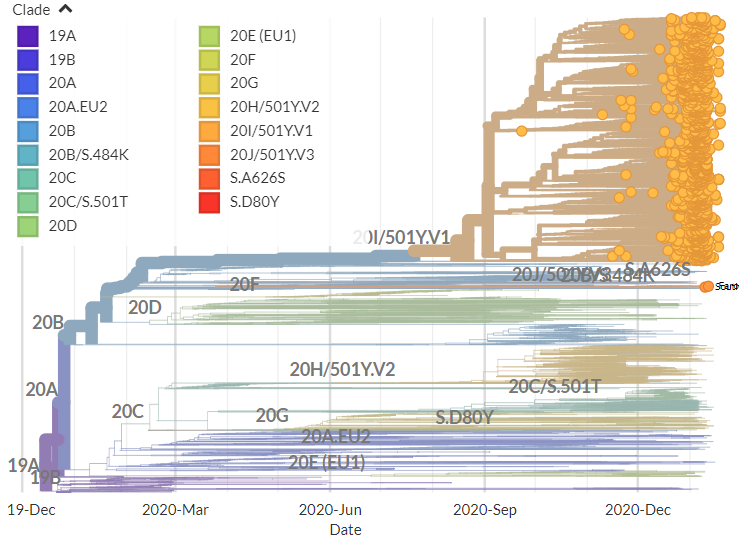
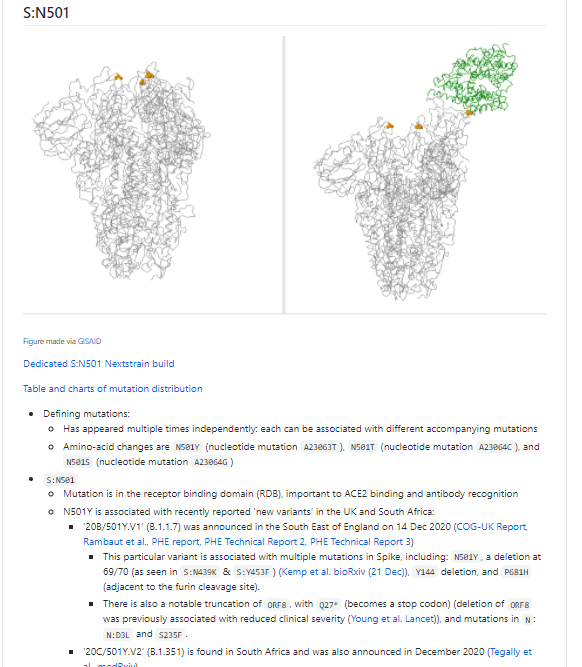
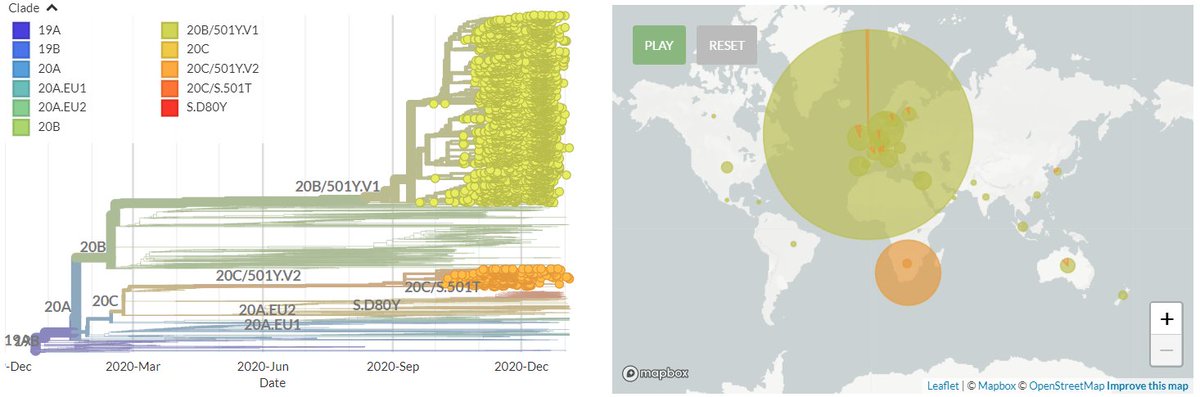
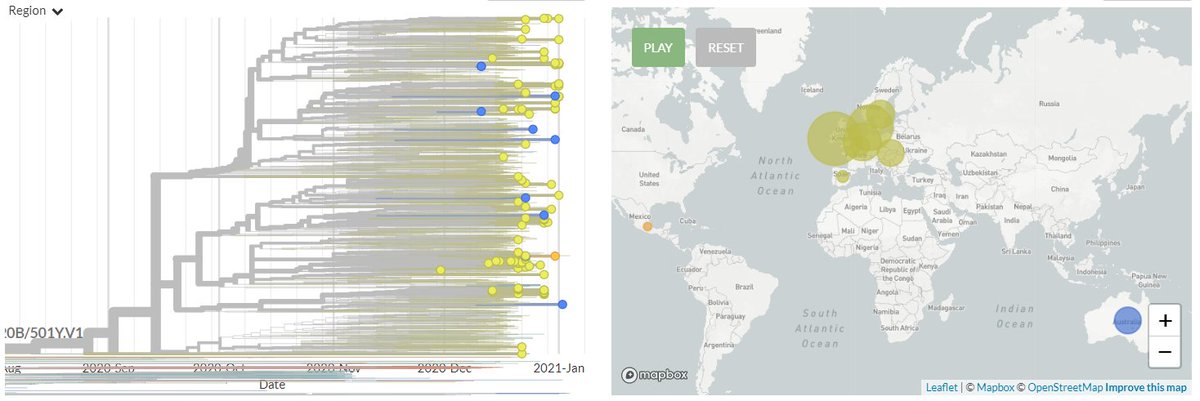
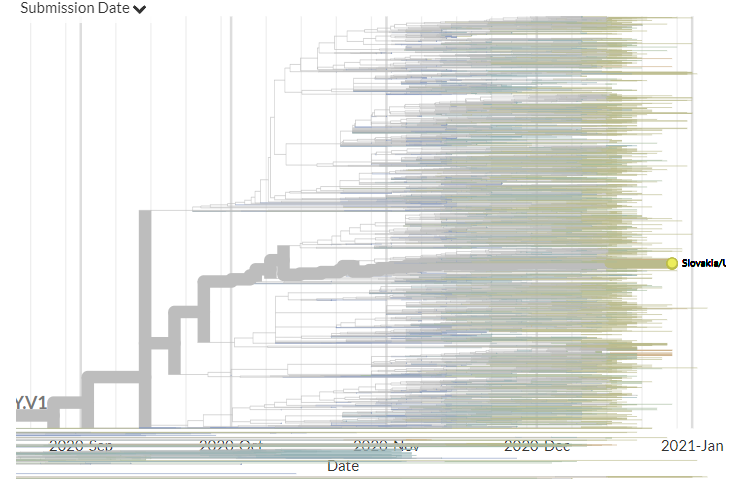
The S:N501 build is now updated with data from 25th Jan.

Remember, you can always check on any country by just typing that country name in the 'Filter' box on the left menu!

1/18

https://t.co/FTjvV7T7wL

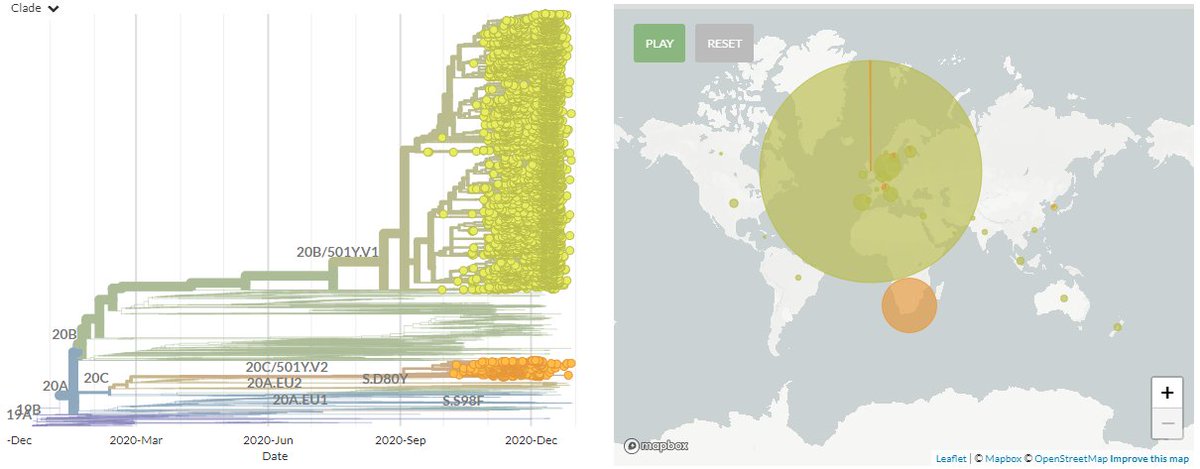
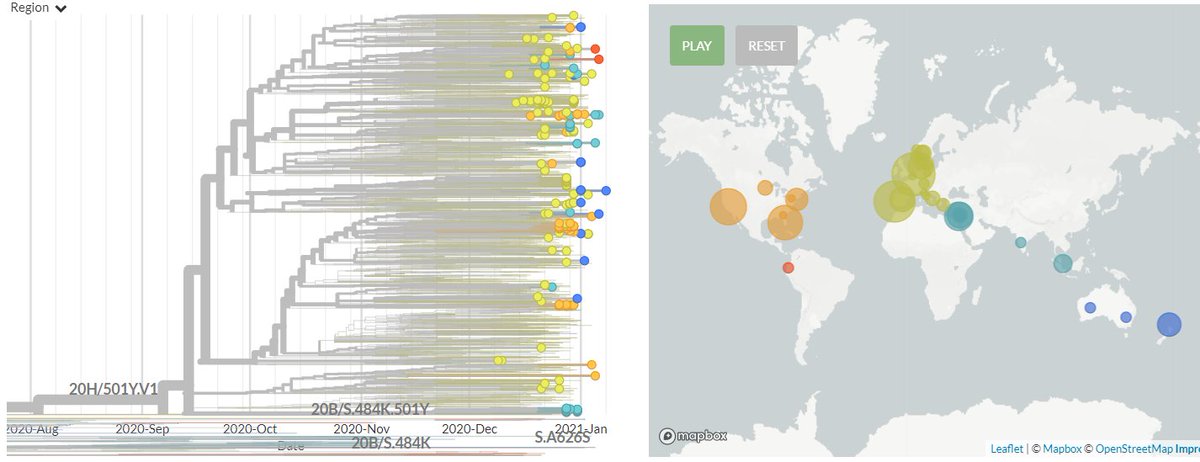
In the 501Y.V1 (B.1.1.7) variant, here are a few of the non-UK countries with new sequences in this variant, including Denmark, Italy, Spain, France, Portugal, Norway, Germany, the USA, South Kora, & Switzerland, & the UAE, Austria, & Czech Republic for the 1st time

2/18
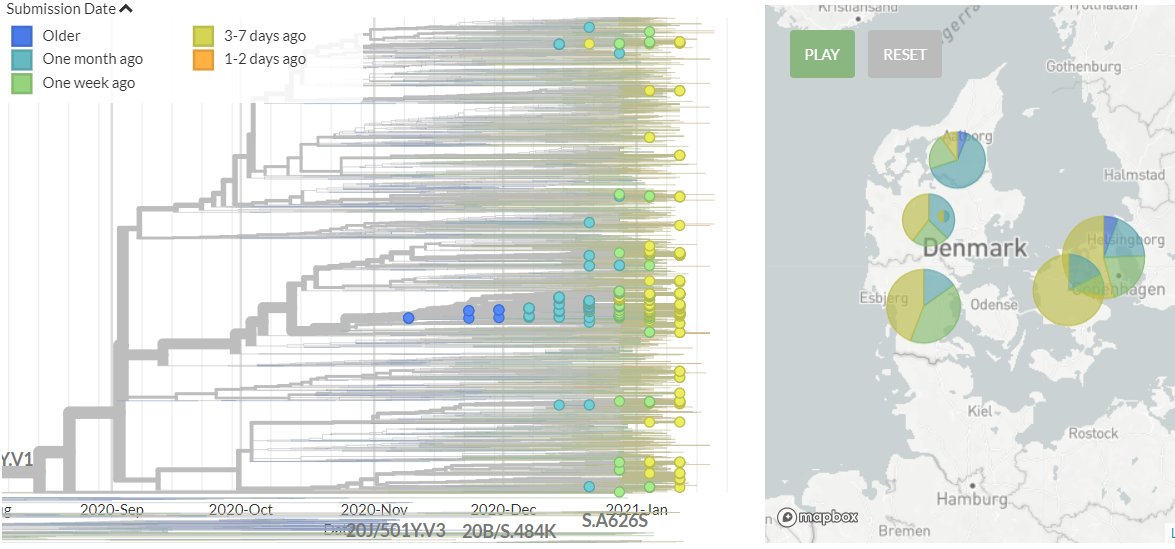
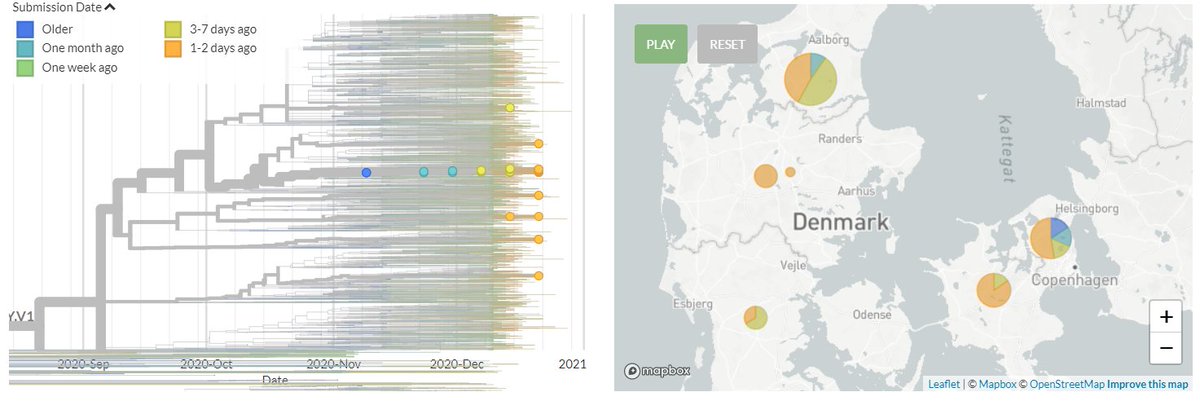
Denmark has 52 new samples (some yellow), showing both separate introductions and further spread of existing local clusters.

3/18
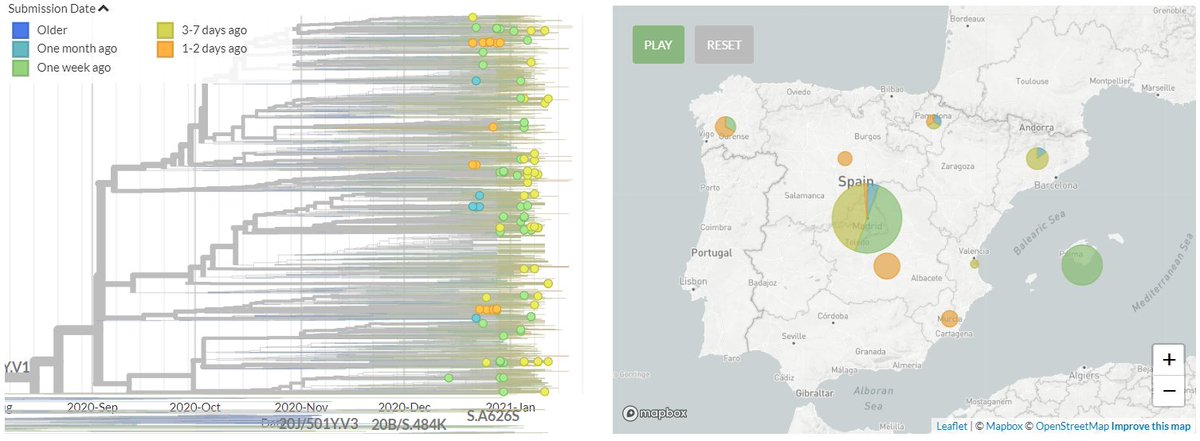
Spain has 62 new sequences (orange & yellow). Many of these are separate introductions, and a few new sequences form distinct clusters. Some new sequences also cluster closely with older sequences (green).

4/18
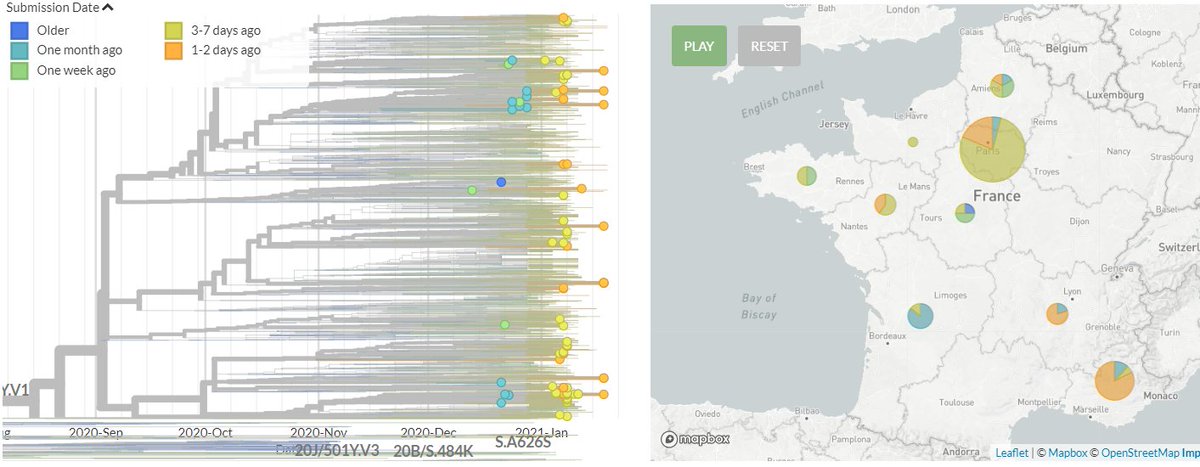
France has 72 new sequences (orange & yellow). These show both separate introductions and clustering with older sequences.

5/18
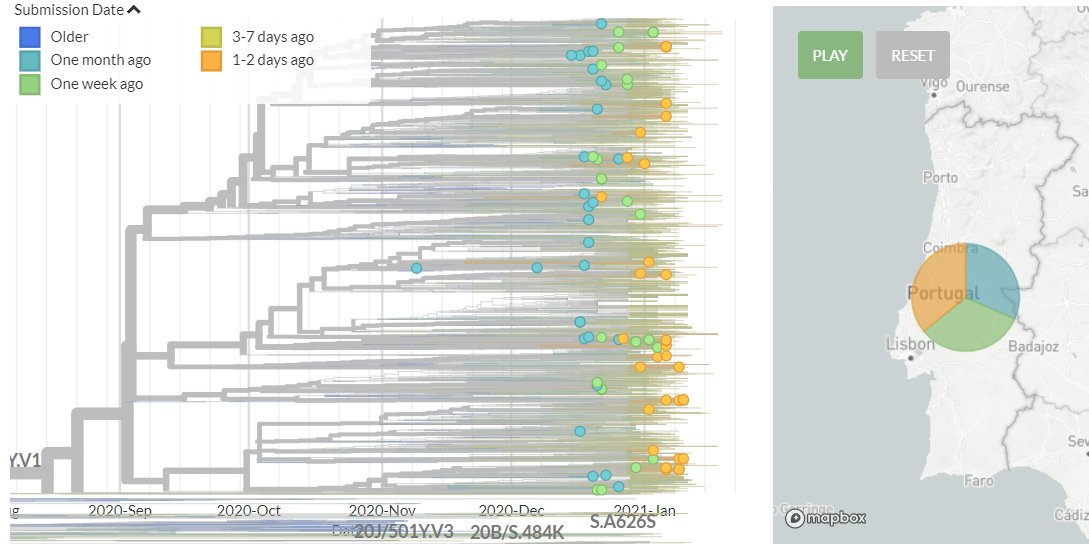
Portugal has 30 new sequences (orange), most of which are separate introductions, but some do connect with previous sequences.

Norway has 10 new sequences (yellow). Most of these seem to be separate introductions.

6/18
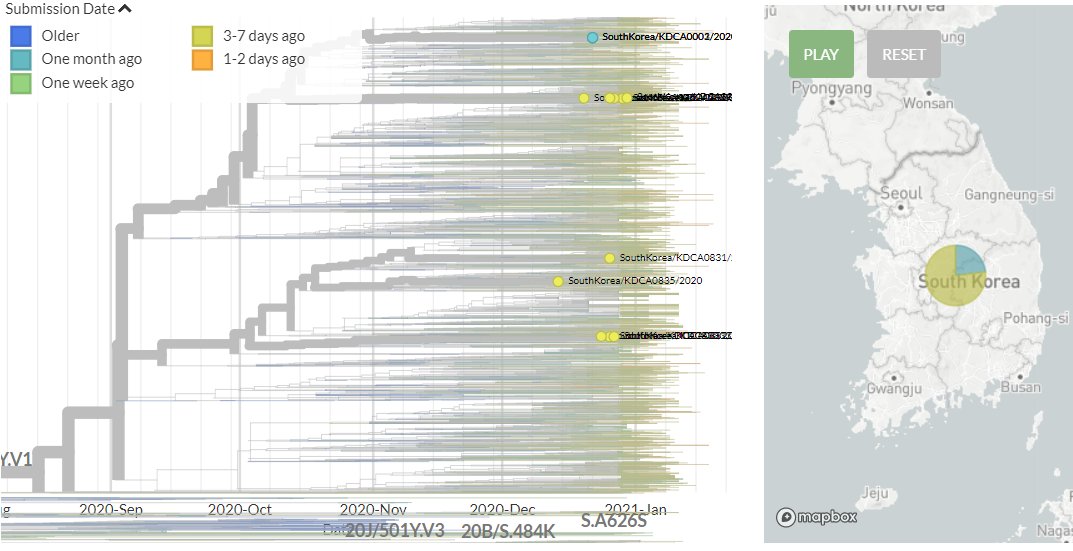
There are 10 new sequences from South Korea (yellow). These are separate introductions, but some of the new seqs cluster, which could indicate local transmission or a common exposure source.

7/18
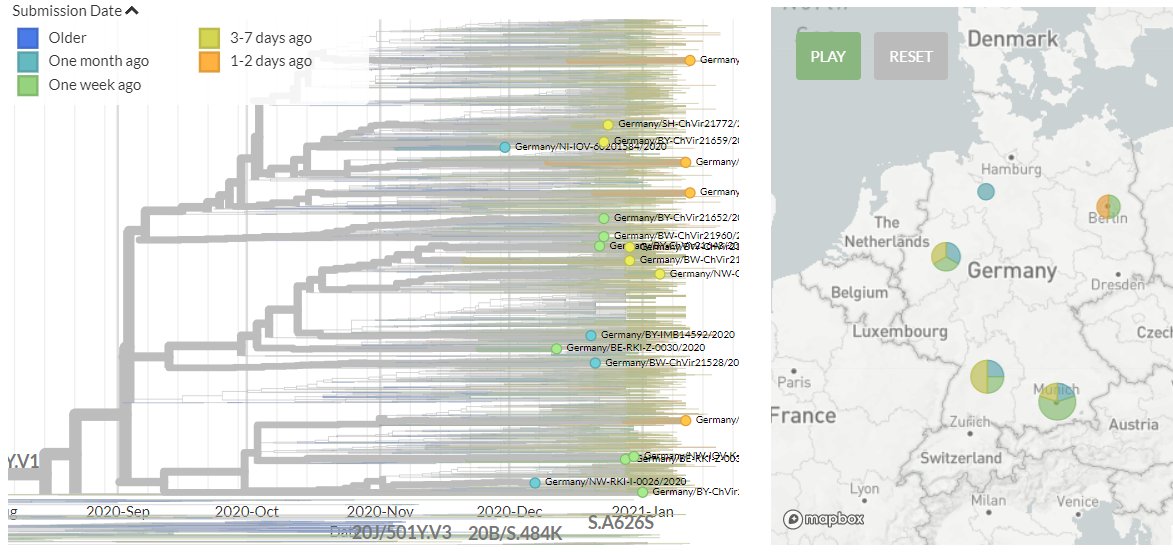
Germany has 9 new sequences (orange & yellow), which indicate separate introductions.

8/18
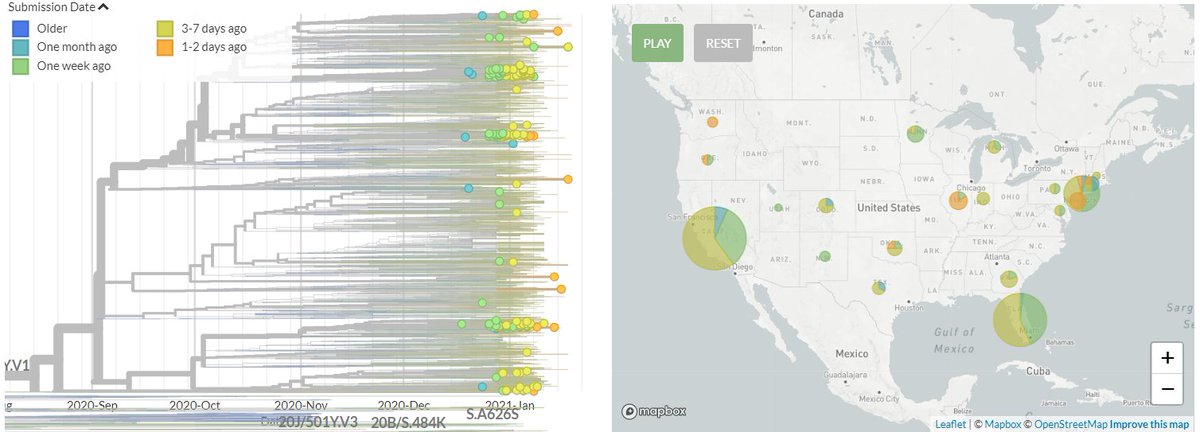
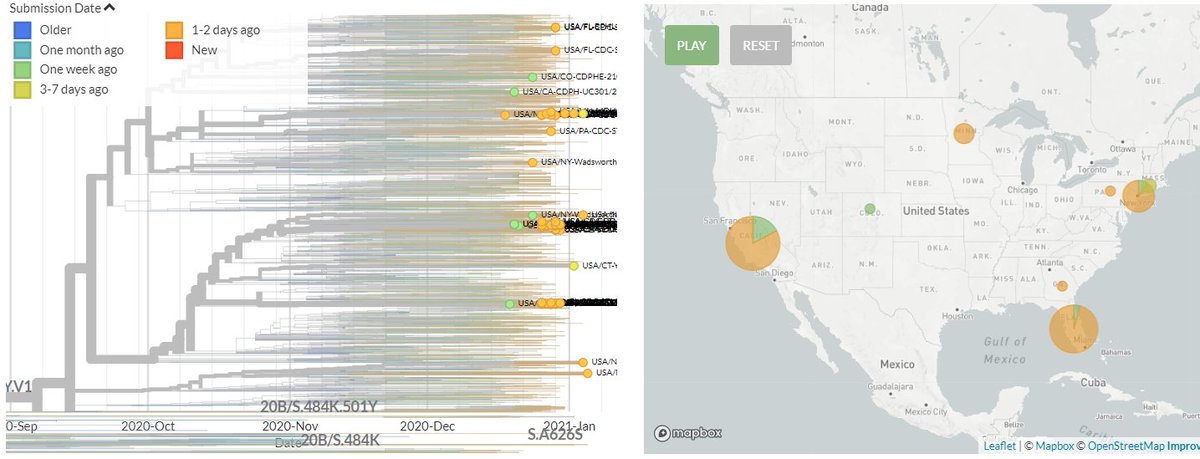
The USA has 123 new sequences (orange & yellow). Many of these do cluster with older sequences and seem to indicate ongoing local transmission.

9/18
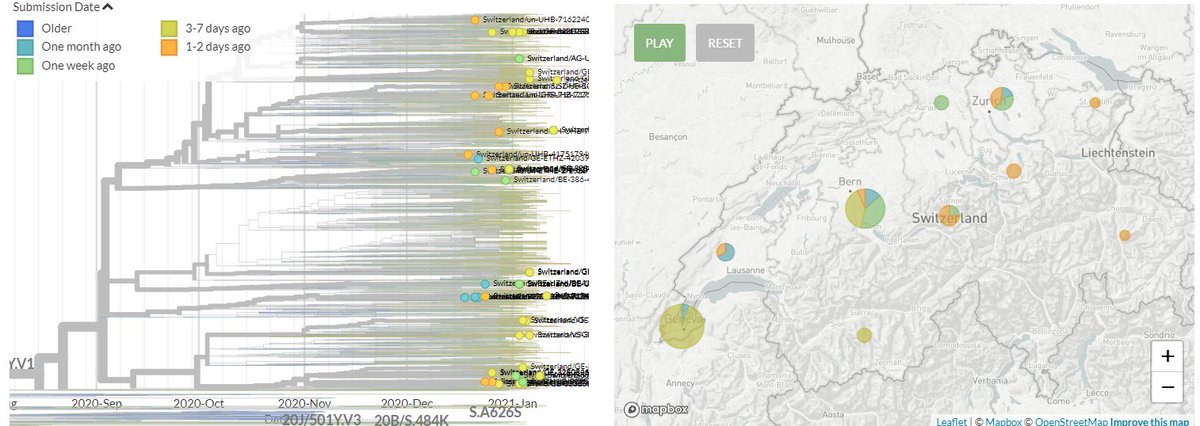
Switzerland has 30 new sequences (yellow & orange), many of which indicate separate introductions.

10/18
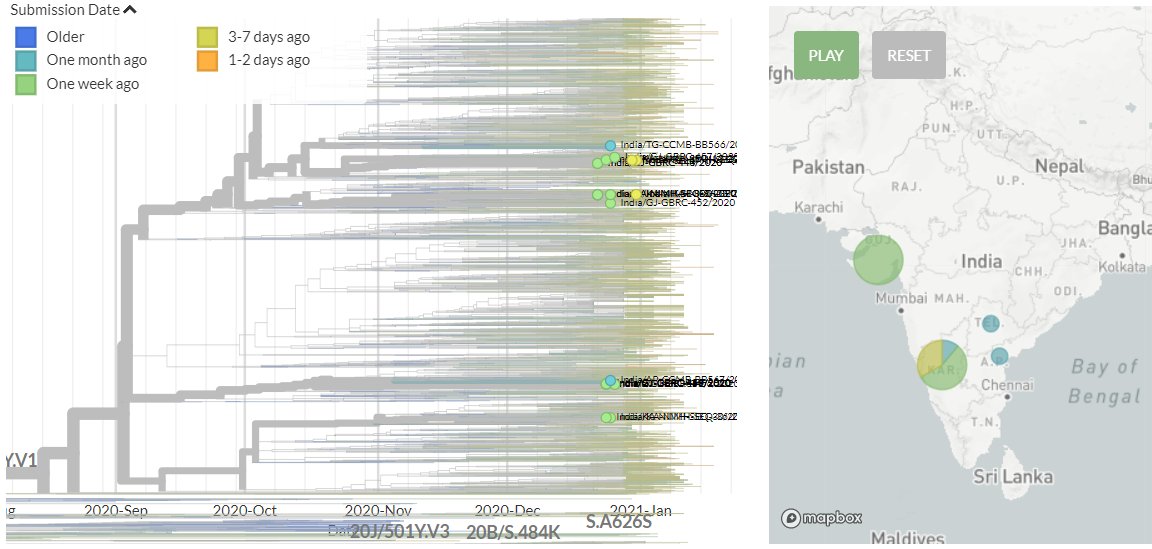
India has 3 new sequences (yellow). These connect to older sequences, which may indicate local transmission or a common exposure source.

11/18
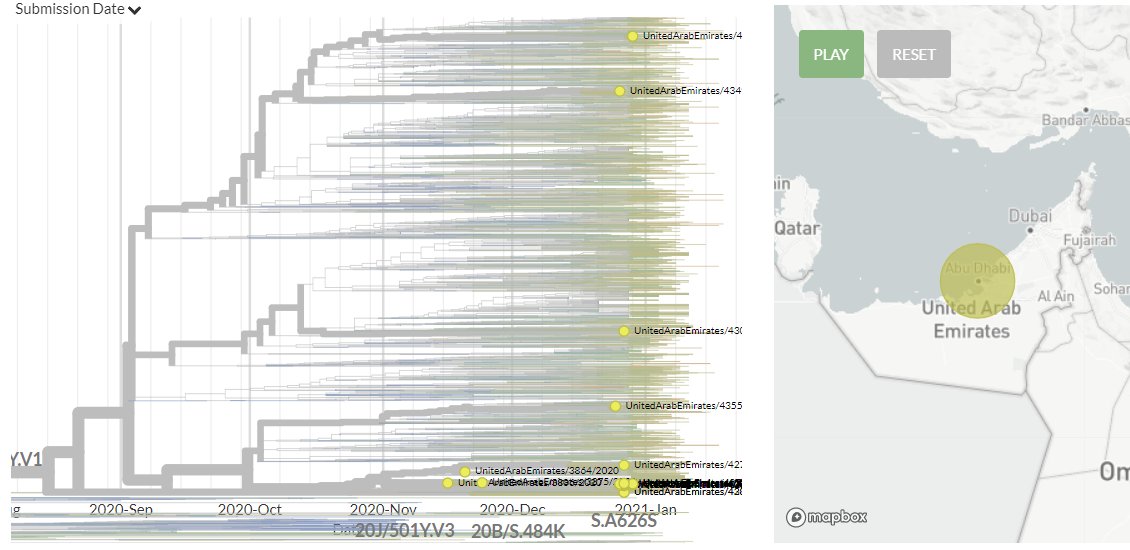
United Arab Emirates has 21 sequences for the first time. Many show independent introductions, but some form a large cluster that is likely local transmission.

12/18
The Czech Republic has 10 sequences for the 1st time and Austria has 41 sequences for the 1st time.

All the Czech & many of the Austrian seqs fall in 1 cluster each, likely indicating local transmission. These clusters are near each other & connected to Slovakian seqs.

13/18
In 501Y.V2, there are new sequences from Germany, Denmark, Spain, the United Arab Emirates, and Belgium.

14/18
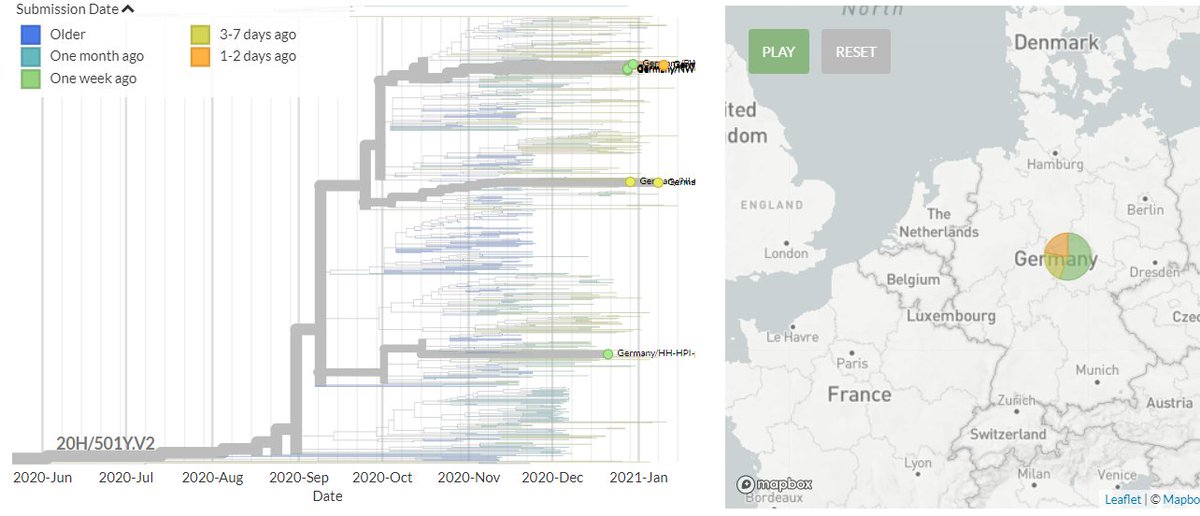
Germany has 4 new sequences (yellow & orange). Some indicate a new introduction, others link to an older sequence.

15/18
United Arab Emirates has 5 sequences for the first time, showing multiple introductions.

16/18
Belgium has 6 sequences for the first time, showing multiple introductions.

Denmark and Spain also have sequences for the first time.

17/18
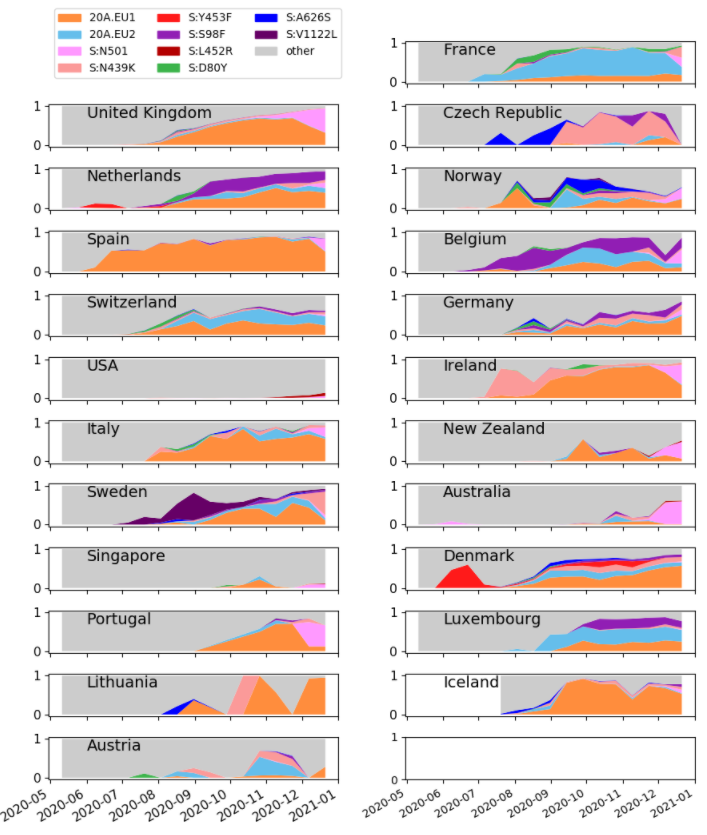
As always, the country plot table is now updated - as usual, be careful interpreting, as sequencing is often still biased toward "S-drop-out" & S:N501 samples, meaning frequencies are not representative.

18/18

https://t.co/c7wlQOLRiq

More from Dr Emma Hodcroft

Lots of tweets about this today!
Let's see what we can see in the focal S:E484 build!

Phylogenetics (what I do - making 'family trees' from virus genetics) can be very informative to see how different variants are spreading, and how cases

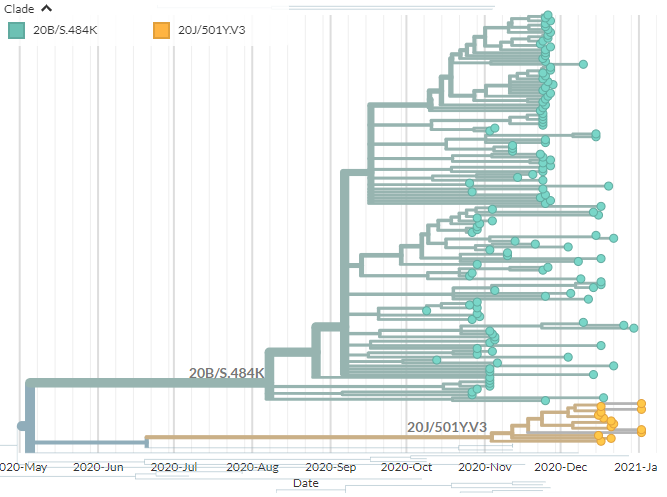
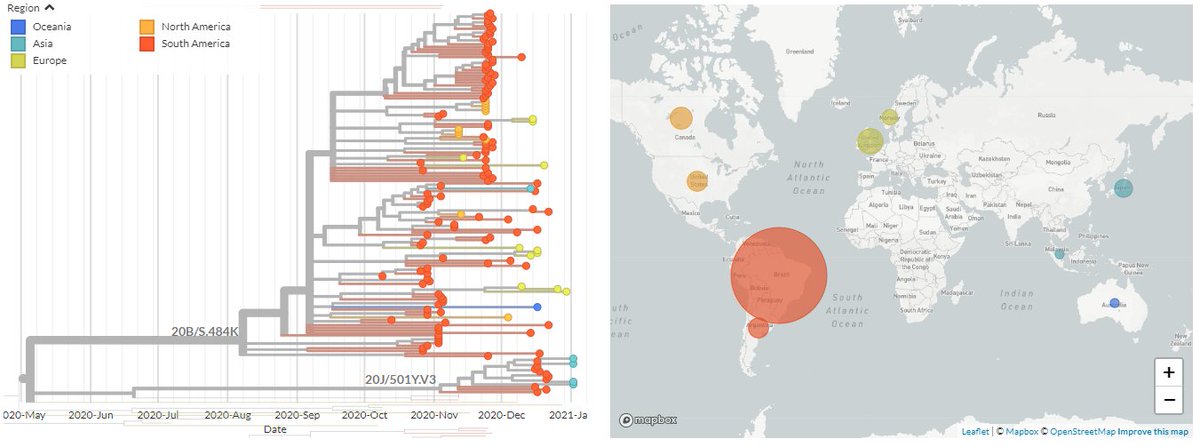
There are two variants circulating predominantly in Brazil:
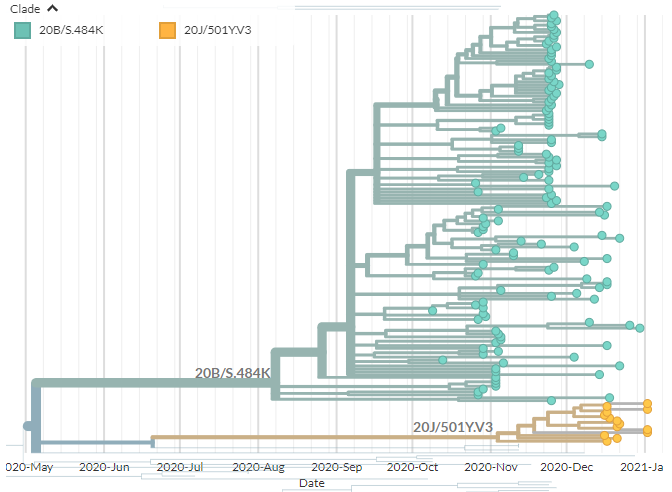
- 20B/S.484K seems to be older & more widespread. It has (among others) a mutation at position 484
- 20J/501Y.V3 is smaller & detected recently. It has mutations at 501 *and* 484.

2/10

https://t.co/Cw5u2kuATa


The variant predominantly in the UK (501Y.V1 / B.1.1.7) and the variant predominantly in South Africa (501Y.V2) also both have 501. 501Y.V2 *also* has the 484K mutation.

Why are there concerns about these mutations? You can read more at https://t.co/wVE7ubYBoy!

3/10


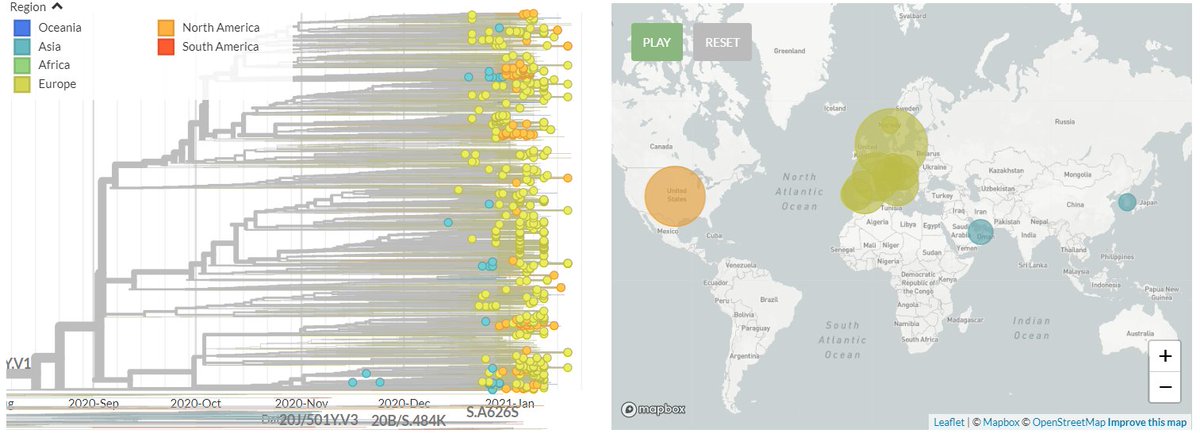
The view below is from an analysis focusing on sequences with a mutation at 484. It shows all the samples in the 2 variants (20B/S.484K & 20J/501Y.V3) & how they're related. More closely related = closer together (very, very roughly).

4/10


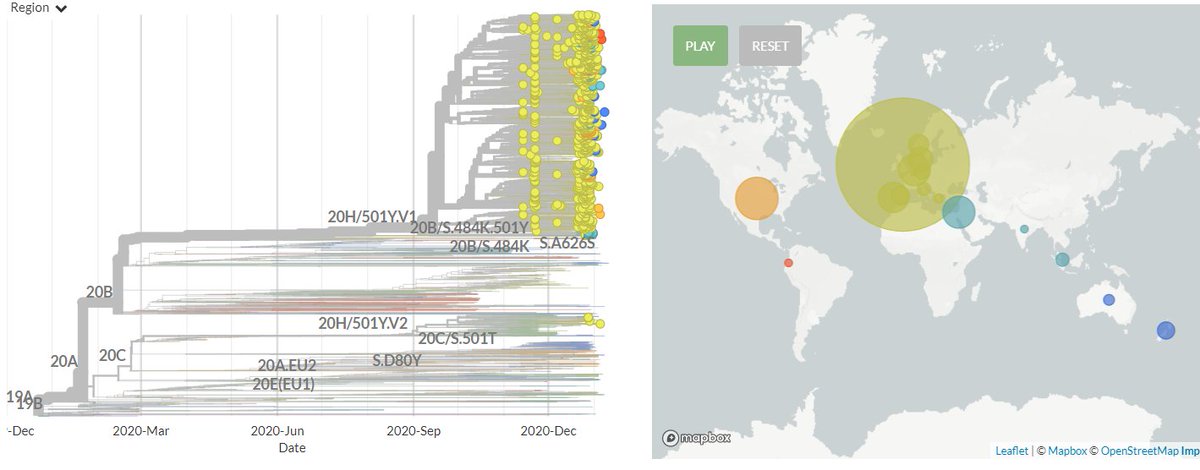
We can colour these samples by region to see where they're from. As we expect - most are in Brazil! A few are in Argentina (also red).

5/10

https://t.co/Cw5u2kuATa
Each day brings new challenges, but here's an update to the dedicated S.N501 build, using data from 6 Jan 2021 to keep you going.

There are 42 new non-UK sequences in 501Y.V1 (B.1.1.7) & 7 new non-South-African sequences in 501Y.V2.

1/14

https://t.co/kT1gFsSZn0


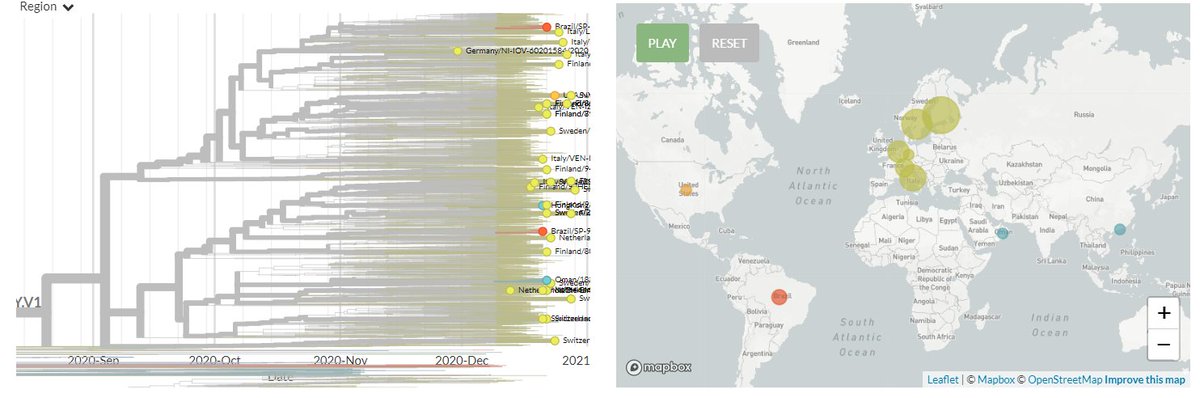
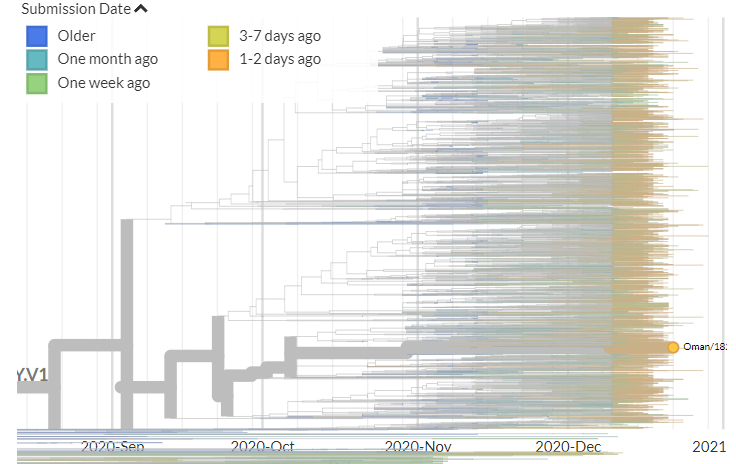
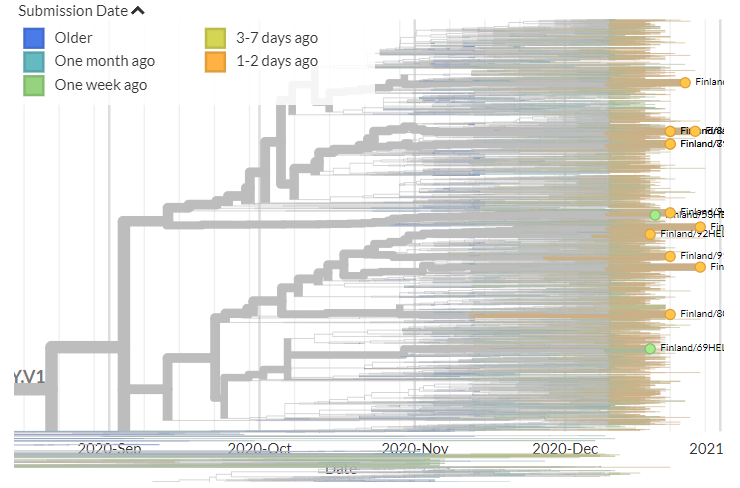
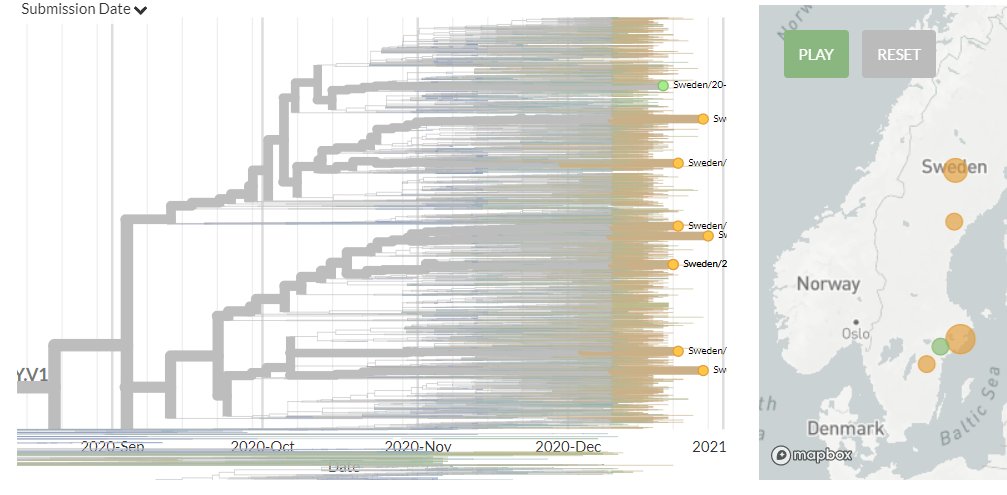
There are 42 new non-UK sequences in 501Y.V1 from the Netherlands, Italy, Hong Kong, Finland, Sweden, Germany, USA, Switzerland, Brazil, and the first sequence from 501Y.V1 in Oman.

https://t.co/XA8VR8HiEq

2/14


Oman has their first sequence which falls into 501Y.V1:

3/14


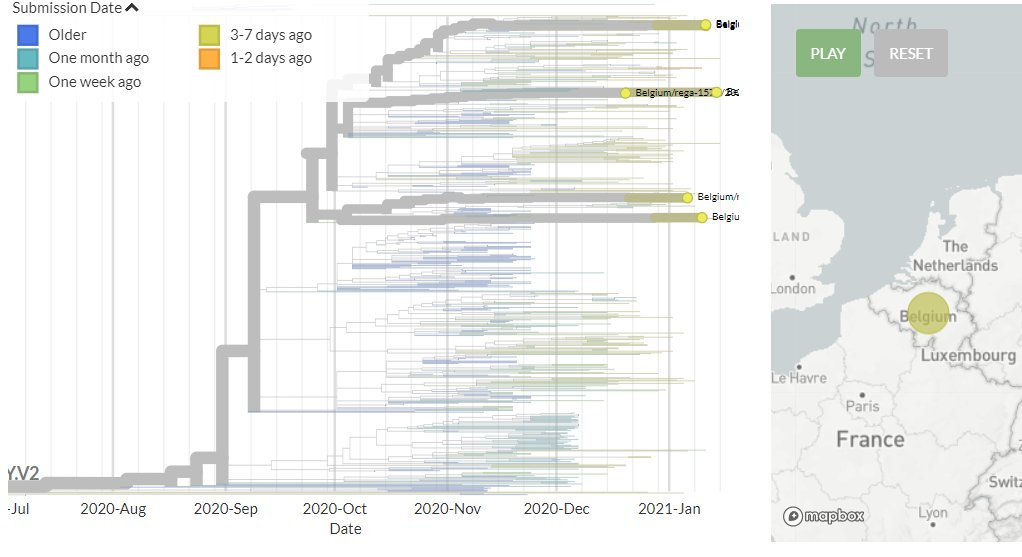
Finland has 12 new sequences (orange), which mostly represent separate introductions. Zooming in (divergence view), we can see 3 of the new sequences are identical (red), which may indicate the cases are connected.

4/14


Sweden has 8 new sequences (orange), which indicate separate introductions.

5/14

More from For later read

Daily Bookmarks to GAVNet 02/12/2021

Quantum causal loops

https://t.co/emX8OxKPl0

#loops #quantum

Large-scale commodity farming accelerating climate change in the Amazon

https://t.co/v3gA7OTP9E

#ClimateChange #forest #farm

Collapsed glaciers increase Third Pole uncertainties: Downstream lakes may merge within a decade

https://t.co/huAma56KeB

#glacier #lakes #ClimateChange

From trash to treasure: Silicon waste finds new use in Li-ion batteries

https://t.co/TkxKFDQMC6

#batteries #treasure #silicon #trash

You May Also Like

@EricTopol @NBA @StephenKissler @yhgrad B.1.1.7 reveals clearly that SARS-CoV-2 is reverting to its original pre-outbreak condition, i.e. adapted to transgenic hACE2 mice (either Baric's BALB/c ones or others used at WIV labs during chimeric bat coronavirus experiments aimed at developing a pan betacoronavirus vaccine)

@NBA @StephenKissler @yhgrad 1. From Day 1, SARS-COV-2 was very well adapted to humans .....and transgenic hACE2 Mice


@NBA @StephenKissler @yhgrad 2. High Probability of serial passaging in Transgenic Mice expressing hACE2 in genesis of SARS-COV-2


@NBA @StephenKissler @yhgrad B.1.1.7 has an unusually large number of genetic changes, ... found to date in mouse-adapted SARS-CoV2 and is also seen in ferret infections.
https://t.co/9Z4oJmkcKj


@NBA @StephenKissler @yhgrad We adapted a clinical isolate of SARS-CoV-2 by serial passaging in the ... Thus, this mouse-adapted strain and associated challenge model should be ... (B) SARS-CoV-2 genomic RNA loads in mouse lung homogenates at P0 to P6.
https://t.co/I90OOCJg7o
THREAD: 12 Things Everyone Should Know About IQ

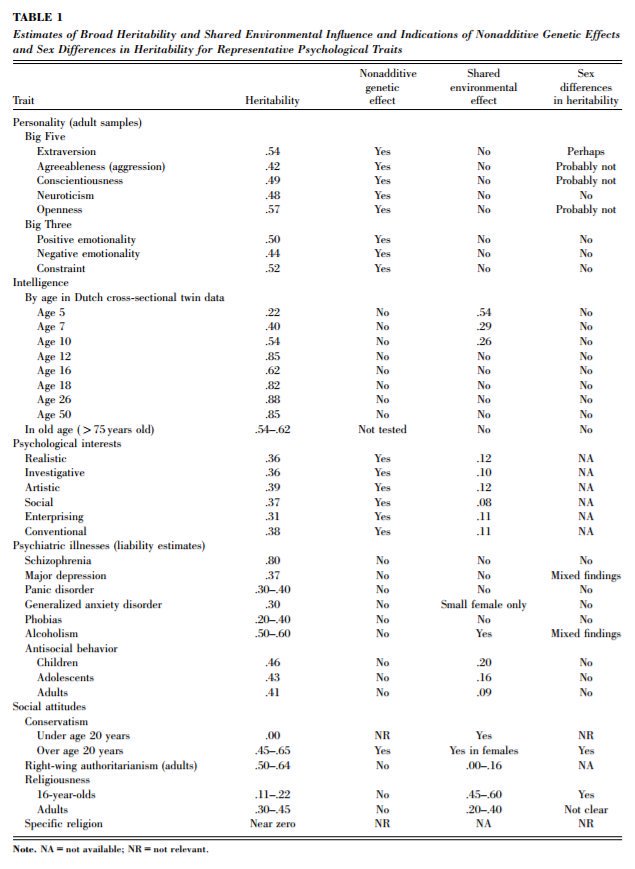
1. IQ is one of the most heritable psychological traits – that is, individual differences in IQ are strongly associated with individual differences in genes (at least in fairly typical modern environments). https://t.co/3XxzW9bxLE


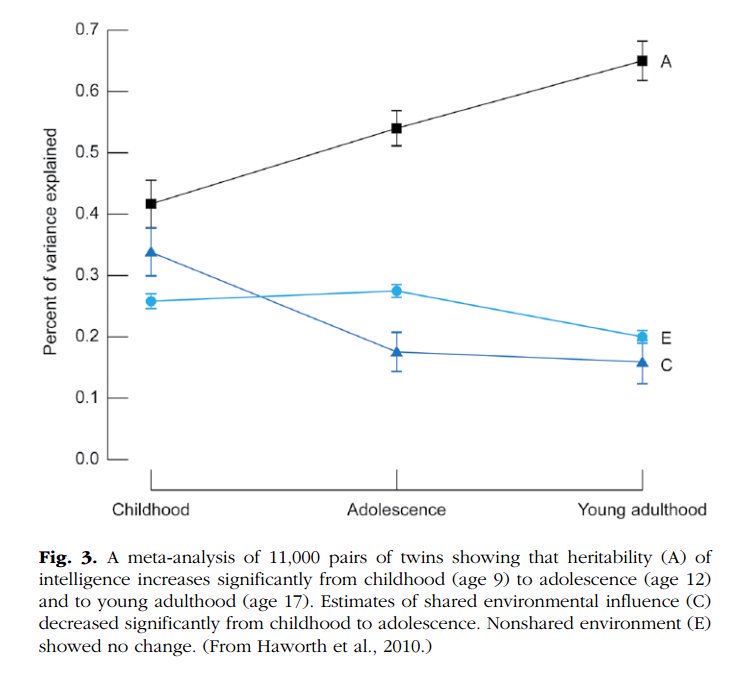
2. The heritability of IQ *increases* from childhood to adulthood. Meanwhile, the effect of the shared environment largely fades away. In other words, when it comes to IQ, nature becomes more important as we get older, nurture less.
https://t.co/UqtS1lpw3n


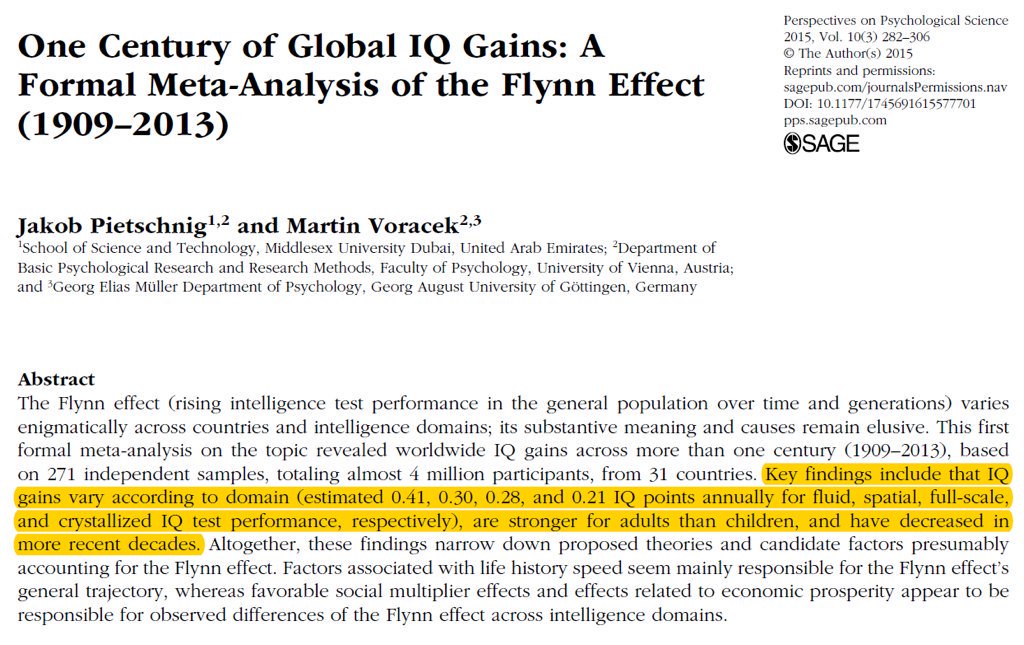
3. IQ scores have been increasing for the last century or so, a phenomenon known as the Flynn effect. https://t.co/sCZvCst3hw (N ≈ 4 million)

(Note that the Flynn effect shows that IQ isn't 100% genetic; it doesn't show that it's 100% environmental.)


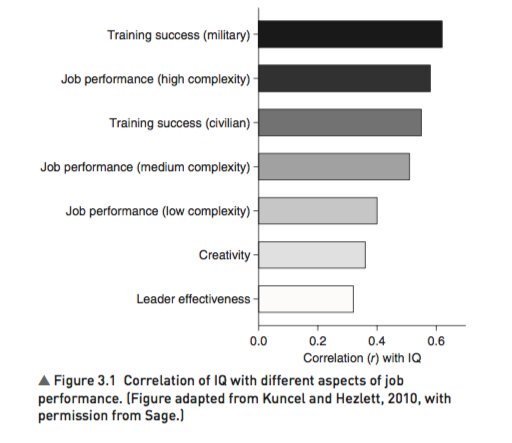
4. IQ predicts many important real world outcomes.

For example, though far from perfect, IQ is the single-best predictor of job performance we have – much better than Emotional Intelligence, the Big Five, Grit, etc. https://t.co/rKUgKDAAVx https://t.co/DWbVI8QSU3


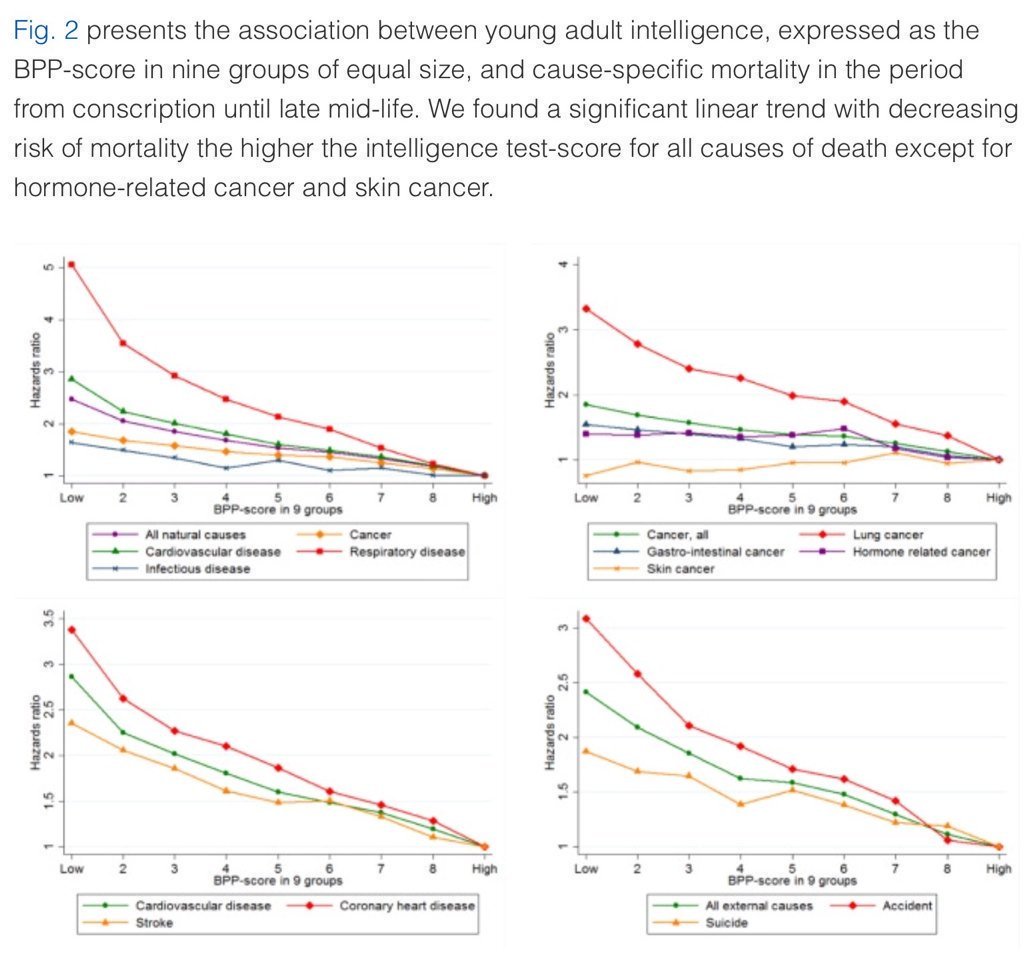
5. Higher IQ is associated with a lower risk of death from most causes, including cardiovascular disease, respiratory disease, most forms of cancer, homicide, suicide, and accident. https://t.co/PJjGNyeQRA (N = 728,160)