Weird feeling. After 10.5 years and roughly £21,000 of debt- I finally paid off the last instalment of my student loan today.

Next month, for the first time- I’ll receive my full post tax salary, for the first time since I graduated.

Sharing as an example of how the system works in practice. In truth I only seriously started paying off the capital in the last few years, when I started to earn a good salary, paying roughly £400 a month off. I suspect many will never significantly eat into the capital.
That’s especially the case for those those under the new regime, who have over £50k of debt. I was lucky in a) lower fees (3k not 9k) and maintenance grant (not loan) still existed.

Indeed IFS forecasts that 83% of students from PST 2012 reforms won’t fully pay back their loan.
Of course those who don’t pay off their fees, the cost will eventually have to be absorbed by the Treasury. Having 17% pay back all and the rest some will still be cheaper for HMT than no loans at all. But we should recognise the a) odd conceit that we have a system of loans...
...which the vast maj will never pay back and that instead b) that graduates are paying in effect a topped up rate of income tax for many, many years.
There are two other things to say about the system 1) the fact of this topped up income tax is another burden for graduates trying to accumulate capital for buying a house/save for a pension etc 2) there is an inequity issue. Wealthier students often receive support...
...from family to reduce (or eliminate) their loans. With George Osborne’s abolition of the maintenance grant (and replacement with another loan) that inequity has become greater. Poorer students start working life as poorer graduates...
...taking home less of their salary than their more privileged counterparts.

Of course, HE has to be paid for and graduates pay according to their ability to do so (as their salary goes up). But as I say, important to see the system for what it is and how it works in practice.
Graduates graduating today will often have over £50k of debt. An enormous figure especially when one considers their experiences of late and labour market they’re graduating into.
Even when things get better and *some* get good salaries it will take them many, many years- paying a big chunk of their post tax salaries to get into any position of paying it off.

The rest will likely have it hovering over them, in one form or another, until their 50s.
I have no complaints. I have a good job and benefitted hugely from my degree. That said, for the present cohort and that of the last few years there remain questions about a) intergenerational equity b) equity within their generation (for reason identified above)...
...c) sustainability of the student loan book long term. Truth is many politicians have in effect simply deferred the long term cost to the public purse to the decades hence, when many fail to repay. And who will have to deal with that? Ah yes- the grown up students.
To expand on this point for those asking- effectively we have created a system where the same two graduates, earning the same salary, in the same job might have quite substantially different take home pay. And that will most likely be as a result of their family background. https://t.co/nArHkMdQl0
And I should mention something about interest. I paid a lower rate of interest than current students. For those starting in 2020 in England and Wales their rate of interest is 5.6%. So a third year student who owes £30,000 will have £1,680 added to their debt this year.
Therefore, many students will find the capital they owe, even when in work, going up, not down.
You might ask whether that on top of the de facto graduate tax the Plan 2 students are paying, the very large capital sums they must repay, whether an interest rate of 5.6% makes any prospect of repayment, for all those outside the very top jobs, remotely credible.
As a result of the interest, many graduates work for years while their stock of debt goes *up*

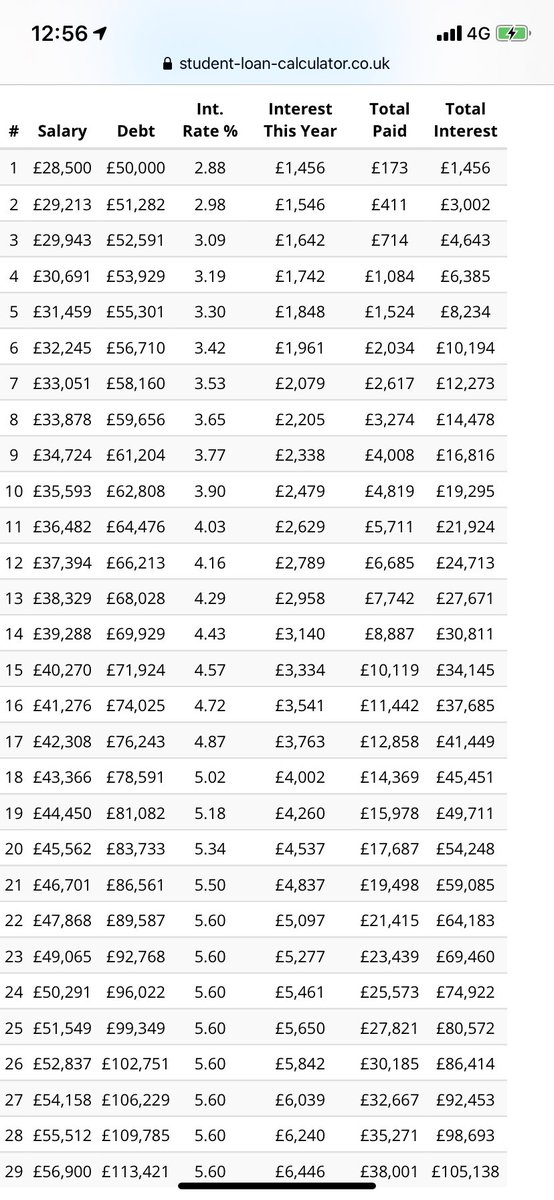
So let’s take a graduate on Plan 2 with a debt of £50k and a v respectable starting salary of £28,500.

Despite a good, rising salary their debt *never goes down*. Rises to £113k.
The system I was on (Plan 1) I think can (just) accurately be called a student loan system. The fees were much lower, the maintenance grant still exist to leaven some inequalities and the interest was lower.

For Plan 2 (since 2012) those things are no longer the case.
I’m not saying whether the contributory principle is right or wrong, that’s for others to argue about: what I’m saying is that in particular, post-2012, we in fact have a de facto graduate tax. There’s no realistic prospect of many graduates paying back the stock of debt...
...and so it is, in effect, an extra income tax levy which will exist on graduates for 30 years. The debt will simply escape them and payments continue. I suspect older generations are ignorant of how the system operates in reality simply because they’ve never experienced it.
The fact that it is a de facto graduate tax generates all sorts of policy questions and it’d be better for the graduates and for policy makers to recognise it and treat it as such.

End.

More from Lewis Goodall

Some quick thoughts on what we just saw

Firstly hardly a unique insight but hard to overstimate the difference between the two last inaugurals. America has meandered sharply along its political arc.

Biden's rhetoric reached high. Every sentence seemed purposefully...


...constructed to negate every political and personal characteristic of his predecessor.

And insofar as he's not Trump, that he does accept, cherish and understand democratic norms, institutions and conventions in a way that Trump never could, Biden will make a real difference.

He will change the tone and tenor of politics, not only in America but across the West. As I've said before, just replacing Trump is a substantial victory for him and will earn him praise from historians.

But that aura will disappear quickly. A governing project it will not make

But how much praise he receives and stature conferred by posterity will depend on what happens next.

Because the big overarching question for me, watching this, is which of those two inaugurals, Trump or Biden's, is going to seem unusual in the future.

The relief that many are feeling is predicated on a type of politics ending. But it is at least as possible that it is Biden ..not Trump who is the last gasp of something. Is it Trump who is the dying embers of a dying, increasingly powerless old white America...

More from Finance

1/ I'm thrilled to announce the launch of my new website, a one-stop shop for all the content I'm creating.

There you'll find links to all my podcasts, the TTMYGH newsletter, and other exciting future projects.

2/ In 2020, I reignited my passion for interviewing brilliant people by launching The Grant Williams Podcast in various forms, including The End Game, The Super Terrific Happy Hour, and The Narrative Game.


3/ Starting February 1, I'm taking the bold step of moving these podcasts completely behind a paywall.

For the very affordable price of only $10 a month, listeners can gain access to the Copper Tier of
https://t.co/fxUfH8maI4, which includes all current & future podcasts.


4/ Why am I doing this? First and foremost, I aspire to create VALUABLE content. By definition, if something is priced at $0, it isn’t valuable. The time, effort and creativity that goes into these episodes is substantial. To keep doing them properly, they can no longer be free.

5/ I also strongly believe content creators should be able to make a living creating content. If everything is free, that’s not possible. I never seriously considered accepting outside sponsors – complete integrity is too critical to me.
THREAD: Who are the rising stars of Chinese elite politics in the central Party-State bureaucracy?

For @MacroPoloChina I analyzed last year's ministerial-level promotions to posts in Beijing

TLDR: Ties to Xi Jinping—or a Xi ally—are very helpful! (1/14)

https://t.co/kO2A0Efyq2


Seven politicians were promoted to ministerial-level positions in central Party agencies last year

All are likely to feature on the next Central Committee selected at the 2022 Party Congress

Some could make the CCP's elite 25-person Politburo (2/14)

https://t.co/kO2A0Efyq2


Likeliest for the Politburo is Meng Xiangfeng, new Executive Deputy Director of the CCP General Office

He would replace Xi ally Ding Xuexiang as CCP chief-of-staff if Ding is promoted further in 2022

Meng worked under Xi allies Cai Qi in Hangzhou and Chen Xi in Liaoning (3/14)


Less likely for the Politburo but still important is Jiang Jinquan, new Director of the CCP Policy Research Office

He replaces 5th-ranked leader Wang Huning who led the Party's brains trust for 18 years

Wang remains prominent and will be <68 in 2022, so he'll stay around (4/14)


Other notable central Party promotions include Li Shulei and Liang Yanshun, who both assisted Xi when he led the Central Party School from 2007-2012

Li is a political conservative who is said to be quite close with Xi, even drafting his 2014 speech on culture and art (5/14)

You May Also Like

THREAD: 12 Things Everyone Should Know About IQ

1. IQ is one of the most heritable psychological traits – that is, individual differences in IQ are strongly associated with individual differences in genes (at least in fairly typical modern environments). https://t.co/3XxzW9bxLE


2. The heritability of IQ *increases* from childhood to adulthood. Meanwhile, the effect of the shared environment largely fades away. In other words, when it comes to IQ, nature becomes more important as we get older, nurture less.
https://t.co/UqtS1lpw3n


3. IQ scores have been increasing for the last century or so, a phenomenon known as the Flynn effect. https://t.co/sCZvCst3hw (N ≈ 4 million)

(Note that the Flynn effect shows that IQ isn't 100% genetic; it doesn't show that it's 100% environmental.)


4. IQ predicts many important real world outcomes.

For example, though far from perfect, IQ is the single-best predictor of job performance we have – much better than Emotional Intelligence, the Big Five, Grit, etc. https://t.co/rKUgKDAAVx https://t.co/DWbVI8QSU3


5. Higher IQ is associated with a lower risk of death from most causes, including cardiovascular disease, respiratory disease, most forms of cancer, homicide, suicide, and accident. https://t.co/PJjGNyeQRA (N = 728,160)