Terry Smith is often referred to as "the English Warren Buffett".

He runs Fundsmith which has a fund size of £27.9bn.

Despite the size, Fundsmith did a CAGR of 18.4%.

In his book Investing for Growth, he explains his investing philosophy.

Here's a breakdown:

1. Fundsmith's winning formula

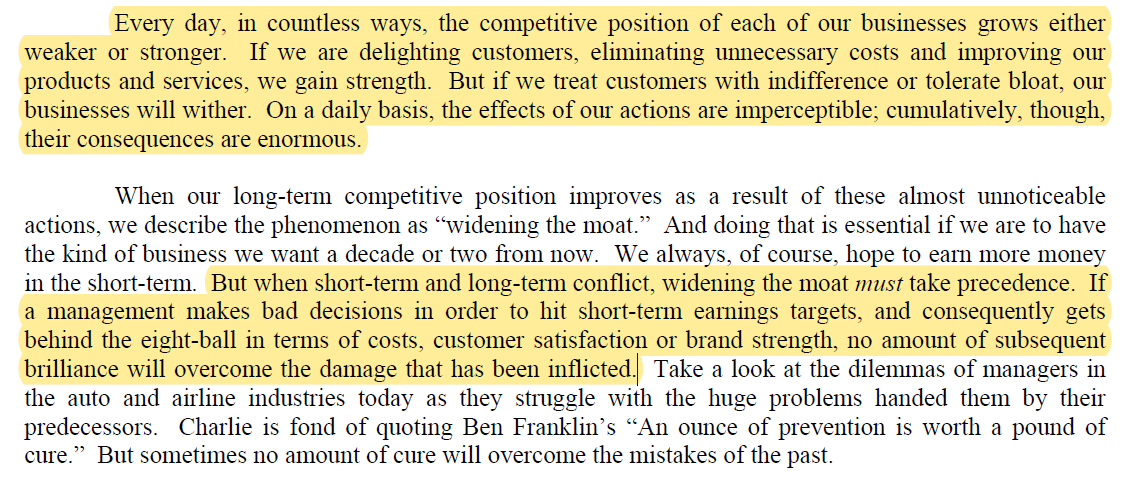
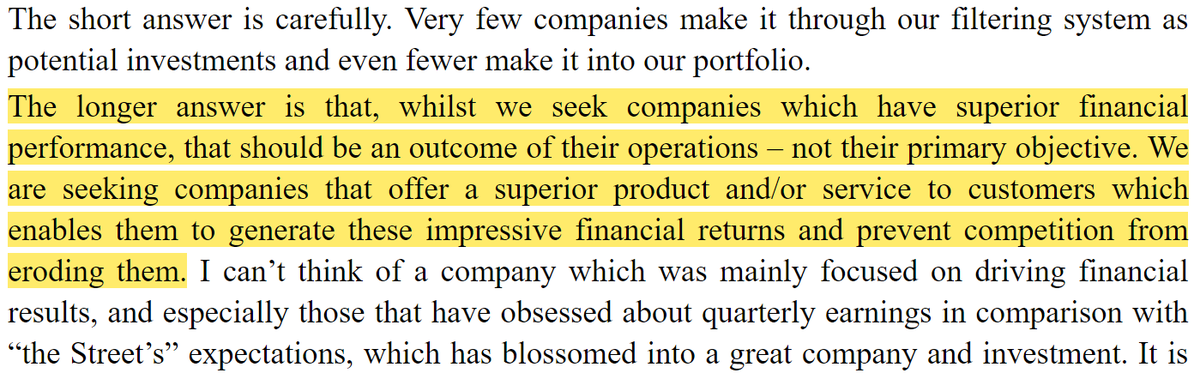
Find companies that focus on delivering value.

Not those who are looking to pacify Wall Street with short-term results.
2. Avoiding "cheap" companies?

Low multiples are not a reason to buy a company.

A ship will continue to sink if it has a hole in it.

"A stock may have a low valuation but an even lower intrinsic value. Buying such a stock is not a recipe for investment success."
3. Getting quality right

For long-term investors, getting the quality of the business is more important than the valuation.

“An investor could have paid 281 times earnings for L’Oréal, 156 times for Colgate, and 147 times for Brown-Forman and still beat the market.”
4. "Unprofitable" companies could be good investments

Many of the best companies don't show earnings today.

But that's because they're heavily reinvesting for the future.

It's just that the earnings hasn't show up.
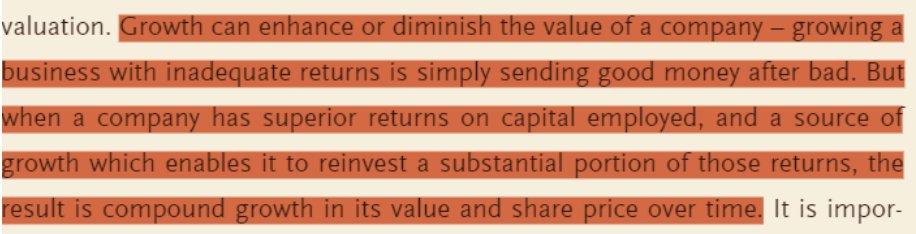
5. Not all growth are good

Growth is good only when the return on invested capital (ROIC) exceeds the cost of capital (COC).

If COC > ROIC, the company destroys value as it grows.
6. On share buybacks

A repurchase only creates value if the shares are trading below intrinsic value and there is no better use for the cash.
7. On price anchoring

Often times investors hold back from buying because they "missed the boat".

Or they're waiting for it to "retrace back".

If it's a good company and within your buy range, just buy it.
8. 10 advice for retail investors

-If you don't fully understand it, don't invest
-Don't try to time the market
-Minimize fees
-Deal as infrequently as possible
-Don't over-diversify
-Never invest just to avoid tax
-Never invest in poor-quality companies
-Buy shares in a business which can be run by an idiot
-Don't engage in "greater fool theory"
-If you don't like what's happening to your shares, switch off the screen
If you like this, follow me here @steadycompound

I write about investment concepts, business breakdowns and growth philosophies.
If you have enjoyed this thread, you're gonna love my newsletter where I curate 3 ideas on investing and growth philosophies.

Every week.

https://t.co/96pjE7aGBm

More from Thomas Chua

Having a finance degree did not make me a better investor.

Rather, I learned 10x more about investing from Twitter University.

🧵 Here are 5 threads from world-class Fintwitters.

What you learn: Build an investing checklist.

From: @BrianFeroldi, writer at Motley


What you learn: Read 10Ks like a Hedge Fund

From: @FabiusMercurius


What you learn: Perform a DCF analysis.

From: @10kdiver


What you learn: When to sell your stocks

From: @borrowed_ideas, founder at

More from Finance

I'm lucky to attain financial freedom before 30.

I credit Fintwit for my learnings.

Here's 10 key concepts every investor must know:

1. $$ needed to retire
2. Researching a business
3. Reading annual reports
4. Reading earnings calls
5. Criteria of a multi bagger

(Read on...)

6. Holding a multi bagger
7. Economic moats
8. When to buy a stock
9. Earnings vs cashflow
10. Traits of quality companies

Here's my 10 favourite threads on these concepts:

1. How much $$ do you need to retire

Before you start, you must know the end game.

To meet your retirement goals...

How much $$ do you need in your portfolio?

10-K Diver does a good job explaining what's a safe withdrawl rate.

Hint: It's NOT


2. Research a business

Your investment returns are a lagging indicator.

Instead, your research skills are the leading predictor of your results.

Conclusion?

To be a good investor, you must be a great business researcher.

Start with


3. Reading annual reports

This is the bread and butter of a good business analyst.

You cannot just listen to opinions from others.

You must learn to deep dive a business and make your own judgments.

Start with the 10k.

Ming Zhao explains it

You May Also Like

I just finished Eric Adler's The Battle of the Classics, and wanted to say something about Joel Christiansen's review linked below. I am not sure what motivates the review (I speculate a bit below), but it gives a very misleading impression of the book. 1/x


The meat of the criticism is that the history Adler gives is insufficiently critical. Adler describes a few figures who had a great influence on how the modern US university was formed. It's certainly critical: it focuses on the social Darwinism of these figures. 2/x

Other insinuations and suggestions in the review seem wildly off the mark, distorted, or inappropriate-- for example, that the book is clickbaity (it is scholarly) or conservative (hardly) or connected to the events at the Capitol (give me a break). 3/x

The core question: in what sense is classics inherently racist? Classics is old. On Adler's account, it begins in ancient Rome and is revived in the Renaissance. Slavery (Christiansen's primary concern) is also very old. Let's say classics is an education for slaveowners. 4/x

It's worth remembering that literacy itself is elite throughout most of this history. Literacy is, then, also the education of slaveowners. We can honor oral and musical traditions without denying that literacy is, generally, good. 5/x