
“Selling your winners and holding your losers is like cutting the flowers and watering the weeds.”
Peter Lynch averaged 29.2% annual return between 1977 to 1990.
His books One Up Wall Street and Beating the Street offered great insights into his success.
Here are my top 10 lessons from the legend:

“Selling your winners and holding your losers is like cutting the flowers and watering the weeds.”
“People who succeed in the stock market also accept periodic losses, setbacks, and unexpected occurrences. Calamitous drops do not scare them out of the game.”
"Owning stocks is like having children. Don't get involved with more than you can handle."
"There's no shame in losing money on a stock. Everybody does it. What is shameful is to hold on to a stock, or worse, to buy more of it when the fundamentals are deteriorating."
“This is one of the keys to successful investing: focus on the companies, not on the stocks.”
"While catching up on the news is merely depressing to the citizen who has no stocks, it is a dangerous habit for the investor."
"Never invest in any company before you've done the homework on the company's earnings, prospects, financial condition, competitive position, plans for expansion, and so forth."
"The stock market demands conviction as surely as it victimizes the unconvinced."
"In stocks – as in romance – ease of divorce is not a sound basis for commitment."
"If you can't find any companies that you think are attractive, put your money in the bank until you discover some."
• Investing.
• Business breakdowns.
• Company updates.
Every week.
https://t.co/96pjE7aGBm
More from Thomas Chua






Having a finance degree did not make me a better investor.
Rather, I learned 10x more about investing from Twitter University.
🧵 Here are 5 threads from world-class Fintwitters.
What you learn: Build an investing checklist.
From: @BrianFeroldi, writer at Motley
What you learn: Read 10Ks like a Hedge Fund
From: @FabiusMercurius
What you learn: Perform a DCF analysis.
From: @10kdiver
What you learn: When to sell your stocks
From: @borrowed_ideas, founder at
Rather, I learned 10x more about investing from Twitter University.
🧵 Here are 5 threads from world-class Fintwitters.
What you learn: Build an investing checklist.
From: @BrianFeroldi, writer at Motley
1/ How to create an investment checklist (thread)
— Brian Feroldi (@BrianFeroldi) December 8, 2020
Checklists are an amazing, FREE, underutilized investing tool
Here's the step-by-step process for how to create your own
\u2b07\ufe0f\u2b07\ufe0f\u2b07\ufe0f\u2b07\ufe0f\u2b07\ufe0f\u2b07\ufe0f\u2b07\ufe0f\u2b07\ufe0f\u2b07\ufe0f
What you learn: Read 10Ks like a Hedge Fund
From: @FabiusMercurius
\U0001f9d0How to Read 10Ks Like a Hedge Fund\U0001f9d0
— Ming Zhao (@FabiusMercurius) May 7, 2021
\u201cFundamentals don\u2019t matter anymore!\u201d I\u2019ve heard this a lot lately on Fintwit.\U0001f644
But, for those who\u2019ve diversify beyond $GME and $DOGE, here\u2019s a primer on what metrics fundamental buy-side PMs look at and why:
(real examples outlined)
\U0001f447 pic.twitter.com/tLlNRvpnDK
What you learn: Perform a DCF analysis.
From: @10kdiver
1/
— 10-K Diver (@10kdiver) August 8, 2020
Get a cup of coffee.
In this thread, I'll show you how to do a DCF analysis.
For those unfamiliar, DCF = Discounted Cash Flow.
What you learn: When to sell your stocks
From: @borrowed_ideas, founder at
Buffett's letters taught me more about investing than any business school ever could.
Even after investing for 14 years, I uncover new insights every time I reread his letters.
Recently, I reread his letters from 1977 to 2020 for a third time.
Here are my key insights:

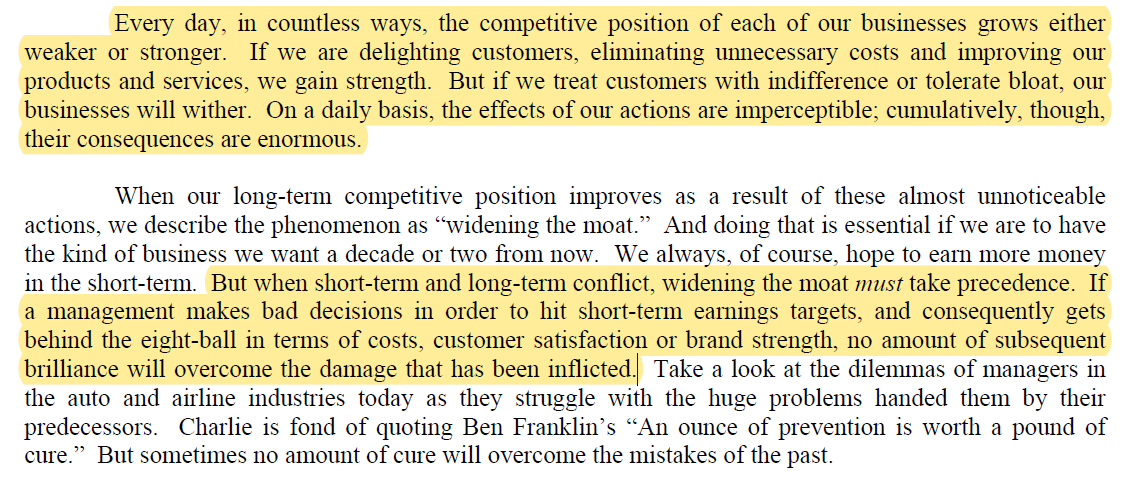
1. Moat is NEVER stagnant
A company's competitive position either grows stronger or weaker each day.
Widening the moat must always take precedence over short-term targets.
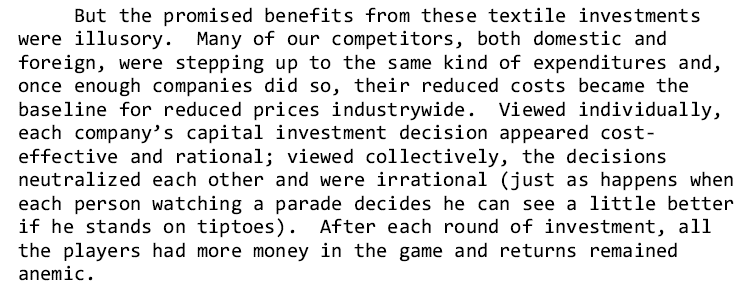
2. Commodity businesses
A business without moat will have its returns competed away.
Regardless of improvement, your competitors will quickly copy your advantage away.
Where returns on capital is dismal, reinvestment will only destroy value.
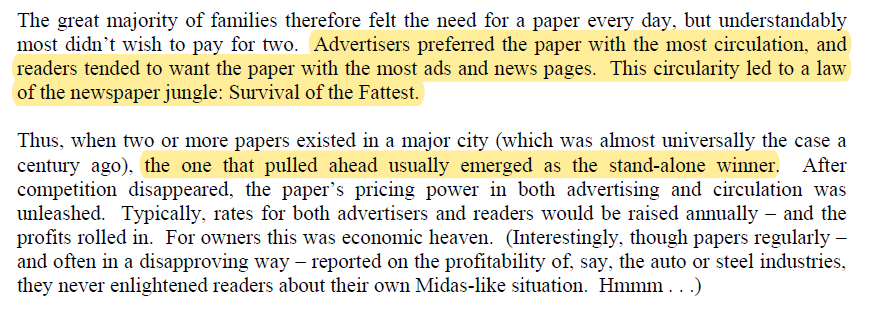
3. The flywheel effect
Buffett was preaching about the flywheel effect before it became cool.
Back then, newspapers were similar to today's platform businesses like Amazon, Meta, and App Store.
More readers beget more advertisers beget more readers.
4. Operating leverage
Companies with high fixed costs and low variable costs will see earnings rise faster than revenue.
However, it cuts both ways.
It becomes a disaster when revenue is declining.
Check out my article on how operating leverage works: https://t.co/Nv747oBAK0

Even after investing for 14 years, I uncover new insights every time I reread his letters.
Recently, I reread his letters from 1977 to 2020 for a third time.
Here are my key insights:
1. Moat is NEVER stagnant
A company's competitive position either grows stronger or weaker each day.
Widening the moat must always take precedence over short-term targets.
2. Commodity businesses
A business without moat will have its returns competed away.
Regardless of improvement, your competitors will quickly copy your advantage away.
Where returns on capital is dismal, reinvestment will only destroy value.
3. The flywheel effect
Buffett was preaching about the flywheel effect before it became cool.
Back then, newspapers were similar to today's platform businesses like Amazon, Meta, and App Store.
More readers beget more advertisers beget more readers.
4. Operating leverage
Companies with high fixed costs and low variable costs will see earnings rise faster than revenue.
However, it cuts both ways.
It becomes a disaster when revenue is declining.
Check out my article on how operating leverage works: https://t.co/Nv747oBAK0


More from Books












You May Also Like








I think a plausible explanation is that whatever Corbyn says or does, his critics will denounce - no matter how much hypocrisy it necessitates.
Corbyn opposes the exploitation of foreign sweatshop-workers - Labour MPs complain he's like Nigel
He speaks up in defence of migrants - Labour MPs whinge that he's not listening to the public's very real concerns about immigration:
He's wrong to prioritise Labour Party members over the public:
He's wrong to prioritise the public over Labour Party
One of the oddest features of the Labour tax row is how raising allowances, which the media allowed the LDs to describe as progressive (in spite of evidence to contrary) through the coalition years, is now seen by everyone as very right wing
— Tom Clark (@prospect_clark) November 2, 2018
Corbyn opposes the exploitation of foreign sweatshop-workers - Labour MPs complain he's like Nigel
He speaks up in defence of migrants - Labour MPs whinge that he's not listening to the public's very real concerns about immigration:
He's wrong to prioritise Labour Party members over the public:
He's wrong to prioritise the public over Labour Party

These 10 threads will teach you more than reading 100 books
Five billionaires share their top lessons on startups, life and entrepreneurship (1/10)
10 competitive advantages that will trump talent (2/10)
Some harsh truths you probably don’t want to hear (3/10)
10 significant lies you’re told about the world (4/10)
Five billionaires share their top lessons on startups, life and entrepreneurship (1/10)
I interviewed 5 billionaires this week
— GREG ISENBERG (@gregisenberg) January 23, 2021
I asked them to share their lessons learned on startups, life and entrepreneurship:
Here's what they told me:
10 competitive advantages that will trump talent (2/10)
To outperform, you need serious competitive advantages.
— Sahil Bloom (@SahilBloom) March 20, 2021
But contrary to what you have been told, most of them don't require talent.
10 competitive advantages that you can start developing today:
Some harsh truths you probably don’t want to hear (3/10)
I\u2019ve gotten a lot of bad advice in my career and I see even more of it here on Twitter.
— Nick Huber (@sweatystartup) January 3, 2021
Time for a stiff drink and some truth you probably dont want to hear.
\U0001f447\U0001f447
10 significant lies you’re told about the world (4/10)
THREAD: 10 significant lies you're told about the world.
— Julian Shapiro (@Julian) January 9, 2021
On startups, writing, and your career: