What's the "value" offered by international relations scholarship?

What does it mean to think about world events "like an international relations scholar"?

Trump's order to withdrawal 🇺🇸 troops from 🇸🇴 offers a useful

This event could be viewed from a variety of angles, from the "micro-level" on up.

International Relations scholars/analysts can and do use each of the following angles, though not all are strictly speaking taking an "International Relations angle".

Let's explore the angles.
The "country-expert" angle entails discussing the event by laying out the situation within Somalia, providing details on key figures involved and perhaps how the conflict has disrupted Somalia's internal governance and society.

https://t.co/uO4iL4MvbJ
The "Military/Security analyst" angle involves outlining the details of what US troops presently do in Somalia and how they carry out their mission (including equipment, mission, and tactics).

See this @ChathamHouse report by @PDWilliamsGWU

https://t.co/0XWu6crZIU
The "Area Studies/Regional Expert" angle involves discussing the decision as an event that will impact the Horn of Africa or East Africa more broadly

https://t.co/iqOzCiq344
A "US Defense Policy" angle might look at the decision in light of the broader goal of removing US troops from the the "Greater Middle East"

See this recent @BrookingsInst report by @MichaelEOHanlon & Bruce Riedel

https://t.co/kolYUGeOmT
A "US Foreign Policy" angle would consider the decision in light of the overall global realignment of US forces, from South Korea to Germany

https://t.co/OMp5VFeOjB
For instance, this angle might consider the domestic political pressures influencing the decision

https://t.co/6FH5buYeH1
Finally, an "International Relations" angle would ask, "what does this teach us about international politics?"
For example, an IR scholar could ask "what does this teach us about the behavior of major powers?"
This could entail evaluating if the decision is consistent with our understanding of great power competition drives troop deployments (such as this forthcoming @The_JOP paper by @carlammm, @markdnieman, @olga_chyzh, & @SamRBell).

https://t.co/q8hSTqpBtj
Or one could see what the event teaches us about hegemonic states?

Ex: Does ability to project power (key feature of a major power) mean having to have a military presence everywhere all the time?

See @pkmacdonald & Joe Parent in @Journal_IS

https://t.co/GcEYfwUYa4
This broader angle provides context, perspective, & language that helps organize thinking and offer understanding of an event.

You know, the things a Liberal Arts education provides

https://t.co/t3UbMq9fm4
In short, the IR angle "pulls up to 30,000 feet"* to ask about the general patterns & behaviors of key actors** operating globally.

[END]

* I've stolen this phrase from JJM, who says it ALL THE TIME :)

** States are a key actor, not the only one (thread for another time)

More from Paul Poast

Is it true that democracies don't go to war with each other?

Sort of. But I wouldn't base public policy on the finding.

Why? Let's turn to the data.

[THREAD]


The idea of a "Democratic Peace" is a widely held view that's been around for a long time.

By 1988, there already existed enough studies on the topic for Jack Levy to famously label Democratic Peace "an empirical law"


The earliest empirical work on the topic was the 1964 report by Dean Babst published in the "Wisconsin Sociologist"


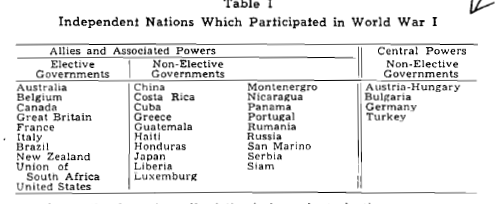
Using the war participation data from Quincy Wright's "A Study of War", Babst produced the following two tables


The tables show that democracies were NOT on both sides (of course, Finland is awkward given that it fought WITH Nazi Germany against the Soviet Union).

Babst expanded his study beyond the World Wars in a 1972 paper in Industrial Research. He confirmed his finding.

More from Trump

Today's Twitter threads (a Twitter thread).

Inside: Stop saying "it's not censorship if it's not the government"; Trump's swamp gators find corporate refuge; and more!

Archived at: https://t.co/7JMcAbaULj

#Pluralistic

1/


Monday night, I'll be helping William Gibson launch the paperback edition of his novel AGENCY at a Strand Bookstore videoconference. Come say hi!

https://t.co/k3fvBdqOK0

2/


Stop saying "it's not censorship if it's not the government": I didn't expect the Spanish Inquisition.

https://t.co/7I0MpCTez5

3/


Trump's swamp gators find corporate refuge: The Swamped project.

https://t.co/MUJyIOr2iw

4/


#15yrsago A-Hole bill would make a secret technology into the law of the land https://t.co/57bJaM1Byr

#15yrsago Hollywood’s MP loses the election — hit the road, Sam! https://t.co/12ssYpV46B

#15yrsago How William Gibson discovered science fiction https://t.co/MYR0go37nW

5/

You May Also Like

The UN just voted to condemn Israel 9 times, and the rest of the world 0.

View the resolutions and voting results here:

The resolution titled "The occupied Syrian Golan," which condemns Israel for "repressive measures" against Syrian citizens in the Golan Heights, was adopted by a vote of 151 - 2 - 14.

Israel and the U.S. voted 'No'
https://t.co/HoO7oz0dwr


The resolution titled "Israeli practices affecting the human rights of the Palestinian people..." was adopted by a vote of 153 - 6 - 9.

Australia, Canada, Israel, Marshall Islands, Micronesia, and the U.S. voted 'No' https://t.co/1Ntpi7Vqab


The resolution titled "Israeli settlements in the Occupied Palestinian Territory, including East Jerusalem, and the occupied Syrian Golan" was adopted by a vote of 153 – 5 – 10.

Canada, Israel, Marshall Islands, Micronesia, and the U.S. voted 'No'
https://t.co/REumYgyRuF


The resolution titled "Applicability of the Geneva Convention... to the
Occupied Palestinian Territory..." was adopted by a vote of 154 - 5 - 8.

Canada, Israel, Marshall Islands, Micronesia, and the U.S. voted 'No'
https://t.co/xDAeS9K1kW