Categories Stockslearnings
7 days
30 days
All time
Recent
Popular






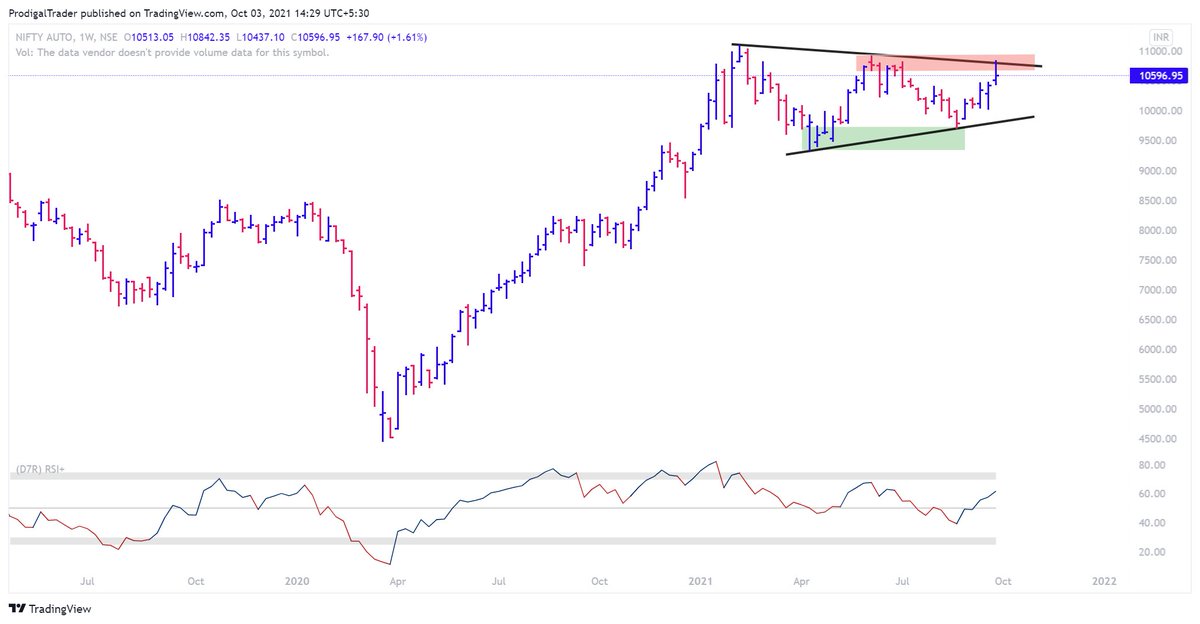


In such a case, H&S can be either a continuation pattern or compound fulcrum.
This is how to differentiate:
• if right shoulder is smaller than left, most likely a continuation H&S
• if right is same or higher than left, and the price is not coming to neckline, most likely CF
This is how to differentiate:
• if right shoulder is smaller than left, most likely a continuation H&S
• if right is same or higher than left, and the price is not coming to neckline, most likely CF
sir a doubt does head & shoulders work in down trend ? pic.twitter.com/dytYmbzOfp
— Vega_Greek (@VegaGreek) May 13, 2021


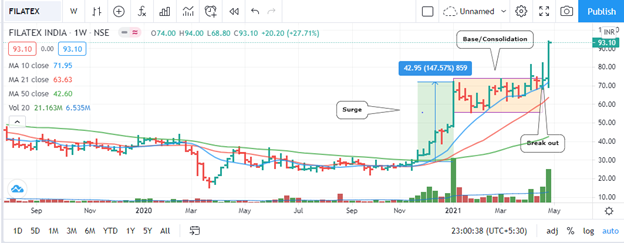


Pls go to Nifty daily chart, convert candle stick chart to line chart
Make time period Weekly
Then click on the encircled + sign in top panel to add different index to compare, u can add any index
Will describe this in our Friday post market session, watch in SE YouTube channel
Make time period Weekly
Then click on the encircled + sign in top panel to add different index to compare, u can add any index
Will describe this in our Friday post market session, watch in SE YouTube channel
Sir can u please make a video on how to get this plotted in trading view .Please sir .a small guidance will be highly appreciated .I know there are many like me who don't know to plot it but are shy to admit .it would benefit them too .thank u sir
— rajesh shetty (@shettyrajeshs) May 4, 2021





4 factors to measure the performance of a trading system:
1 - Accuracy
There is no such thing as 90% Accuracy without compromising on other factors (like profit factor, etc)
Fact - A good trading system will have only 35-60% accuracy without compromising other factors.
(1/n)
2 - Profit Factor (PF)
It is similar to risk-reward. It is derived using the below formula:
Profit Factor = Total Profit by winning trades / Total loss by losing trades
Fact - A trading system above 1.2 PF is good if it scores well with other factors.
(2/n)
3 - Maximum Drawdown
The maximum drawdown also plays a vital role psychologically while picking a trading system.
Fact - Maximum Drawdown in any trading system should not exceed 20%. I suggest picking only the techniques which have less than 10% maximum drawdown.
(3/n)
4 - Maximum Consecutive Losers
We all feel bad even if we lose only Rs.1,000 in a trade. Because it is not only about the money, it is emotionally difficult to accept the failure.
Fact - A good trading system will have less than 15 consecutive losing trades.
(4/n)
TRADE LIKE CRAZY
10 Profitable Intraday Trading Systems, which are backtested against 10-years of Banknifty Historical Data!
(n/n)
https://t.co/BuUie17Ish
1 - Accuracy
There is no such thing as 90% Accuracy without compromising on other factors (like profit factor, etc)
Fact - A good trading system will have only 35-60% accuracy without compromising other factors.
(1/n)
2 - Profit Factor (PF)
It is similar to risk-reward. It is derived using the below formula:
Profit Factor = Total Profit by winning trades / Total loss by losing trades
Fact - A trading system above 1.2 PF is good if it scores well with other factors.
(2/n)
3 - Maximum Drawdown
The maximum drawdown also plays a vital role psychologically while picking a trading system.
Fact - Maximum Drawdown in any trading system should not exceed 20%. I suggest picking only the techniques which have less than 10% maximum drawdown.
(3/n)
4 - Maximum Consecutive Losers
We all feel bad even if we lose only Rs.1,000 in a trade. Because it is not only about the money, it is emotionally difficult to accept the failure.
Fact - A good trading system will have less than 15 consecutive losing trades.
(4/n)
TRADE LIKE CRAZY
10 Profitable Intraday Trading Systems, which are backtested against 10-years of Banknifty Historical Data!
(n/n)
https://t.co/BuUie17Ish


