Are you planning to learn Python for machine learning this year?

Here's everything you need to get started.
🧵👇

In this thread, we'll look at all the concepts in Python you need to know for machine learning along with free resources to help you out.

All of this is based on my experience of successfully teaching 300+ students how to code using Python.

(2 / 19
You can use many languages for machine learning, why Python?

Because of 2 reasons:
- Comparatively easier to learn than other languages
- Has the biggest and most mature community

This makes Python a no-brainer to learn for machine learning as a beginner.

(3 / 19)
These are the absolute basics which you must know about:

- Basic terminal commands
- Basic arithmetic (+,-,/,*)
- Accepting user input
- For & While loops
- Exception handling
- If-Else statements
- Functions, modules & Imports

(4 / 19)
Then comes the more tougher concepts which you must know about:

- Object oriented programming in Python:Classes, Objects, Methods
- PIP (Pypi)
- List slicing
- String formatting
- Dictionaries & Tuples
- Managing environments
- Dunder methods like __init__

(5 / 19)
This are even more advanced concepts but you do not need then to start machine learning:

- Lambda functions
- Built in libraries like CSV, requests, Sqlite
- Map and Filter
- *args and **kwargs
- Async
- Decorators

(6 / 19)
From what I've observed, most beginners just find it really difficult just to get the Python environment setup and then using the terminal becomes an even bigger nightmare for them.

Let's tackle this issue.

(7 / 19)
You need to install:
- Anaconda for managing environments (different versions of Python)
- Python3
- Machine learning packages like Sckit learn and TensorFlow using pip when needed

(8 / 19)
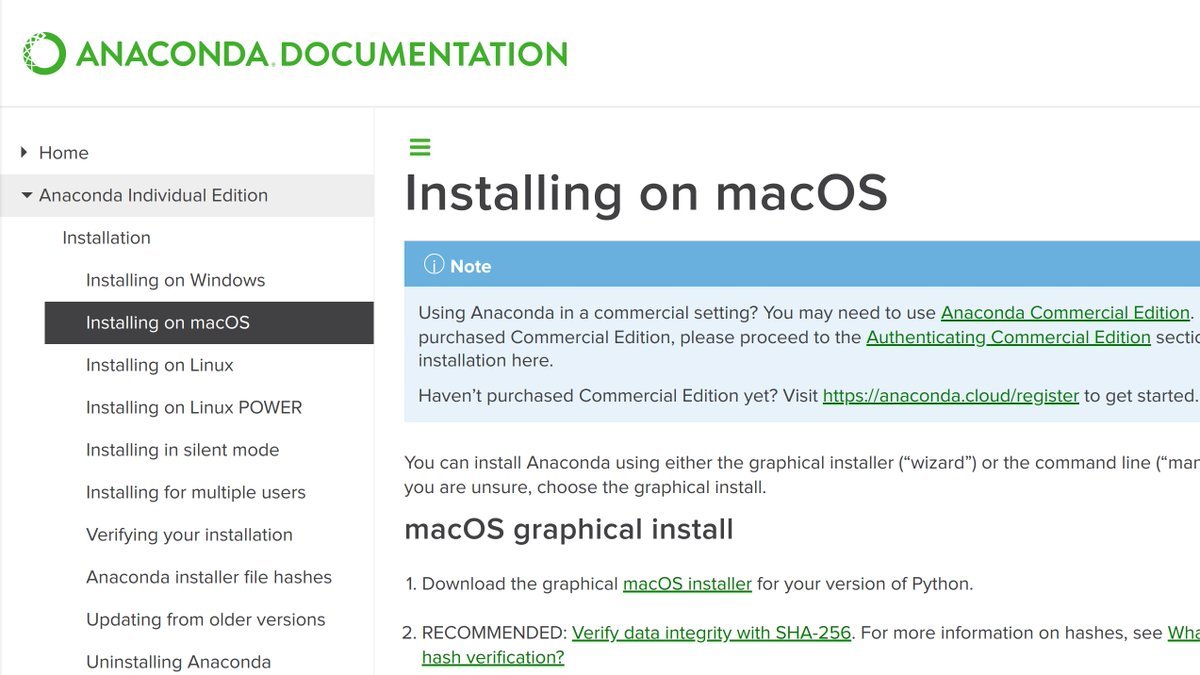
Anaconda installation guide for 👇

MacOS: 🔗docs.​anaconda.​com/anaconda/install/mac-os/
Windows: 🔗docs.​anaconda.​com/anaconda/install/windows/
Linux: 🔗docs.​anaconda.​com/anaconda/install/linux/

(9 / 19)
MacOS and Linux have Python pre-installed, for windows you'll have to install it yourself and it is really easy to mess up the install.

Here's a guide with step by step instructions which will help you.
🔗bit.​ly/3rbDoyl

(10 / 19)
After you do all of that, you need a place to write your code which is called a "code editor".

Here are some popular ones

- VS Code: Feature-rich
- Sublime: Light and simple
- Jupyter: Useful for prototyping
- Pycharm: Full-blown IDE i.​e has loads of features.

(11 / 19)
If all of that seems complicated to you, I suggest you use Google colab, Kaggle notebooks or repl.​it
These are online editors which have everything set up for you.

Not to mention colab and kaggle notebooks give you a free GPU for your machine learning workloads.

(12 / 19)
Links for these editors

Collab : 🔗colab.​research.​google.​com
Kaggle Notebooks : 🔗kaggle.​com/notebooks/welcome
Repl : 🔗repl. it

(13 / 19)
The Basic & Intermediate Python course on freecodecamp go over pretty much all Python concepts you need for machine learning which I have mentioned above.

Basics: 🔗youtube.​com/watch?v=rfscVS0vtbw
Intermediate: 🔗youtube.​com/watch?v=HGOBQPFzWKo

(14 / 19)
Another thing which most beginners skip is knowing how to use the terminal properly and the know-how of navigating around folders.

Here's a brilliant website which gives you an overview of the windows command prompt, enough for you to get started.

🔗bit.​​ly/34tmnGd

(15 / 19)
The story is a bit different on Linux and Mac, their terminals are extremely powerful and packed to the brim with features, here's a tutorial which will help you get started with the basics 👇

​🔗youtube.​com/watch?v=oxuRxtrO2Ag

(16 / 19)
Keep in mind that you should learn how to use the linux terminal because at some point in your machine learning journey you will have to deal with linux.

It is not important to learn it at the start but I do recommend it.

(17 / 19)
This tutorial will help you in knowing how to work with folders, this is important!

Windows: 🔗youtube.​com/watch?v=HDmwiJxzIrw
Mac: 🔗youtube.​com/watch?v=3TAEC-1YUZw
Linux: 🔗youtube.​com/watch?v=HbgzrKJvDRw

(18 / 19)
That's the end of the thread!

Consider following me if you want to see more content like this, cheers.

(19 / 19)

More from Pratham Prasoon

More from Machine learning

Happy 2⃣0⃣2⃣1⃣ to all.🎇

For any Learning machines out there, here are a list of my fav online investing resources. Feel free to add yours.

Let's dive in.
⬇️⬇️⬇️

Investing Services

✔️ @themotleyfool - @TMFStockAdvisor & @TMFRuleBreakers services

✔️ @7investing

✔️ @investing_city
https://t.co/9aUK1Tclw4

✔️ @MorningstarInc Premium

✔️ @SeekingAlpha Marketplaces (Check your area of interest, Free trials, Quality, track record...)

General Finance/Investing

✔️ @morganhousel
https://t.co/f1joTRaG55

✔️ @dollarsanddata
https://t.co/Mj1owkzRc8

✔️ @awealthofcs
https://t.co/y81KHfh8cn

✔️ @iancassel
https://t.co/KEMTBHa8Qk

✔️ @InvestorAmnesia
https://t.co/zFL3H2dk6s

✔️

Tech focused

✔️ @stratechery
https://t.co/VsNwRStY9C

✔️ @bgurley
https://t.co/NKXGtaB6HQ

✔️ @CBinsights
https://t.co/H77hNp2X5R

✔️ @benedictevans
https://t.co/nyOlasCY1o

✔️

Tech Deep dives

✔️ @StackInvesting
https://t.co/WQ1yBYzT2m

✔️ @hhhypergrowth
https://t.co/kcLKITRLz1

✔️ @Beth_Kindig
https://t.co/CjhLRdP7Rh

✔️ @SeifelCapital
https://t.co/CXXG5PY0xX

✔️ @borrowed_ideas
This is a Twitter series on #FoundationsOfML.

❓ Today, I want to start discussing the different types of Machine Learning flavors we can find.

This is a very high-level overview. In later threads, we'll dive deeper into each paradigm... 👇🧵

Last time we talked about how Machine Learning works.

Basically, it's about having some source of experience E for solving a given task T, that allows us to find a program P which is (hopefully) optimal w.r.t. some metric


According to the nature of that experience, we can define different formulations, or flavors, of the learning process.

A useful distinction is whether we have an explicit goal or desired output, which gives rise to the definitions of 1️⃣ Supervised and 2️⃣ Unsupervised Learning 👇

1️⃣ Supervised Learning

In this formulation, the experience E is a collection of input/output pairs, and the task T is defined as a function that produces the right output for any given input.

👉 The underlying assumption is that there is some correlation (or, in general, a computable relation) between the structure of an input and its corresponding output and that it is possible to infer that function or mapping from a sufficiently large number of examples.
10 machine learning YouTube videos.

On libraries, algorithms, and tools.

(If you want to start with machine learning, having a comprehensive set of hands-on tutorials you can always refer to is fundamental.)

🧵👇

1⃣ Notebooks are a fantastic way to code, experiment, and communicate your results.

Take a look at @CoreyMSchafer's fantastic 30-minute tutorial on Jupyter Notebooks.

https://t.co/HqE9yt8TkB


2⃣ The Pandas library is the gold-standard to manipulate structured data.

Check out @joejamesusa's "Pandas Tutorial. Intro to DataFrames."

https://t.co/aOLh0dcGF5


3⃣ Data visualization is key for anyone practicing machine learning.

Check out @blondiebytes's "Learn Matplotlib in 6 minutes" tutorial.

https://t.co/QxjsODI1HB


4⃣ Another trendy data visualization library is Seaborn.

@NewThinkTank put together "Seaborn Tutorial 2020," which I highly recommend.

https://t.co/eAU5NBucbm
Thanks for this incredibly helpful analysis @dgurdasani1

Two questions. 1/ Does this summarise the AZ published data :
The plan is to extend the time interval for all age groups despite it being largely untested on the over 55yrs, although the full data is not yet published


Do we have the actual numbers of over 55yr olds given a 2nd dose at c12 weeks and the accompanying efficacy data?

Not to mention the efficacy data of the full first dose over that same period?

I’d quite like to know whether I am to be a guinea pig & the ongoing risks to manage

You attached photos of excerpts from a paper. Could you attach the link?

Re Pfizer. As I understand it the most efficacious interval for dosing was investigated at the start of the trial.


Here’s the link to the

I’ve got to say that this way of making and announcing decisions is not inspiring confidence in me and I am very pro vaccination as a matter of principle, not least because my brother caught polio before vaccinations available.

You May Also Like