
These networks are primary focus for compression tasks of data in Machine Learning.
Ever heard of Autoencoders?
The first time I saw a Neural Network with more output neurons than in the hidden layers, I couldn't figure how it would work?!
#DeepLearning #MachineLearning
Here's a little something about them: 🧵👇
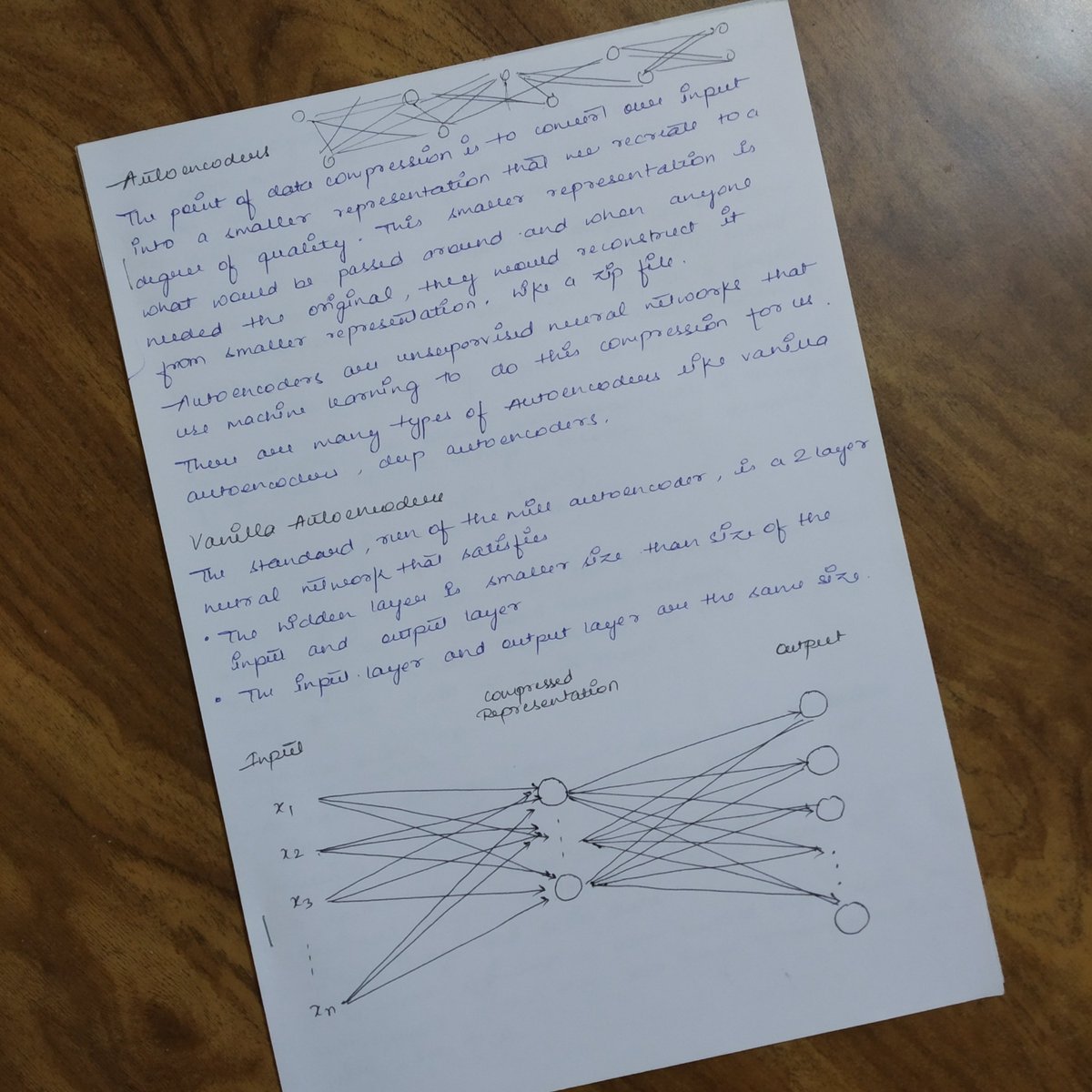
These networks are primary focus for compression tasks of data in Machine Learning.
Later when someone needs, can just take that small representation and recreate the original, just like a zip file.📥
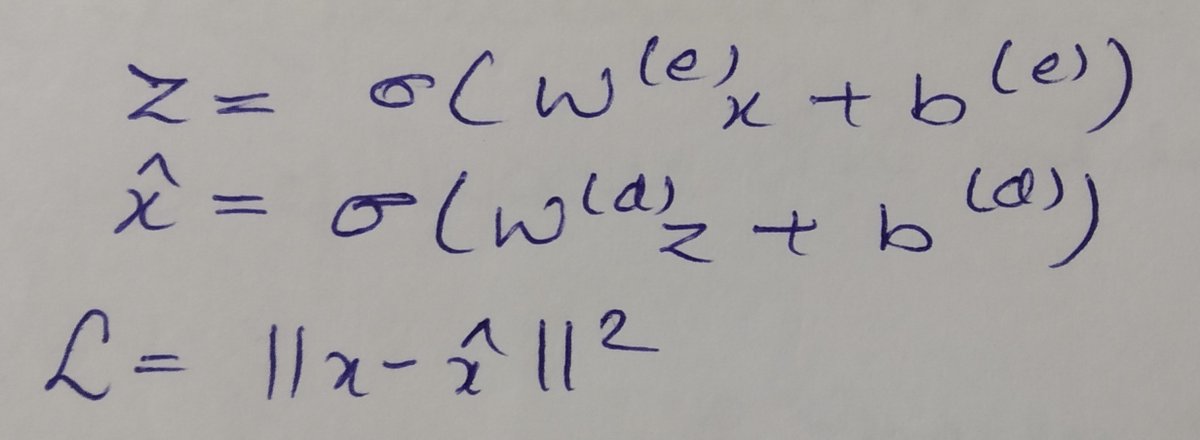
Our inputs and outputs are same and a simple euclidean distance can be used as a loss function for measuring the reconstruction.
Of course, we wouldn't expect a perfect reconstruction.
We are just trying to minimize the L here. All the backpropagation rules still hold.
▫️ Can learn non-linear transformations, with non-linear activation functions and multiple layers.
▫️ Doesn't have to learn only from dense layers, can learn from convolutional layers too, better for images, videos right?
▫️ Can make use of pre-trained layers from another model to apply transfer learning to enhance the encoder /decoder
🔸 Image Colouring
🔸 Feature Variation
🔸 Dimensionality Reduction
🔸 Denoising Image
🔸 Watermark Removal
More from Machine learning


With hard work and determination, anyone can learn to code.
Here’s a list of my favorites resources if you’re learning to code in 2021.
👇
1. freeCodeCamp.
I’d suggest picking one of the projects in the curriculum to tackle and then completing the lessons on syntax when you get stuck. This way you know *why* you’re learning what you’re learning, and you're building things
2. https://t.co/7XC50GlIaa is a hidden gem. Things I love about it:
1) You can see the most upvoted solutions so you can read really good code
2) You can ask questions in the discussion section if you're stuck, and people often answer. Free
3. https://t.co/V9gcXqqLN6 and https://t.co/KbEYGL21iE
On stackoverflow you can find answers to almost every problem you encounter. On GitHub you can read so much great code. You can build so much just from using these two resources and a blank text editor.
4. https://t.co/xX2J00fSrT @eggheadio specifically for frontend dev.
Their tutorials are designed to maximize your time, so you never feel overwhelmed by a 14-hour course. Also, the amount of prep they put into making great courses is unlike any other online course I've seen.
Here’s a list of my favorites resources if you’re learning to code in 2021.
👇
1. freeCodeCamp.
I’d suggest picking one of the projects in the curriculum to tackle and then completing the lessons on syntax when you get stuck. This way you know *why* you’re learning what you’re learning, and you're building things
2. https://t.co/7XC50GlIaa is a hidden gem. Things I love about it:
1) You can see the most upvoted solutions so you can read really good code
2) You can ask questions in the discussion section if you're stuck, and people often answer. Free
3. https://t.co/V9gcXqqLN6 and https://t.co/KbEYGL21iE
On stackoverflow you can find answers to almost every problem you encounter. On GitHub you can read so much great code. You can build so much just from using these two resources and a blank text editor.
4. https://t.co/xX2J00fSrT @eggheadio specifically for frontend dev.
Their tutorials are designed to maximize your time, so you never feel overwhelmed by a 14-hour course. Also, the amount of prep they put into making great courses is unlike any other online course I've seen.


Starting a new project using #Angular? Here is a list of all the stuff i use to launch my projects the fastest i can.
A THREAD 👇
Have you heard about Monorepo? I created one with all my Angular (and Nest) projects using https://t.co/aY5llDtXg8.
I can share A LOT of code with it. Ex: Everytime i start a new project, i just need to import an Auth lib, that i created, and all Auth related stuff is set up.
Everyone in the Angular community knows about https://t.co/kDnunQZnxE. It's not the most beautiful component library out there, but it's good and easy to work with.
There's a bunch of state management solutions for Angular, but https://t.co/RJwpn74Qev is by far my favorite.
There's a lot of boilerplate, but you can solve this with the built-in schematics and/or with your own schematics
Are you not using custom schematics yet? Take a look at this:
https://t.co/iLrIaHVafm
https://t.co/3382Tn2k7C
You can automate all the boilerplate with hundreds of files associates with creating a new feature.
A THREAD 👇
Have you heard about Monorepo? I created one with all my Angular (and Nest) projects using https://t.co/aY5llDtXg8.
I can share A LOT of code with it. Ex: Everytime i start a new project, i just need to import an Auth lib, that i created, and all Auth related stuff is set up.
Everyone in the Angular community knows about https://t.co/kDnunQZnxE. It's not the most beautiful component library out there, but it's good and easy to work with.
There's a bunch of state management solutions for Angular, but https://t.co/RJwpn74Qev is by far my favorite.
There's a lot of boilerplate, but you can solve this with the built-in schematics and/or with your own schematics
Are you not using custom schematics yet? Take a look at this:
https://t.co/iLrIaHVafm
https://t.co/3382Tn2k7C
You can automate all the boilerplate with hundreds of files associates with creating a new feature.
You May Also Like







One of the most successful stock trader with special focus on cash stocks and who has a very creative mind to look out for opportunities in dark times
Covering one of the most unique set ups: Extended moves & Reversal plays
Time for a 🧵 to learn the above from @iManasArora
What qualifies for an extended move?
30-40% move in just 5-6 days is one example of extended move
How Manas used this info to book
Post that the plight of the
Example 2: Booking profits when the stock is extended from 10WMA
10WMA =
Another hack to identify extended move in a stock:
Too many green days!
Read
Covering one of the most unique set ups: Extended moves & Reversal plays
Time for a 🧵 to learn the above from @iManasArora
What qualifies for an extended move?
30-40% move in just 5-6 days is one example of extended move
How Manas used this info to book
The stock exploded & went up as much as 63% from my price.
— Manas Arora (@iManasArora) June 22, 2020
Closed my position entirely today!#BroTip pic.twitter.com/CRbQh3kvMM
Post that the plight of the
What an extended (away from averages) move looks like!!
— Manas Arora (@iManasArora) June 24, 2020
If you don't learn to sell into strength, be ready to give away the majority of your gains.#GLENMARK pic.twitter.com/5DsRTUaGO2
Example 2: Booking profits when the stock is extended from 10WMA
10WMA =
#HIKAL
— Manas Arora (@iManasArora) July 2, 2021
Closed remaining at 560
Reason: It is 40+% from 10wma. Super extended
Total revenue: 11R * 0.25 (size) = 2.75% on portfolio
Trade closed pic.twitter.com/YDDvhz8swT
Another hack to identify extended move in a stock:
Too many green days!
Read
When you see 15 green weeks in a row, that's the end of the move. *Extended*
— Manas Arora (@iManasArora) August 26, 2019
Simple price action analysis.#Seamecltd https://t.co/gR9xzgeb9K


