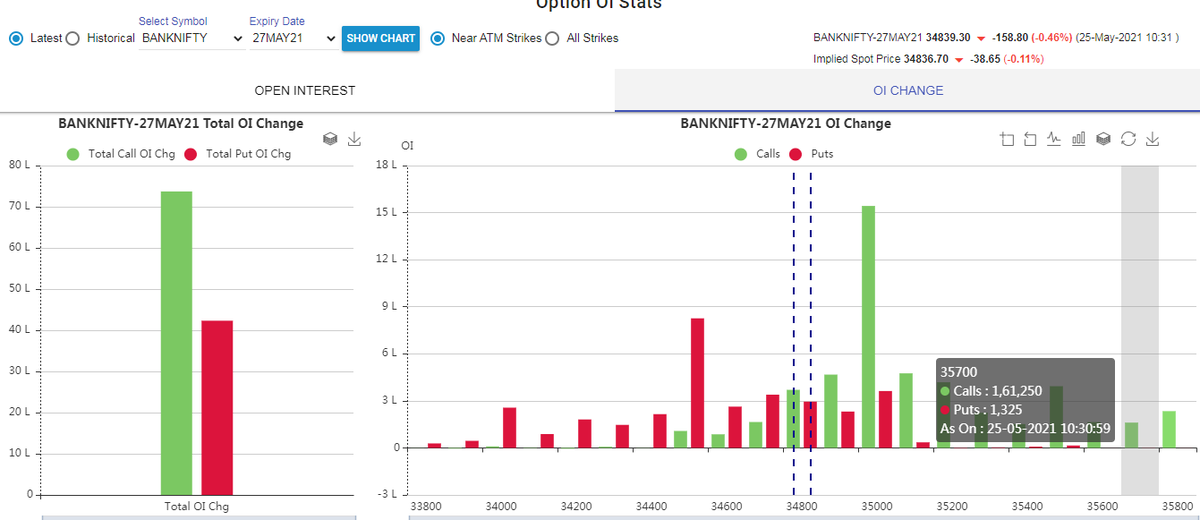
What is best way to sell strangle in Banknifty on an intraday basis
Simple
at 9:45 Open Option chain and check In which strike highest OI change in call side and put side
Sell both option with combine SL
Enjoy easy and simple intraday trading strategy
Today 35000CE and 34500PE
More from Jig's Patel
Thread on Short straddle with adjustments:
Short straddle is non-directional strategy
Selling same strike price CALL/PUT option same underlying with same expiry.
Nifty Spot at 14353, So you can sell 14350 CE as well 14350 PE of 14 Jan. Expiry.
(1/n)
*RETWEET for max response
Bullish short straddle: Selling 14400 CE and 14400 PE of same expiry.
Bearish short straddle: Selling 14250 CE and 14250 PE of same expiry.
You can sell straddle as per your market view.
If you are natural view sell CE and PE at ATM strike.
(2/n)
Short straddle has limited profit potential (only premium) and unlimited risk without adjustment.
In Example, Short straddle of 14350, Breakeven is (14131.0-14569.0), need 1.7Lac Margin to sell straddle.
Maximum profit: 16k and Loss: Unlimited, Winning probability: 50%
(3/n)
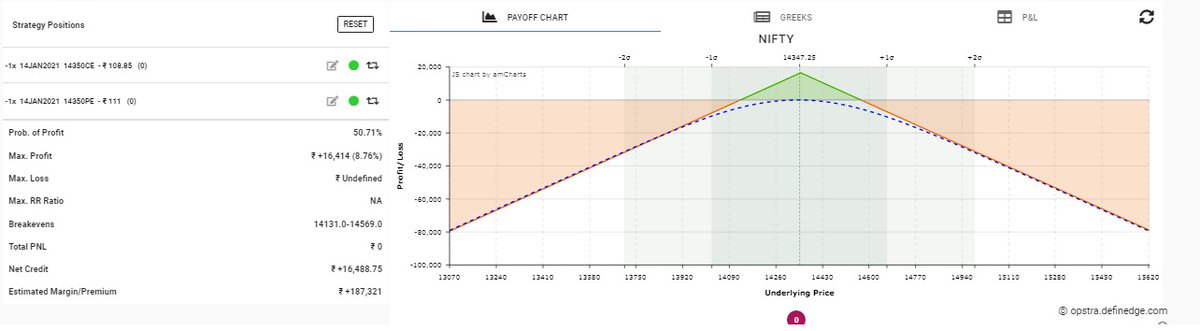
If market staying near at 14350 then win. Probability increase slowly. Rewards also increase slowly.
Volatility(IV) is also play important role in selling straddle, Like If IV increase so straddle premium increase and IV cool off so premium casually comes down.
(4/n)
Short straddle adjustment:
https://t.co/59Lr64kEtK way to limit the overnight risk.
Convert short straddle in Ironfly, its nothing we have to add long strangle in short straddle it become Ironfly. It gives the good Risk Rewards.
(5/n)

Short straddle is non-directional strategy
Selling same strike price CALL/PUT option same underlying with same expiry.
Nifty Spot at 14353, So you can sell 14350 CE as well 14350 PE of 14 Jan. Expiry.
(1/n)
*RETWEET for max response
Bullish short straddle: Selling 14400 CE and 14400 PE of same expiry.
Bearish short straddle: Selling 14250 CE and 14250 PE of same expiry.
You can sell straddle as per your market view.
If you are natural view sell CE and PE at ATM strike.
(2/n)
Short straddle has limited profit potential (only premium) and unlimited risk without adjustment.
In Example, Short straddle of 14350, Breakeven is (14131.0-14569.0), need 1.7Lac Margin to sell straddle.
Maximum profit: 16k and Loss: Unlimited, Winning probability: 50%
(3/n)
If market staying near at 14350 then win. Probability increase slowly. Rewards also increase slowly.
Volatility(IV) is also play important role in selling straddle, Like If IV increase so straddle premium increase and IV cool off so premium casually comes down.
(4/n)
Short straddle adjustment:
https://t.co/59Lr64kEtK way to limit the overnight risk.
Convert short straddle in Ironfly, its nothing we have to add long strangle in short straddle it become Ironfly. It gives the good Risk Rewards.
(5/n)


More from Optionslearnings


Don’t ask any question now just try to understand how I trade in live market
Yesterday sell 14700 than 14600 than 14800 market come down sell sell 15 k call going up sell 14400 put Getting some profit buy protection 14450 pe 14950 ce now u know ur max loss now wait or do adjustment with sell upar side ce or pe it\u2019s practical knowledge not books knowledge pic.twitter.com/J5sPGClVUZ
— itrade(DJ) (@ITRADE191) May 16, 2021
volatility is very high when market open big gap down or option up hote he and jab market settle hota he option price cool down hote he agar market up bhi ja raha ho to bhi buy option utna nahi badenga ..
He maine kyun likha tha ?? Or call buy kyun nahi kaha tha ?? Kyun sirf put sell kaha Agar maarket up hi jane wala tha to koi bata sakta he ?? https://t.co/w21XemUTLo
— itrade(DJ) (@ITRADE191) May 12, 2021

Detailed thread on how @niki_poojary & I managed our positions on Thursday and got a big profit via straddles.
Many people were asking us in the comments, how we managed.
Explained transparently what we did.
Hope you get something to learn from this. 😀👍
Many people were asking us in the comments, how we managed.
Explained transparently what we did.
Hope you get something to learn from this. 😀👍
Sep 23, 2021 - Weekly expiry, preceded by the FOMC meet and not to mention the gap up which then turned out to be a trending day
— Nikita Poojary (@niki_poojary) September 25, 2021
Here\u2019s how the strangles were converted into straddles & how the positions were managed!
Time for a Thread \U0001f9f5

You May Also Like




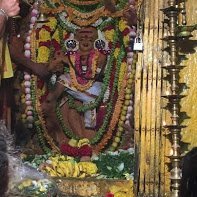
Margatha Natarajar murthi - Uthirakosamangai temple near Ramanathapuram,TN
#ArudraDarisanam
Unique Natarajar made of emerlad is abt 6 feet tall.
It is always covered with sandal paste.Only on Thriuvadhirai Star in month Margazhi-Nataraja can be worshipped without sandal paste.

After removing the sandal paste,day long rituals & various abhishekam will be https://t.co/e1Ye8DrNWb day Maragatha Nataraja sannandhi will be closed after anointing the murthi with fresh sandal paste.Maragatha Natarajar is covered with sandal paste throughout the year
as Emerald has scientific property of its molecules getting disturbed when exposed to light/water/sound.This is an ancient Shiva temple considered to be 3000 years old -believed to be where Bhagwan Shiva gave Veda gyaana to Parvati Devi.This temple has some stunning sculptures.

#ArudraDarisanam
Unique Natarajar made of emerlad is abt 6 feet tall.
It is always covered with sandal paste.Only on Thriuvadhirai Star in month Margazhi-Nataraja can be worshipped without sandal paste.
After removing the sandal paste,day long rituals & various abhishekam will be https://t.co/e1Ye8DrNWb day Maragatha Nataraja sannandhi will be closed after anointing the murthi with fresh sandal paste.Maragatha Natarajar is covered with sandal paste throughout the year
as Emerald has scientific property of its molecules getting disturbed when exposed to light/water/sound.This is an ancient Shiva temple considered to be 3000 years old -believed to be where Bhagwan Shiva gave Veda gyaana to Parvati Devi.This temple has some stunning sculptures.