As is traditional for this time of year, and more in hope than expectation, my top ten trade / Brexit hopes for 2021...
1 - The UK Government ditches the unnecessary secrecy and engages much more openly with business, NGOs etc about their priorities, and reflects them
(NB not confident on the last two)
More from David Henig
Quick intro to more analysis later - since Freeports are mentioned in this article worth making the point that it seems to me under the UK-EU deal that if the UK provides subsidies for them, or relaxes labour or environmental rules in them, the EU can take retaliatory action.
There has never been level playing field content like this in a trade deal. The idea it is any kind of UK win, when the UK's opening position was no enforceable commitments whatsoever, is ridiculous.
The EU can take retaliatory action against the UK if we weaken labour standards, weaken pretty firm climate change targets, unfairly subsidise, or just in general seem to be out of line. There are processes to follow, but it looks like the PM did it again...
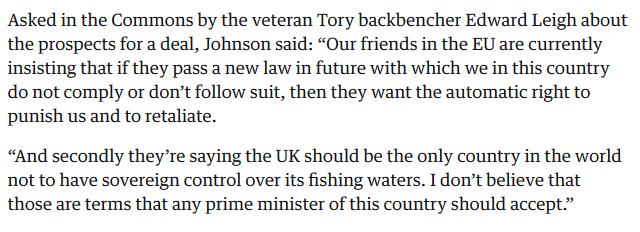
Final one for now. Quite how Labour gets itself in such a fuss about whether to support a deal with the strongest labour and environment commitments ever seen in a trade deal is a sign of just how far it hasn't moved on from leaving.
PS well... (sorry DAG). It certainly didn't have a good effect. And I think if we had settled LPF issues with the EU much earlier there is a good chance the conditions would have been far less stringent. By making an issue, we made it much worse.
Michael Gove: "Outside the EU, with a good trade deal in place, we can tackle the injustices and inequalities that have held Britain back."
— Jennifer Rankin (@JenniferMerode) December 26, 2020
The UK did not need to leave the EU to tackle injustices and inequalities at home. Not a new point, but true.https://t.co/fE4glUAylc
There has never been level playing field content like this in a trade deal. The idea it is any kind of UK win, when the UK's opening position was no enforceable commitments whatsoever, is ridiculous.
For the lawyers. Night. pic.twitter.com/5XvFMhcaeE
— Sam Lowe (@SamuelMarcLowe) December 25, 2020
The EU can take retaliatory action against the UK if we weaken labour standards, weaken pretty firm climate change targets, unfairly subsidise, or just in general seem to be out of line. There are processes to follow, but it looks like the PM did it again...
Final one for now. Quite how Labour gets itself in such a fuss about whether to support a deal with the strongest labour and environment commitments ever seen in a trade deal is a sign of just how far it hasn't moved on from leaving.
PS well... (sorry DAG). It certainly didn't have a good effect. And I think if we had settled LPF issues with the EU much earlier there is a good chance the conditions would have been far less stringent. By making an issue, we made it much worse.
As a lay person is it fair to say that the \u201cthreat\u201d to break international law in Ireland was possibly a strategic blunder that has now determined the future trajectory of the UK for the next 20 years? I can imagine most countries will study what\u2019s baked into this and replicate?
— Meister 1 (@blueelmacho) December 26, 2020
More from Brexit




You May Also Like







A list of cool websites you might now know about
A thread 🧵
1) Learn Anything - Search tools for knowledge discovery that helps you understand any topic through the most efficient
2) Grad Speeches - Discover the best commencement speeches.
This website is made by me
3) What does the Internet Think - Find out what the internet thinks about anything
4) https://t.co/vuhT6jVItx - Send notes that will self-destruct after being read.
A thread 🧵
1) Learn Anything - Search tools for knowledge discovery that helps you understand any topic through the most efficient
2) Grad Speeches - Discover the best commencement speeches.
This website is made by me
3) What does the Internet Think - Find out what the internet thinks about anything
4) https://t.co/vuhT6jVItx - Send notes that will self-destruct after being read.