For a number of key journalists, their only job is to take dictation from the 10 Downing Street spokesman & give it to the Times, Telegraph or Spectator for publishing. This is part of a therapy effort for the small minority of the population who read those publications & .../2.
... would otherwise be confused by being confronted with the reality of the world around them. The articles are interesting for two reasons:
⁃They tell you precisely what 10 Downing Street currently wants those readers, which include other journalists, to hear. /3.
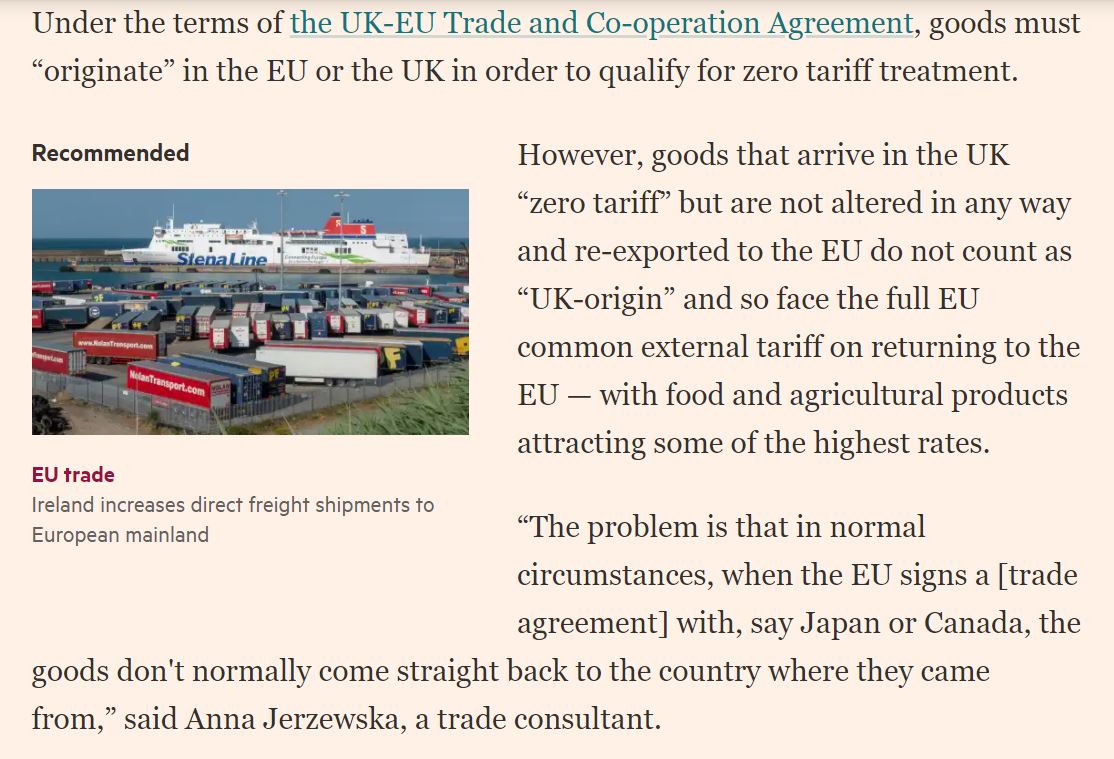
⁃Looking at their detailed content, such as it is, shows just how possible a “deal” quite obviously is & how nonsensical a “no deal” would be. They also (if you’re familiar with a bit of background, which you surely are) highlight just how bad a “deal” of the sort .../4.
... the government envisages - a massive climb down from the UK’s extraordinarily privileged position in the EU’s customs union & single market - would be for the UK. And how a “no deal” would be even worse - substantially so - than such a (really awful) “deal”. /5.
Essentially, “no deal” hits the UK with a barrage of tariffs & non-tariff barriers (& other, serious problems) from day one. A “deal” hits the UK with less at the outset & would only, case by case, impose more in future as & when the UK diverged from relevant EU rules. /6.
When the UK government talks about “no deal” being something it embraces, it’s like saying: “To stop you possibly making me slowly descend this cliff in the future (if I put you in that position by my own actions), I’m going to jump off it now”. /7.
As for who understands whom, there’s a tendency in the articles - sorry, 10 Downing Street statements - to accuse the EU of failing to understand the UK. This is to indulge in pure projection (think Johnson, think Trump). /8.
It’s an almost total failure by the current UK leadership to understand, or at least acknowledge in practice, the most basic & important aspects of the EU position. A failure which has led us to where we are now. /9.
Key points not acknowledged by our leaders in this catalogue of ignorance, misunderstanding & fantastical thinking include:
(a) The EU negotiates as a single entity on changes of membership, whether accession of new member states or departure of old member states, & on .../10.
... trade, regulatory & customs matters, which includes everything to do with the “four freedoms” (freedom of movement of goods, services, people & capital). /11.
(b) The four freedoms, in turn, are all - & indivisibly - fundamental to the functioning of an economy as integrated as the EU single market & customs union, including non-EU countries which fully, or nearly so, participate in it. There’s minimal room for manoeuvre. /12.
(c) The single market & customs union, & their integrity, are of fundamental strategic importance to the EU, its very existence as an entity able to advance & protect its members interests, their prosperity & security. There’s no room to undermine either. /13.
(d) The UK is a combination of far too large & far too close to be given a free ride on anything, yet far too small (1/5th the EU’s economic size & power) to have any real leverage in negotiations. /14.
(e) Ireland will not be sacrificed. Both because of the importance of the peace settlement on the island of Ireland. And because it would be the end of the EU. (Imagine the implications if the EU institutions, or the big member states, ignored .../15.
... a member state’s vital interests in favour of a non-EU member. It was bad enough when Greece thought - rightly or wrongly - its interests were being ignored in favour of fellow EU members, during the Euro crisis). /16.
What this tells you - & should have been understood in the UK before contemplating a referendum on EU membership - is that any EU member state, however small, is effectively 5x the UK’s size, in negotiations with the UK, once the UK has left the EU. /17.
(f) As for “no deal” hitting Ireland, it’s true that the potential economic damage there is big. Except that the EU will support Ireland. Who will support the UK? Concerning the Ireland land border, theoretically a “no deal” could lead to a so-called hard border .../18.
... being reimposed. In practice, the UK & EU have already agreed (regrettably, over the heads of the NI population, rendering the arrangement dangerously unstable) to separate NI from mainland UK (the island of GB). /19.
If the UK tries to back out of guaranteeing all aspects of the Good Friday Agreement, as interpreted by Ireland/EU & USA, there will be retribution from the USA - where it’s a bipartisan issue - & EU, until the UK’s forced to give in. So, Ireland’s protected in a “no deal”./20.
(g) More widely, the EU is very well prepared for a “no deal”. Unlike the UK, which can’t afford it (although may still, recklessly, lurch into it) the EU can easily absorb the impact, painful though it will be. The proportionate impacts are around 5x different. /21.
(h) “Deal” or “no deal”, the UK effectively loses part of its territory (NI). The only way of maintaining UK territorial integrity & avoiding damage 3x greater than Covid (“no deal”) or 2x Covid (“deal”), is for the UK to stay in the customs union & single market .../22.
... or practically identical arrangements. (And the only way of achieving that, at this stage, is an emergency extension to the UK’s EU transition period, providing time & diplomatic space for a solution which doesn’t trash the country). /23.
(i) The EU isn’t going anywhere. It’s a giant on the UK’s doorstep. It’s a fundamental component of the alliance, upon which the UK depends, led by the world’s super-giant, the USA. /24.
For as long as that’s true, & for as long as the UK’s too big to ignore & too small to be able to assert itself, there’ll be no free rides. Cake’s off the menu. /25.
In short, in the Eurovision Negotiating Contest, the credibility of the UK’s negotiating position, its ability to assert it, & the benefits of Brexit, all score nul points (rounded to the nearest whole number). /26.
To be fair, this isn’t a negotiation.
Every outcome, other than staying in the customs union & single market, badly hammers the UK. By definition, an abject negotiating failure. /27.
For the EU, every outcome is, unavoidably, a bit less good than the status quo. An irritation rather than a crisis. (The one exception is to allow a massive hole to be punched in the single market & customs union via an untethered, unregulated UK. That won’t be permitted)./28.
So what does the EU score? Full marks for simply pocketing its overwhelming advantage & refusing to be diverted from using it to maximise EU interests. Is there much skill in that? Maybe, maybe not. But this is about results. The EU’s sitting pretty. The UK isn’t. /29.
Everyone, EU, UK, USA & beyond, should be extremely worried about the geopolitical impact of Brexit. The UK’s “Sonderweg” is in danger of seriously undermining the US-led alliance on which we all depend for our prosperity & security. /30.
That’s the subject of a separate piece which I hope to share soon. For now, it’s sufficient to note that while the disruptor-in-chief has been in the White House, the folly & harm of the UK’s behaviour has perhaps been less clear to some, masked by the even greater threat .../31.
... from Washington DC itself. With a new administration taking over in six weeks, barring Trump & Trumpism staging an effective coup d’état in the USA, that’s no longer the case. /32.
“No deal” is the most damaging version of the UK domestic & geopolitical nightmare which is Brexit. Except, that is, for the EU self-destructing by conceding to UK cake-and-eat-it demands: that isn’t going to happen. /33.
The sooner No. 10’s Eurovision Negotiating Band & its supporting cast of Brexit-blinded politicians, journalists & others leave the stage, or change their cacophonous, destructive act, the better. 3 weeks left. Still a chance to win the prize - of stopping a major crisis./34. End