https://t.co/TVXC4QOjt0
https://t.co/QnMiOrdNhx
https://t.co/ZK2vfwYEFj
in fact, adaptation in CaLu-3 actually reverses changes that happened in VERO E6. P681 and RRAR is fine-tuned to growth in CaLu-3 cell cultures. P681 guards the cardin-weintraub motif against cleavage in
https://t.co/fjg6ZXc2KN
the FCS is perfectly stable in anything that isn't VERO E6 classic or 293T-ACE2. anything that had TMPRSS2 and grown in trypsin-free media stably maintains the FCS.
in fact, the PRRARS, as opposed to other mutated cleavage sites--even the "perfect" H5CS--confers the greatest infectivity in CaLu-3 cells.
in fact, even P681R or S686G changes were less fit in CaLu-3 compared to PRRA virus--the P681R virus show either no difference or is slightly less effective compared to the P681 virus, and the S686G virus
https://t.co/DNtIR17r4S
https://t.co/nDNNw9OaWd


P681 is favored specifically becuse of the cardin-weintraub motif it leaves behind (pRRaRs(O-hexNAc)) compared to R681.
in deed, even the optimized RRRKR site fares LESS well compared to the unmodified PRRAR site for CaLu-3.

once agaiP681 and P681 with RRARS in particular, optimizes CaLu-3 cell entry for the SARS-CoV-2 S.

https://t.co/H7UqiJ15v9
The final piece of the puzzle: it turned out that CaLu-3 cells DO glycosylate the S1-S2 in the presence of P681, which is necessary for all the previous mechanisms to function—in deed the live SARS-CoV-2 virus on CaLu-3
These uncleaved fractions indicate that intact cardin-weintraub motifs are formed during


https://t.co/tAP9OQ9FYl
More from Daoyu
https://t.co/SvP0tfbDki

https://t.co/k9mmL9e5kn

https://t.co/7fR13yb3qJ

https://t.co/EXerlaiG9u
https://t.co/iNCdLY1Pzn
https://t.co/k9mmL9e5kn
https://t.co/7fR13yb3qJ
https://t.co/EXerlaiG9u
Interesting!
— Florin (@Florin_Uncovers) February 20, 2022
NAHL Laos was built by USAID PREDICT to work with Metabiota. Daszak says Sep 2018 they were still not allowed to collect samples for Shi at WIV.
Doesn't mean EcoHealth didn't get them before/after directly/indirectly. We know the Navy sampled bats there in 2017.\U0001f642 pic.twitter.com/mVp6dytD6X
https://t.co/iNCdLY1Pzn
EXCLUSIVE: Hunter Biden DID help secure millions in funding for US contractor in Ukraine specializing in deadly pathogen research https://t.co/fFBX7IFcKh
— Daily Mail US (@DailyMail) March 25, 2022
@danwalker9999 https://t.co/o8zqouq0HB
Bias, however, is an important problem in the WHO data. Also, an important problem seen in the points being scattered around is that they seems to be pulled toward the Huanan market—it was likely that it was used as the point of origin for the coordinate
System used. https://t.co/KnPRvIN8uK At this level of imprecision, it becomes impossible ti distinguish the Huanan market, the Wuhan CDC, and the Hankou railway station—the last of which is the main transport hub in Wuhan and the only transport hub reachable from the WIV within

1 transfer on the metro system. Cases “unlinked” were mainly clustered north of the Hankou station—which was one of the major exits through the hankou station and one of the transfer stations next to the Hankou railway station. Even connor reed, which is on the east of the
Yangtze river, supposedly have onset in November 2019 (whistleblower case #2), was connected to the WIV directly—it was on the same metro line, line 8, as the WIV. As he is an education worker, he need to commute to Wuchang where the universities are—exposing him to the WIV
Every time he takes line 8 to commute. https://t.co/5TIqOjt2p1
In addition to enforced ascertainment bias toward the market with a retrospective case search that specifically targeted the immediate surrounding of Huanan market, symptomology bias with lineage B created an
Bias, however, is an important problem in the WHO data. Also, an important problem seen in the points being scattered around is that they seems to be pulled toward the Huanan market—it was likely that it was used as the point of origin for the coordinate
System used. https://t.co/KnPRvIN8uK At this level of imprecision, it becomes impossible ti distinguish the Huanan market, the Wuhan CDC, and the Hankou railway station—the last of which is the main transport hub in Wuhan and the only transport hub reachable from the WIV within
1 transfer on the metro system. Cases “unlinked” were mainly clustered north of the Hankou station—which was one of the major exits through the hankou station and one of the transfer stations next to the Hankou railway station. Even connor reed, which is on the east of the
Yangtze river, supposedly have onset in November 2019 (whistleblower case #2), was connected to the WIV directly—it was on the same metro line, line 8, as the WIV. As he is an education worker, he need to commute to Wuchang where the universities are—exposing him to the WIV
Every time he takes line 8 to commute. https://t.co/5TIqOjt2p1
In addition to enforced ascertainment bias toward the market with a retrospective case search that specifically targeted the immediate surrounding of Huanan market, symptomology bias with lineage B created an
@franciscodeasis https://t.co/Sd9IslUCH5 a FCS need a FCS in the inoculum to exist. It can not arise de-novo as it will be destroyed instantly by the immune system.
https://t.co/UgXygDjYbW a fourth Sars-like CoV is live at the WIV. This fourth virus is an infectious clone, where engineering of the S1-S2 is used regularly as mean to generate a culturable virus in HAE cells. No VERO E6 here, and HeLa-hACE2 is the new VERO of the WIV
https://t.co/DtjyycKy1v
https://t.co/PG7LVnHfsy
Even with VERO E6, only half the time does passage lead to the loss of the FCS—smaller plaques need to be explicitly picked for that to be a certainty.
Marburg virus is a novel virus that escaped from the lab. https://t.co/OGQM6qV27l the only reason why it did not become a pandemic is due to it being too lethal to sustain asymptomatic transmission in humans.
The highest reported number of cases were in WuChang right on top of the old WIV headquarters, In contrast to the population density data of Wuhan—note that the place near the market had the highest population density in all of Wuhan, which make it the most optimal location for

https://t.co/UgXygDjYbW a fourth Sars-like CoV is live at the WIV. This fourth virus is an infectious clone, where engineering of the S1-S2 is used regularly as mean to generate a culturable virus in HAE cells. No VERO E6 here, and HeLa-hACE2 is the new VERO of the WIV
https://t.co/DtjyycKy1v
https://t.co/PG7LVnHfsy
Even with VERO E6, only half the time does passage lead to the loss of the FCS—smaller plaques need to be explicitly picked for that to be a certainty.
Marburg virus is a novel virus that escaped from the lab. https://t.co/OGQM6qV27l the only reason why it did not become a pandemic is due to it being too lethal to sustain asymptomatic transmission in humans.
The highest reported number of cases were in WuChang right on top of the old WIV headquarters, In contrast to the population density data of Wuhan—note that the place near the market had the highest population density in all of Wuhan, which make it the most optimal location for
More from All






How can we use language supervision to learn better visual representations for robotics?
Introducing Voltron: Language-Driven Representation Learning for Robotics!
Paper: https://t.co/gIsRPtSjKz
Models: https://t.co/NOB3cpATYG
Evaluation: https://t.co/aOzQu95J8z
🧵👇(1 / 12)
Videos of humans performing everyday tasks (Something-Something-v2, Ego4D) offer a rich and diverse resource for learning representations for robotic manipulation.
Yet, an underused part of these datasets are the rich, natural language annotations accompanying each video. (2/12)
The Voltron framework offers a simple way to use language supervision to shape representation learning, building off of prior work in representations for robotics like MVP (https://t.co/Pb0mk9hb4i) and R3M (https://t.co/o2Fkc3fP0e).
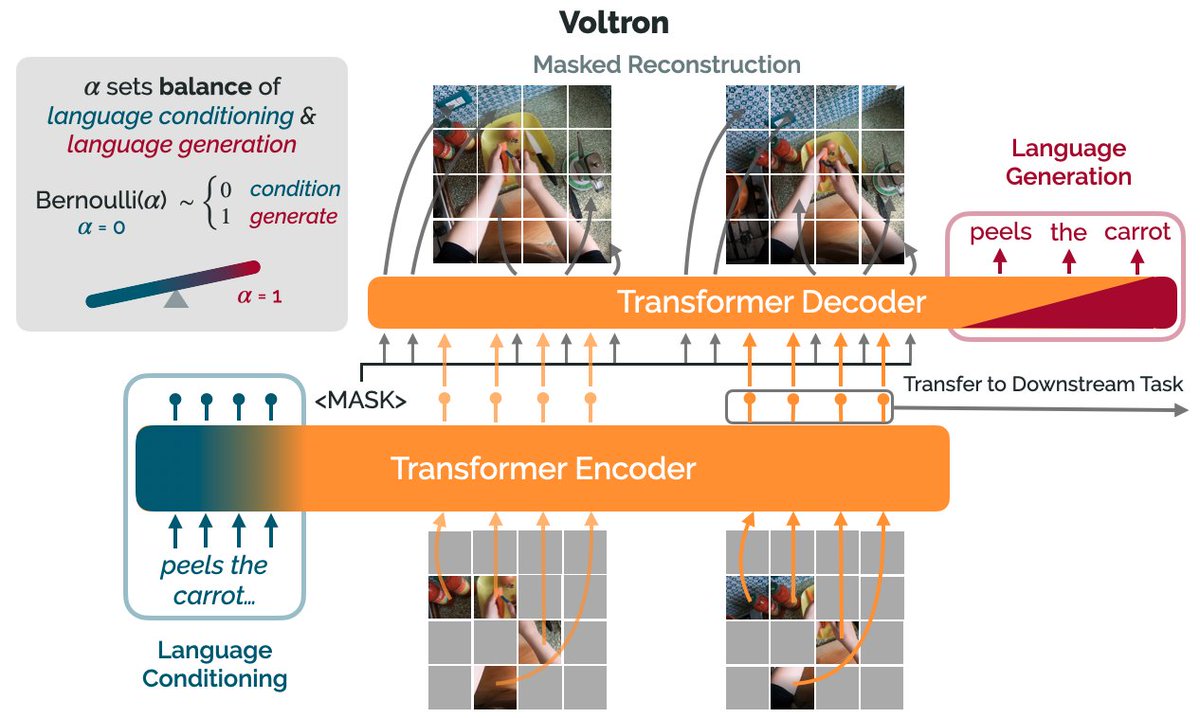
The secret is *balance* (3/12)
Starting with a masked autoencoder over frames from these video clips, make a choice:
1) Condition on language and improve our ability to reconstruct the scene.
2) Generate language given the visual representation and improve our ability to describe what's happening. (4/12)
By trading off *conditioning* and *generation* we show that we can learn 1) better representations than prior methods, and 2) explicitly shape the balance of low and high-level features captured.
Why is the ability to shape this balance important? (5/12)
Introducing Voltron: Language-Driven Representation Learning for Robotics!
Paper: https://t.co/gIsRPtSjKz
Models: https://t.co/NOB3cpATYG
Evaluation: https://t.co/aOzQu95J8z
🧵👇(1 / 12)
Videos of humans performing everyday tasks (Something-Something-v2, Ego4D) offer a rich and diverse resource for learning representations for robotic manipulation.
Yet, an underused part of these datasets are the rich, natural language annotations accompanying each video. (2/12)
The Voltron framework offers a simple way to use language supervision to shape representation learning, building off of prior work in representations for robotics like MVP (https://t.co/Pb0mk9hb4i) and R3M (https://t.co/o2Fkc3fP0e).
The secret is *balance* (3/12)
Starting with a masked autoencoder over frames from these video clips, make a choice:
1) Condition on language and improve our ability to reconstruct the scene.
2) Generate language given the visual representation and improve our ability to describe what's happening. (4/12)
By trading off *conditioning* and *generation* we show that we can learn 1) better representations than prior methods, and 2) explicitly shape the balance of low and high-level features captured.
Why is the ability to shape this balance important? (5/12)