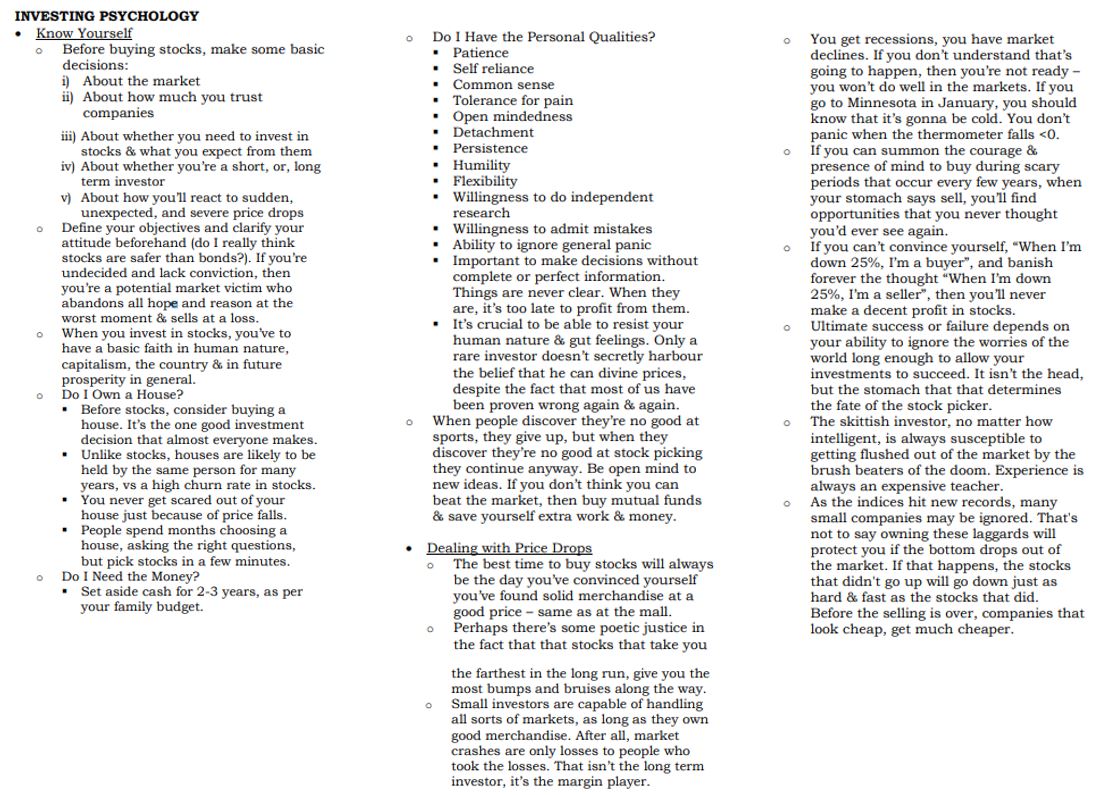
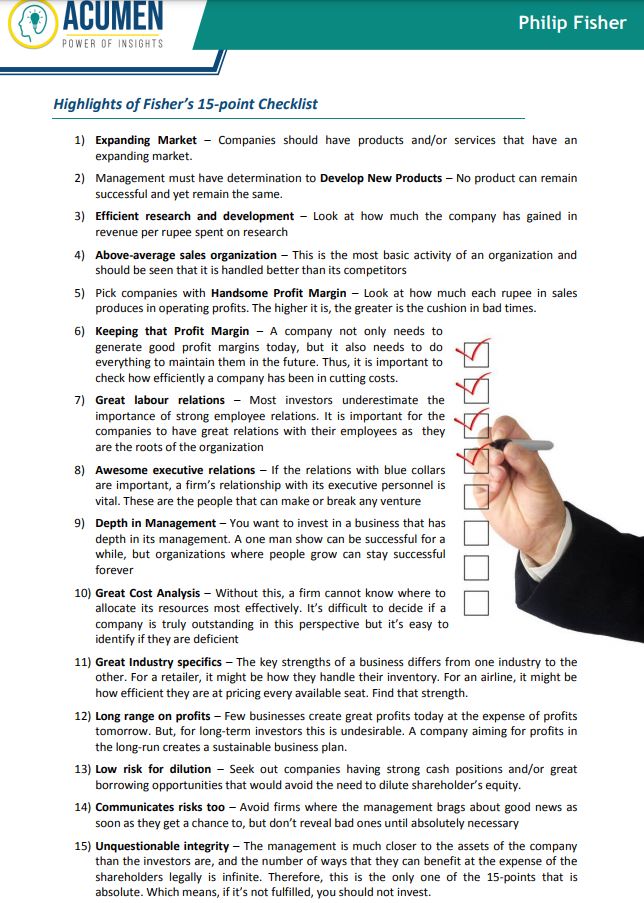
Good Investing Checklist that goes thru Basics, Financials, Valuation & Behavioral factors. h/t Nicole Seah (not sure if it's @startingfromnix)

1.The Story
Do I understand the business?
Do I believe in the mission?
Moat?
How well do I trust Mgmt?
Do I know the key risks?
Do I have an idea why the company is trading at a discount to its intrinsic value?
What are the potential catalysts?
Is there room for future growth?
2. Financial Metrics
Financial statements and footnotes
Cyclical, countercyclical?
Inflation impact
Operating Leverage
Assessing Working Capital + Capex
Trends in Revenues, Margins, Cash flows...
Recent investments, acquisitions?
3.Valuation
Relative Valuation
DCF
Good pts on few of the behavioral biases to watch out for 👇
It's good to have a short thesis and few other details written down after the initial purchases, so that you're clear on what to track and be objective in follow ups.
The author's Medium page 👇

https://t.co/9yKiGjlFy2

More from Ram Bhupatiraju

More from All

https://t.co/6cRR2B3jBE
Viruses and other pathogens are often studied as stand-alone entities, despite that, in nature, they mostly live in multispecies associations called biofilms—both externally and within the host.

https://t.co/FBfXhUrH5d


Microorganisms in biofilms are enclosed by an extracellular matrix that confers protection and improves survival. Previous studies have shown that viruses can secondarily colonize preexisting biofilms, and viral biofilms have also been described.


...we raise the perspective that CoVs can persistently infect bats due to their association with biofilm structures. This phenomenon potentially provides an optimal environment for nonpathogenic & well-adapted viruses to interact with the host, as well as for viral recombination.


Biofilms can also enhance virion viability in extracellular environments, such as on fomites and in aquatic sediments, allowing viral persistence and dissemination.

You May Also Like

I just finished Eric Adler's The Battle of the Classics, and wanted to say something about Joel Christiansen's review linked below. I am not sure what motivates the review (I speculate a bit below), but it gives a very misleading impression of the book. 1/x


The meat of the criticism is that the history Adler gives is insufficiently critical. Adler describes a few figures who had a great influence on how the modern US university was formed. It's certainly critical: it focuses on the social Darwinism of these figures. 2/x

Other insinuations and suggestions in the review seem wildly off the mark, distorted, or inappropriate-- for example, that the book is clickbaity (it is scholarly) or conservative (hardly) or connected to the events at the Capitol (give me a break). 3/x

The core question: in what sense is classics inherently racist? Classics is old. On Adler's account, it begins in ancient Rome and is revived in the Renaissance. Slavery (Christiansen's primary concern) is also very old. Let's say classics is an education for slaveowners. 4/x

It's worth remembering that literacy itself is elite throughout most of this history. Literacy is, then, also the education of slaveowners. We can honor oral and musical traditions without denying that literacy is, generally, good. 5/x