The productivity per acre was very low
The threat of famine loomed.
We were dependent on US for feeding our people.
2/n
We always talk of the right man at the right place.
For Indians, that person arrived on the scene by mid 1960s.
The farmers did not have a clue as to how to exploit the benefits of better irrigation to improve agricultural production. 3/n
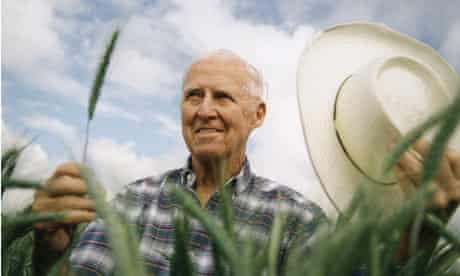
In their midst walked in Dr.Norman Borlaug, an American, who had done considerable work in the famished Mexico amongst the peasants with considerable success.
Would he be the Saviour? 4/n
One of the problems the wheat farmers of North India faced was that the plants were long which meant it could not support the weight of the wheat at the head, leading to the plant slanting and finally falling off.
The wastage due to this was phenomenal 5/n
M S Swaminathan, wrote to Indian Agricultural Research Institute, asking them to invite Borlaug to India in order to improve the conditions.
Norman did some out of the box thinking.
6/n
While in India, this unassuming scientist from America, would head to the fields every morning.
He would spend a considerable amount of time inviting discussions with Indian scientists not just in wheat but also in other crops such as chickpea and rice 7/n
He would share his ideas on development as well. He set off on tour across the North Indian belt along with Swaminathan to understand India’s agricultural belt 8/n
Six months later, Borlaug would send four selected varieties of wheat to India that he thought would work well in the Indian conditions. 9/n
The shorter, more compact and durable plant was easily able to support the heavier weight of the grains without falling down. This innovative concept led to Indian wheat farmers improving the farm output four times over. 10/n
The same concept was later extended to the rice farming
In pre-Borlaug 1963, wheat grew in sparse, irregular strands, was harvested by hand, and was susceptible to rust disease.
The maximum yield was 800 lb per acre. 11/n
By 1968, thanks to Borlaug’s varieties, the wheat grew densely packed, was resistant to rust, and the maximum yield had risen to 6,000 lb per acre.” 12/n
His variety along with Better irrigation, mechanization, modern farming methods heralded the Green Revolution in India. The rest, as they say, is history. 13/n
For once the Nobel Peace Prize judges were spot on when they elected him for the prestigious award in 1970.
The Nobel citation was
''More than any other person of this age, he helped provide bread for a hungry world. 14/n
We have made this choice in the hope that providing bread will also give the world peace.''
Norman was active well into his 90s, training modern day agricultural scientists from the developing world, till his death a day ago. 15/n
Norman was really the Father of Green Revolution.
He died aged 95 in 2009
He leaves a legacy that is hard to beat.
We, as a Country, are indebted to him forever n/n
PS: Correction: Norman died 'a decade ago' and not as stated in 15/n. Error is regretted