
Wish's superpower is leaving no room for taste or opinion. It's what happens when a machine builds a company based on data. The founder didn't plan to sell cheap goods to low-socioeconomic customers, but where the data took him.
The most sophisticated growth team no one talks about: @WishShopping
1. The #1 shopping app in 40+ countries
2. Rumored to often be the #1 spender on FB and Google
3. 2 million items sold daily
I sat down with @cplimon to learn about the notoriously secretive company. Read on 👇
Wish's superpower is leaving no room for taste or opinion. It's what happens when a machine builds a company based on data. The founder didn't plan to sell cheap goods to low-socioeconomic customers, but where the data took him.
cursed wish ads pic.twitter.com/eMlx4LqgKA
— big meaty claws (@leisurepIex) June 4, 2019
Most of Wish’s initial sales came from places like Florida, greater LA county, and middle-America. Specifically, zip codes with 95% Spanish speakers. Later, Africa, Latin America and Eastern Europe (avg household income $18,000/year)
Even though Wish grew primarily through paid ads, they recognized they also had a perception problem. e.g. The top Google search result for Wish was "is Wish a scam." So they invested in brand campaigns, partnering with respected brands.
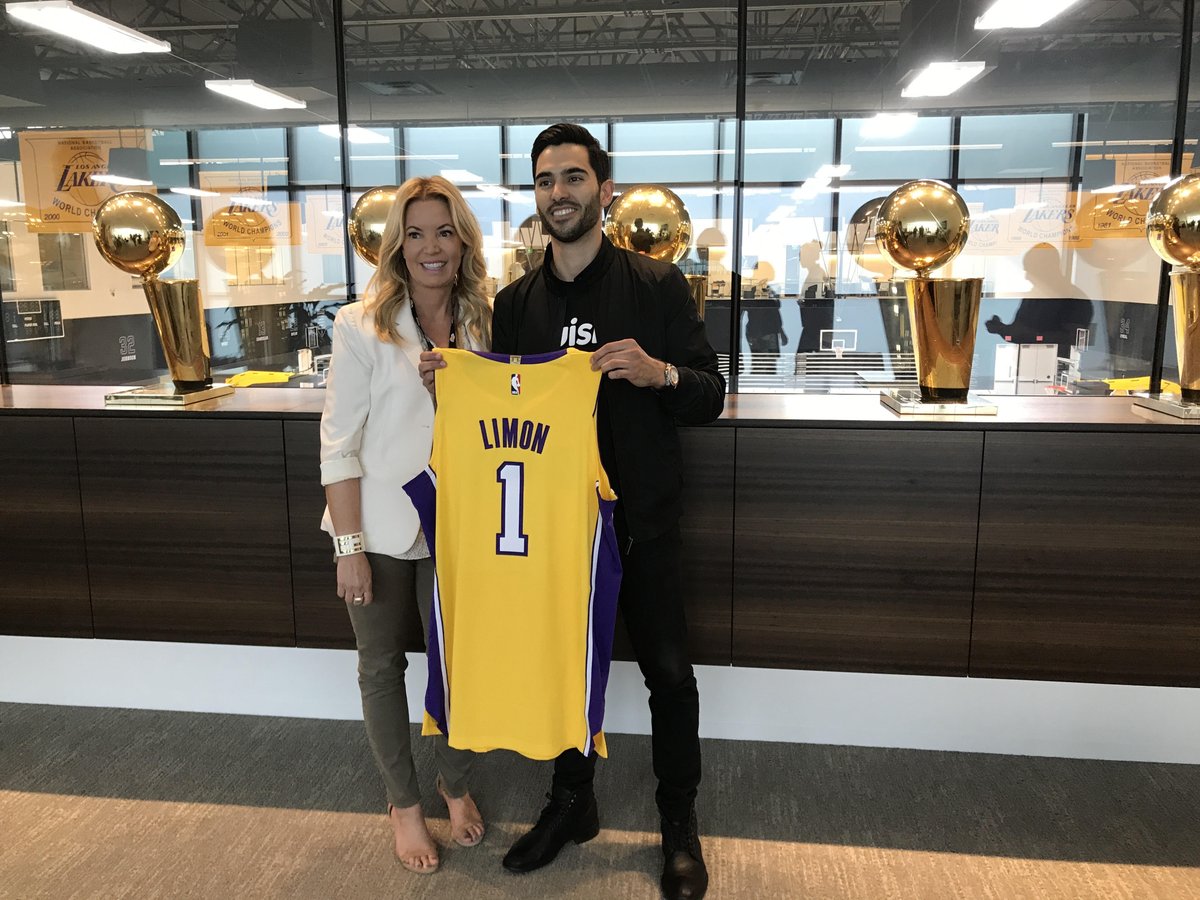
The founder, Peter, is the Michael Jordan of growth & performance marketing. He understands how every moving piece impacts every other piece. But with that, he maintains complete control of what everyone does at the company.
Wish started as a free wishlisting product (get it?), and with that acquired a ton of free demand. They then went to the merchants of the most wishlisted products (in China), and offered this demand to them if they would sell their products on the platform.
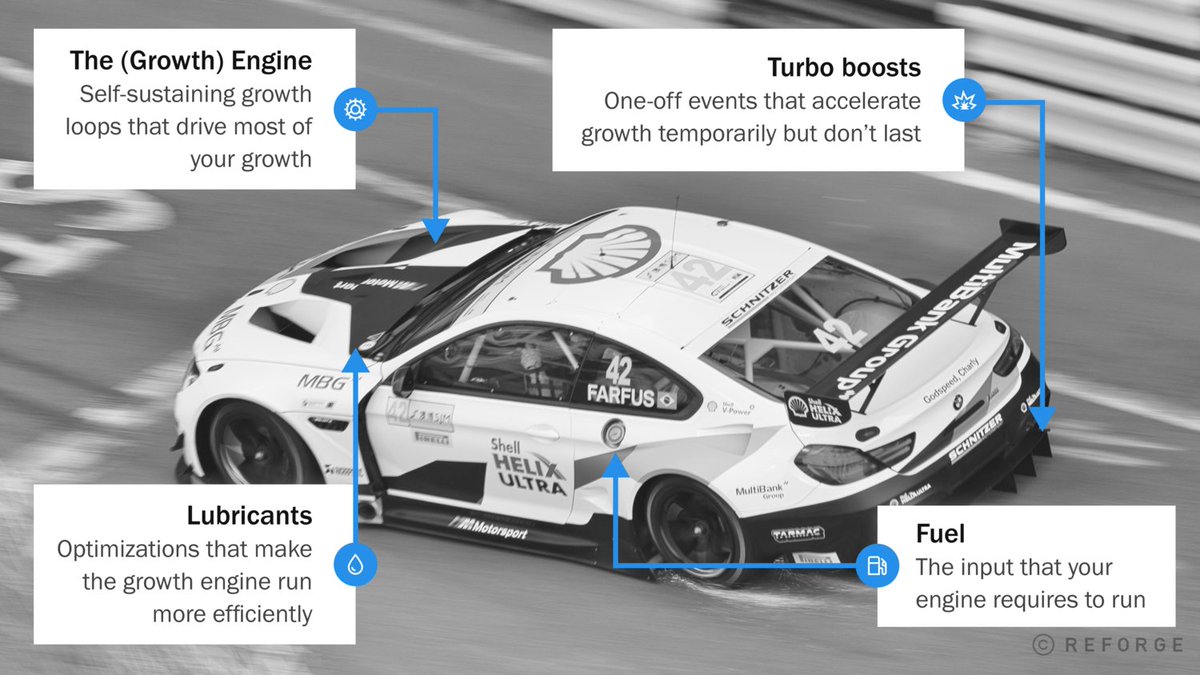
Wish helped invent what is now one of the most significant products within Facebook ads: Dynamic Product Ads. This gives companies the ability to upload a giant list of product SKUs, which FB pulls from to run ads dynamically.
* Efficiency: Probably had a record of GMV to headcount ratio, several million GMV per employee for a long time
* The right timing: Wish was possible because of the combination of growth of smartphones + emergence of FB ads + Peter's unique skillset
* Stunts: Wish also sponsored the Mayweather/MacGregor fight, and some of the world's most successful soccer players
https://t.co/VavQ59kUl4
More from Lenny Rachitsky
Matt Mochary has been CEO coach to @naval, the founders of OpenAI, Notion, Rippling, Robinhood, Coinbase, Reddit, Plaid, Flexport, Opendoor, partners at Sequoia, YC, Benchmark, and many others.
He also open-sourced his entire curriculum, templates and all. Here's a link 👇
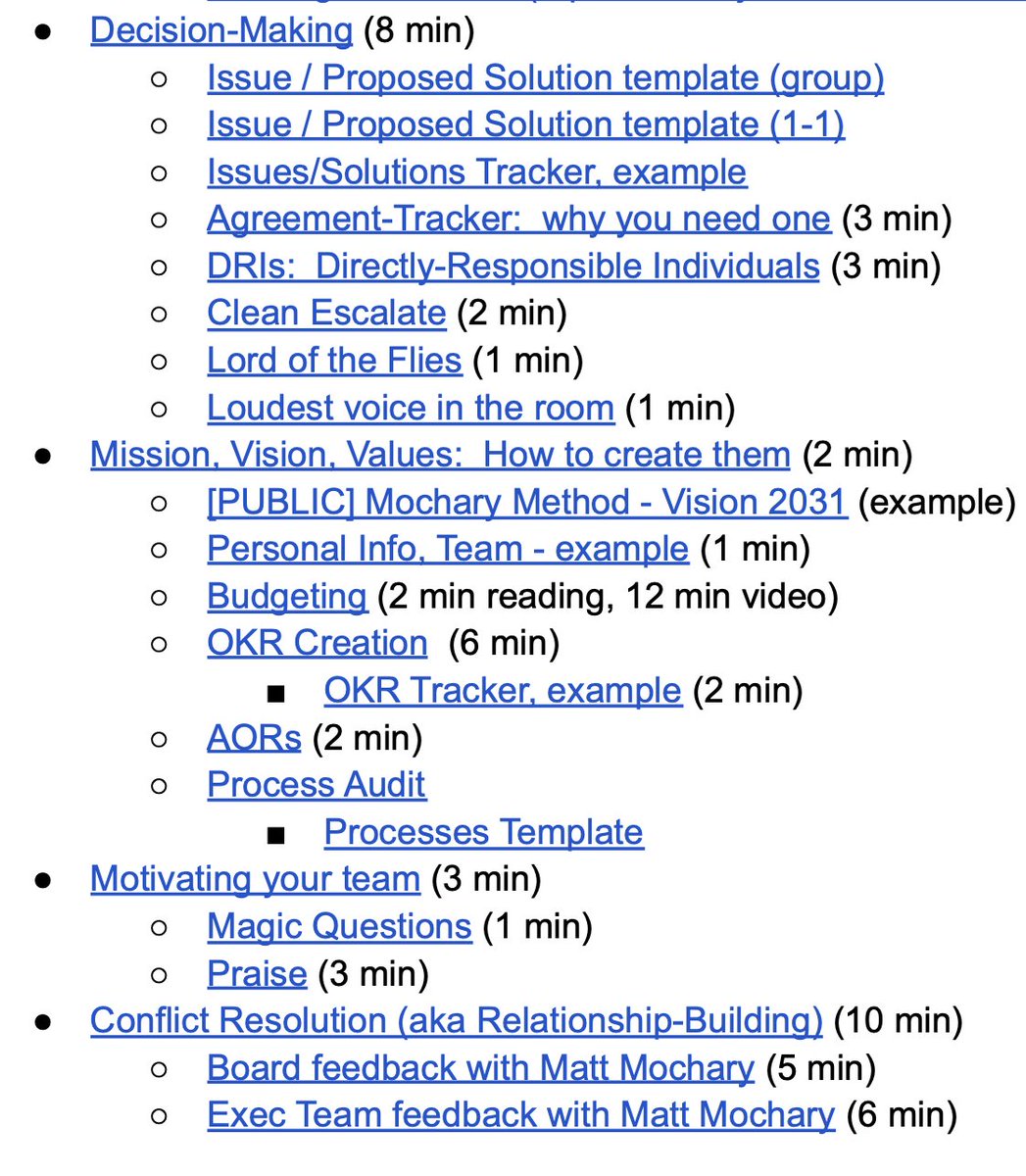
The Mochary Method Curriculum ➔ https://t.co/A8J51IzYhz
My recent conversation with @mattmochary where we talk about fear, anger, innovation, how to lay people off well, and his coaching practice ➔
Also in podcast form ➔
For more from Matt, buy this book
He also open-sourced his entire curriculum, templates and all. Here's a link 👇
The Mochary Method Curriculum ➔ https://t.co/A8J51IzYhz
My recent conversation with @mattmochary where we talk about fear, anger, innovation, how to lay people off well, and his coaching practice ➔
Also in podcast form ➔
For more from Matt, buy this book
Earlier today, I gave a talk at the @SubstackInc's writer conference about building a writing habit. Below are the ten concrete strategies I shared that have helped me publish a post every week for 1.5 years 👇
0/ First of all, just sharing advice about this topic gives me serious impostor syndrome because writing is still pretty new to me, and I have much to learn. But these are things that have helped me, and I hope they'll help you.
1/ Strategy 1: Commit publicly
This was maybe 50% of my initial motivation. Having told people I was going to write weekly made me feel bad when even thinking about skipping a week. It gave me just enough nudge to keep
1b/ You don't need to make this super public. Just sending an email to a few friends regularly with your concrete goals about writing (and anything else) works wonders.
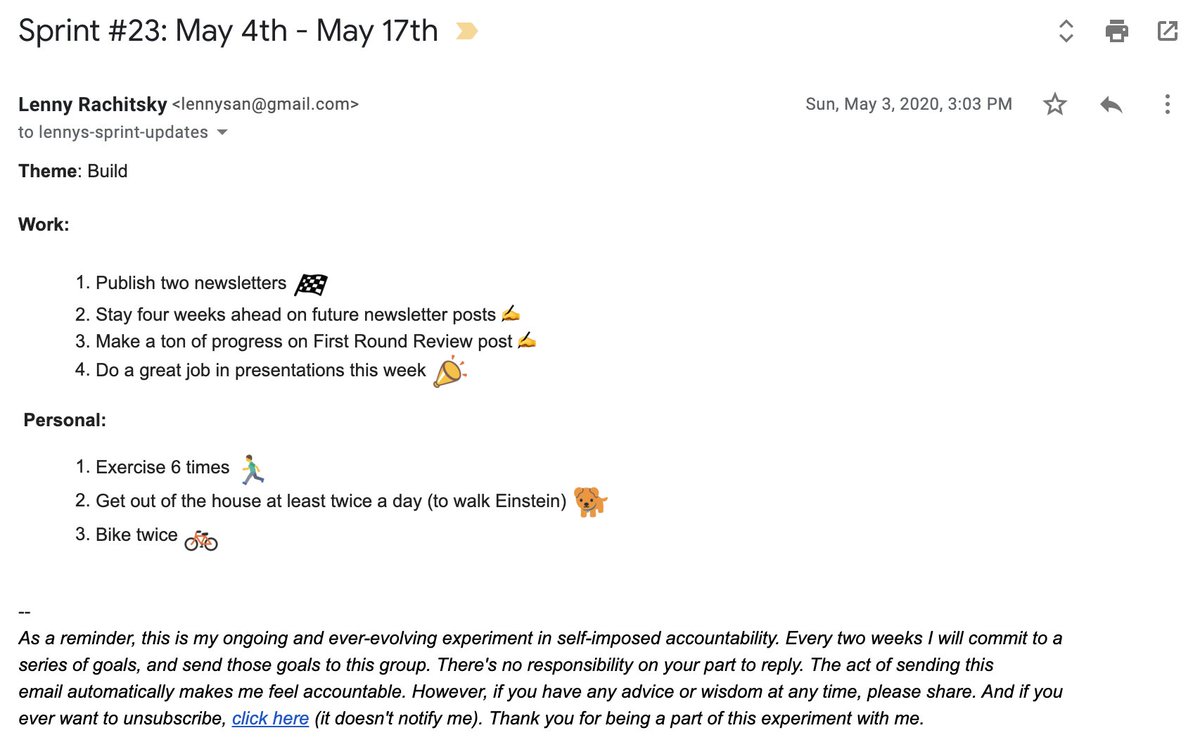
1c/ If you *really* want to be motivated, ask people for money. Nothing motivates you more than people paying you for regular
0/ First of all, just sharing advice about this topic gives me serious impostor syndrome because writing is still pretty new to me, and I have much to learn. But these are things that have helped me, and I hope they'll help you.
1/ Strategy 1: Commit publicly
This was maybe 50% of my initial motivation. Having told people I was going to write weekly made me feel bad when even thinking about skipping a week. It gave me just enough nudge to keep
I'm kicking off an experiment. Inspired by the great @joulee, and building off of the great inbound questions I continue to get from ya'll -- I\u2019m going to start using my newsletter to answer your questions. \U0001f44b
— Lenny Rachitsky (@lennysan) September 12, 2019
Sign up belowhttps://t.co/z1F1efMcue
1b/ You don't need to make this super public. Just sending an email to a few friends regularly with your concrete goals about writing (and anything else) works wonders.
1c/ If you *really* want to be motivated, ask people for money. Nothing motivates you more than people paying you for regular
Life alert: I\u2019m adding a paid plan to my newsletter \U0001f91e
— Lenny Rachitsky (@lennysan) April 7, 2020
After much prodding from readers and friends, I\u2019m going to take the leap and give this life-path a shot.
Consider subscribing and joining me on this journey \U0001f64fhttps://t.co/gtFm4POGSQ
More from World


THREAD
1)
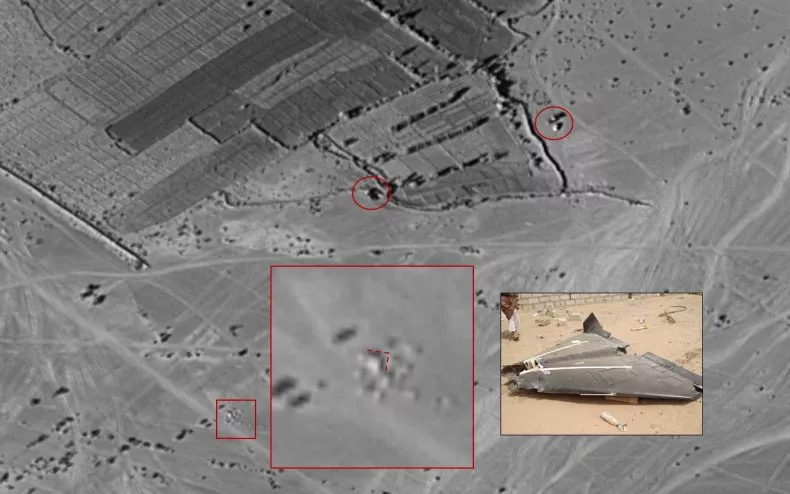
Newsweek — #Iran has sent deadly "Shahed-136 suicide/kamikaze drones" to the Houthis in #Yemen. These advanced UAVs are deployed to the Houthi-controlled northern Yemeni province of Al-Jawf.
More reason why the West should not appease Tehran.
https://t.co/gtNDCGbtQs
2)
#Iran has long provided drones to the Houthis
March 22, 2017
“… seven Houthi Qasef-1 drones and one drone engine recovered by forces from the UAE. Six of the drones were captured in October on a known Iranian smuggling route that runs through
3)
US to designate #Iran-backed Houthis in #Yemen as a foreign terrorist org (FTO)
https://t.co/ILBCg3Pfvs
Iran’s IRGC long funded/armed/trained/provided for the Houthis.
Dec 30—Missile attack on Aden airport. Yemen gov holds Houthis

4)
#Iran provides at least $360 million, ballistic missiles, other ordnance, technology and training to the Houthis in
5)
The Houthis recently claimed responsibility for a missile attack targeting Saudi Arabia’s Aramco oil

1)
Newsweek — #Iran has sent deadly "Shahed-136 suicide/kamikaze drones" to the Houthis in #Yemen. These advanced UAVs are deployed to the Houthi-controlled northern Yemeni province of Al-Jawf.
More reason why the West should not appease Tehran.
https://t.co/gtNDCGbtQs
2)
#Iran has long provided drones to the Houthis
March 22, 2017
“… seven Houthi Qasef-1 drones and one drone engine recovered by forces from the UAE. Six of the drones were captured in October on a known Iranian smuggling route that runs through
3)
US to designate #Iran-backed Houthis in #Yemen as a foreign terrorist org (FTO)
https://t.co/ILBCg3Pfvs
Iran’s IRGC long funded/armed/trained/provided for the Houthis.
Dec 30—Missile attack on Aden airport. Yemen gov holds Houthis
4)
#Iran provides at least $360 million, ballistic missiles, other ordnance, technology and training to the Houthis in
5)
The Houthis recently claimed responsibility for a missile attack targeting Saudi Arabia’s Aramco oil



"MLs" do support the proletariat of Xinjiang & have the whole time. People like @Tursunali_7 & @GulnarNorthwest (and many others) who show the world the real Xinjiang via their everyday videos.
Shopkeepers like in this video below say
"Pompeo, we Xinjiang people hate you."

Or everyday working people like Zaynura Namatqari, who speak out against vicious & disgusting US lies and accusations about
.@qiaocollective have a brilliant thread of everyday proletarian Uyghurs speaking out against the harassment they face from the US and their paid
'Uyghur proletariat' looks like this:

Not like this: (photo from a pro Islamist separatist protest in Turkey in 2017)

Shopkeepers like in this video below say
"Pompeo, we Xinjiang people hate you."
Or everyday working people like Zaynura Namatqari, who speak out against vicious & disgusting US lies and accusations about
BBC's false reporting is hurting real Uygurs.
— Jingjing Li \u674e\u83c1\u83c1 (@Jingjing_Li) February 13, 2021
At a press conference, I saw this Uygur lady, who is a former trainee of a vocational education & training center in #Xinjiang, got emotional & furious at @BBC 's false reporting accusing systematic rape in #China. #Uyghur pic.twitter.com/vdu7KlAWMr
.@qiaocollective have a brilliant thread of everyday proletarian Uyghurs speaking out against the harassment they face from the US and their paid
The family of a retired cadre scorn Pompeo and the American imperialist interests he stands for. They celebrate China's sanctioning of Pompeo as the proper move against U.S. imperialist designs on Xinjiang. pic.twitter.com/vOfExwMfD8
— Qiao Collective (@qiaocollective) February 12, 2021
'Uyghur proletariat' looks like this:
Not like this: (photo from a pro Islamist separatist protest in Turkey in 2017)

You May Also Like

1/“What would need to be true for you to….X”
Why is this the most powerful question you can ask when attempting to reach an agreement with another human being or organization?
A thread, co-written by @deanmbrody:
2/ First, “X” could be lots of things. Examples: What would need to be true for you to
- “Feel it's in our best interest for me to be CMO"
- “Feel that we’re in a good place as a company”
- “Feel that we’re on the same page”
- “Feel that we both got what we wanted from this deal
3/ Normally, we aren’t that direct. Example from startup/VC land:
Founders leave VC meetings thinking that every VC will invest, but they rarely do.
Worse over, the founders don’t know what they need to do in order to be fundable.
4/ So why should you ask the magic Q?
To get clarity.
You want to know where you stand, and what it takes to get what you want in a way that also gets them what they want.
It also holds them (mentally) accountable once the thing they need becomes true.
5/ Staying in the context of soliciting investors, the question is “what would need to be true for you to want to invest (or partner with us on this journey, etc)?”
Multiple responses to this question are likely to deliver a positive result.
Why is this the most powerful question you can ask when attempting to reach an agreement with another human being or organization?
A thread, co-written by @deanmbrody:
Next level tactic when closing a sale, candidate, or investment:
— Erik Torenberg (@eriktorenberg) February 27, 2018
Ask: \u201cWhat needs to be true for you to be all in?\u201d
You'll usually get an explicit answer that you might not get otherwise. It also holds them accountable once the thing they need becomes true.
2/ First, “X” could be lots of things. Examples: What would need to be true for you to
- “Feel it's in our best interest for me to be CMO"
- “Feel that we’re in a good place as a company”
- “Feel that we’re on the same page”
- “Feel that we both got what we wanted from this deal
3/ Normally, we aren’t that direct. Example from startup/VC land:
Founders leave VC meetings thinking that every VC will invest, but they rarely do.
Worse over, the founders don’t know what they need to do in order to be fundable.
4/ So why should you ask the magic Q?
To get clarity.
You want to know where you stand, and what it takes to get what you want in a way that also gets them what they want.
It also holds them (mentally) accountable once the thing they need becomes true.
5/ Staying in the context of soliciting investors, the question is “what would need to be true for you to want to invest (or partner with us on this journey, etc)?”
Multiple responses to this question are likely to deliver a positive result.



Neo-nazi group #PatriotFront held a photo op in #Chicago last weekend & is currently marching around #DC so it's as good time as any to compile a list of their identified members for folks to watch for
Who are these chuds?
Patriot Front broke away from white nationalist org Vanguard America following #unitetheright in #charlottesville after James Alex Fields was seen with a VA shield before driving his car into a crowd, murdering Heather Heyer & injuring dozens of others
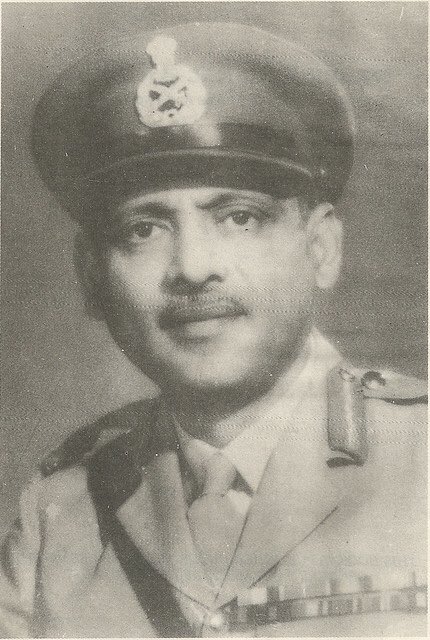
Syed Robbie Javid a.k.a. Sayed Robbie Javid or Robbie Javid of Alexandria,
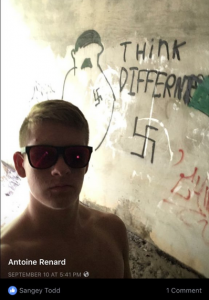
Antoine Bernard Renard (a.k.a. “Charlemagne MD” on Discord) from Rockville, MD.
https://t.co/ykEjdZFDi6
Brandon Troy Higgs, 25, from Reisterstown,
Who are these chuds?
Patriot Front broke away from white nationalist org Vanguard America following #unitetheright in #charlottesville after James Alex Fields was seen with a VA shield before driving his car into a crowd, murdering Heather Heyer & injuring dozens of others
Syed Robbie Javid a.k.a. Sayed Robbie Javid or Robbie Javid of Alexandria,
Happy Monday everyone :-) Let's ring in September by reacquainting ourselves with Virginia neo-Nazi and NSC Dixie affiliate Sayed "Robbie" Javid, now known by "Reform the States". Robbie is an explicitly genocidal neo-Nazi, so lets get to know him a bit better!
— Garfield but Anti-Fascist (@AntifaGarfield) August 31, 2020
CW on this thread pic.twitter.com/3gzxrIo9HD
Antoine Bernard Renard (a.k.a. “Charlemagne MD” on Discord) from Rockville, MD.
https://t.co/ykEjdZFDi6
Brandon Troy Higgs, 25, from Reisterstown,