https://t.co/YXvnzxegSC
A Master thread on @Singh7575 Sir's Long Only Setups with examples on Charts!
This setup is a gift to anyone who trades long ideas and those who want to trade in CASH due to Capital Constraint. Fits best for people who don't do FNO as this picks some amazing scripts.
https://t.co/YXvnzxegSC
This setup best fits in @tradingview /@zerodhaonline or any broker that provides charting. We only need 2 Indicators.
Indicator 1- 13EMA
Indicator 2 - 34EMA
Both indicators are compulsory and should be exponential(EMA) instead of Simple moving average.(SMA)
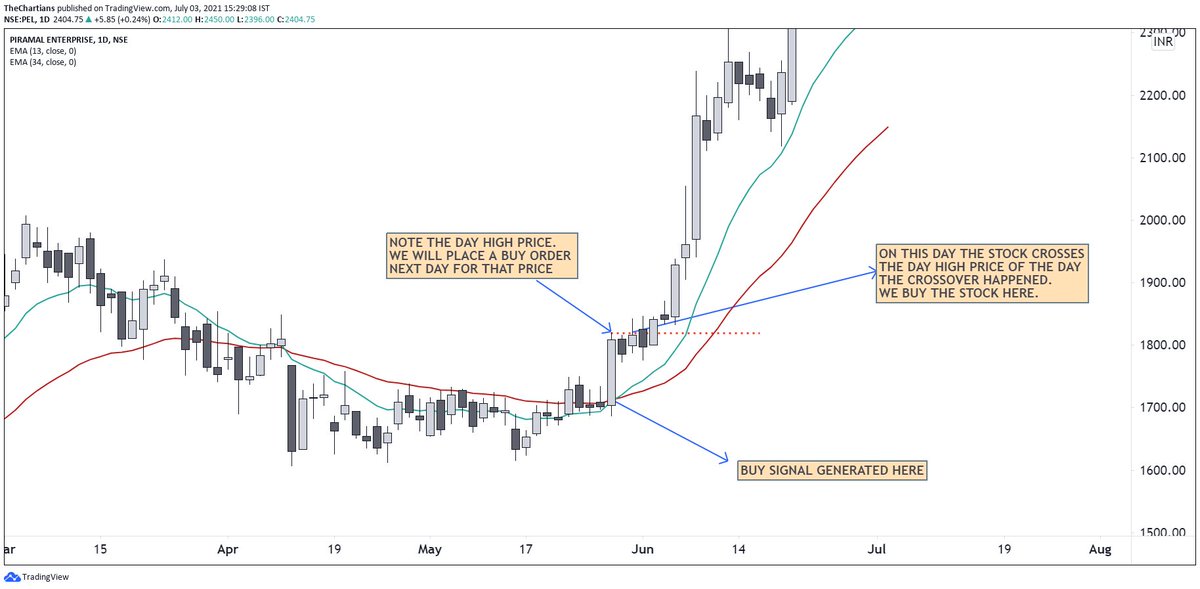
Whenever this Setup meets a condition where 13EMA crosses 34EMA from below as depicted in the chart. Whenever the 13EMA crosses 34EMA from below it is a LONG (BUY) SIGNAL.
❗️Timeframe needs to be Daily Only!
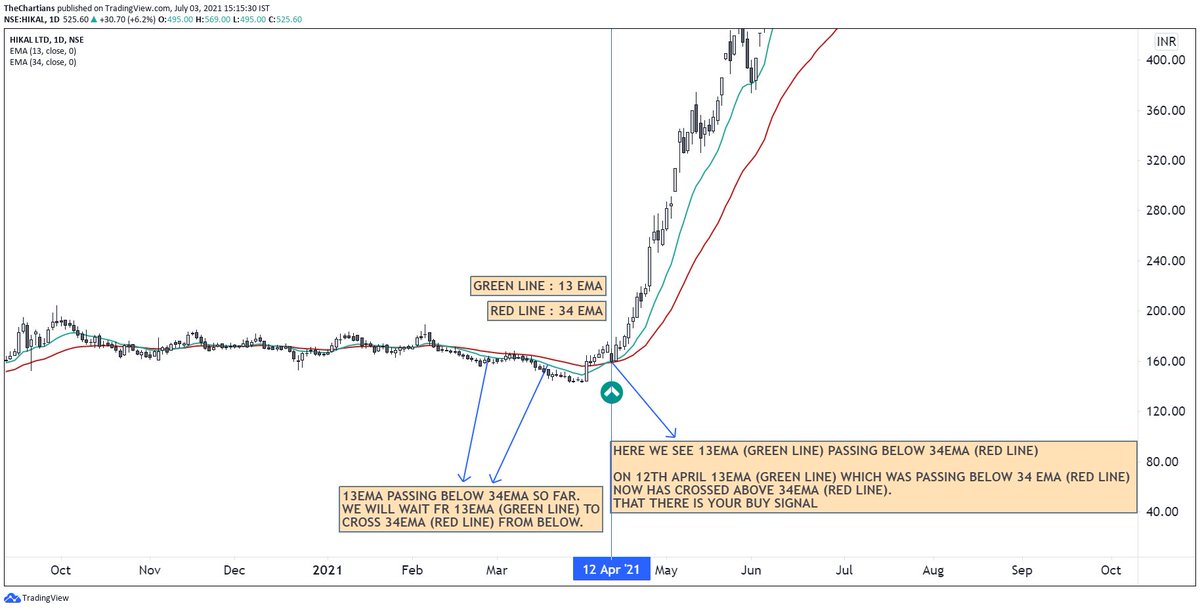
The Condition is to place order above the Day's High when crossover happened. Place buying bid above Previous Day’s high. If on current day the stock
doesn’t cross previous day’s high, place a buying bid the next day above current day’s high. For E.g.
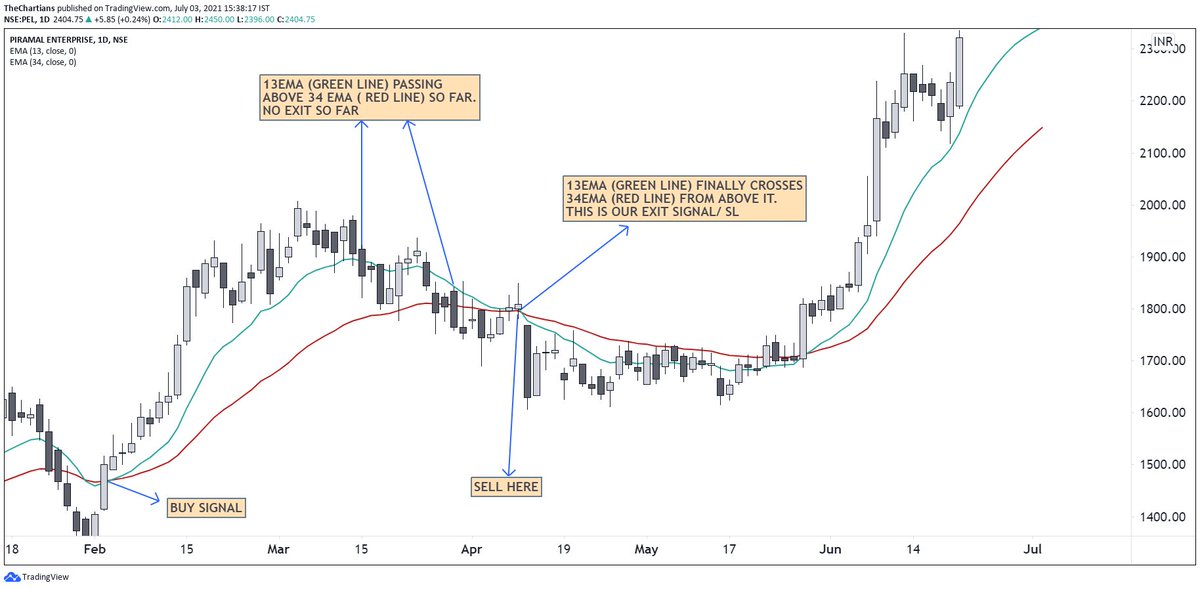
Whenever the 13EMA crosses 34EMA from above it is a signal to EXIT or take your SL. For E.g.
SL is a very subjective but vital part in any trading setup. Some take SL based on certain%, PREVIOUS DAY LOW, WEEK LOW. For our comfort on the system we usually take SL as following.
Entry is near a SWING LOW we take SWING LOW as SL.
Let's see how we did it.


Angad Sir's YouTube Channel.
https://t.co/NyAnucpLjU
More from The Chartians
To be a Successful Trader you need Edge.
And Edge comes with Data and Resources.
But 90% of Retail don’t have access to authentic educational data.
This compilation is surely a 50,000₹ Technical Analysis’s course in itself 🧵
https://t.co/PTeE1Hms9Y
https://t.co/2JvDpSzHds
https://t.co/QuX8o1MUbo
https://t.co/5dBdHq9CBY
And Edge comes with Data and Resources.
But 90% of Retail don’t have access to authentic educational data.
This compilation is surely a 50,000₹ Technical Analysis’s course in itself 🧵
https://t.co/PTeE1Hms9Y
Trading on chart patterns is difficult, Until you see this:
— The Chartians (@chartians) August 6, 2022
Free Technical Analysis course (1/10) \U0001f9f5
https://t.co/2JvDpSzHds
Trading on chart patterns is difficult, Until you read this ! \u26a1\ufe0f
— The Chartians (@chartians) August 21, 2022
Everything about Cup and Handle Pattern
Free Technical Analysis course (2/10) \U0001f9f5
https://t.co/QuX8o1MUbo
Trading on chart patterns is difficult until you read this !\u26a1\ufe0f
— The Chartians (@chartians) August 28, 2022
Everything about Ascending Triangle Pattern
Free Technical Analysis course (3/10) \U0001f9f5
https://t.co/5dBdHq9CBY
Trading on chart patterns is difficult, Until you read this ! \u26a1\ufe0f
— The Chartians (@chartians) October 9, 2022
Everything about Head and Shoulder Pattern
Free Technical Analysis course (4/10) \U0001f9f5
Took me 5 years to get the best Chartink scanners for Stock Market, but you’ll get it in 5 mminutes here ⏰
Do Share the above tweet 👆
These are going to be very simple yet effective pure price action based scanners, no fancy indicators nothing - hope you liked it.
https://t.co/JU0MJIbpRV
52 Week High
One of the classic scanners very you will get strong stocks to Bet on.
https://t.co/V69th0jwBr
Hourly Breakout
This scanner will give you short term bet breakouts like hourly or 2Hr breakout
Volume shocker
Volume spurt in a stock with massive X times
Do Share the above tweet 👆
These are going to be very simple yet effective pure price action based scanners, no fancy indicators nothing - hope you liked it.
https://t.co/JU0MJIbpRV
52 Week High
One of the classic scanners very you will get strong stocks to Bet on.
https://t.co/V69th0jwBr
Hourly Breakout
This scanner will give you short term bet breakouts like hourly or 2Hr breakout
Volume shocker
Volume spurt in a stock with massive X times
Find out the answer for the question we asked today morning.
Here is the
Here is the
Glad that many could guess/ know the candle stick pattern and mainly know how to use it.
— The Chartians (@chartians) July 24, 2021
The one shown in the image was bullish Harami
The word Harami comes from an old Japanese word meaning pregnant.. pic.twitter.com/4qBDCyY2Pq


More from Stockslearnings




4 factors to measure the performance of a trading system:
1 - Accuracy
There is no such thing as 90% Accuracy without compromising on other factors (like profit factor, etc)
Fact - A good trading system will have only 35-60% accuracy without compromising other factors.
(1/n)
2 - Profit Factor (PF)
It is similar to risk-reward. It is derived using the below formula:
Profit Factor = Total Profit by winning trades / Total loss by losing trades
Fact - A trading system above 1.2 PF is good if it scores well with other factors.
(2/n)
3 - Maximum Drawdown
The maximum drawdown also plays a vital role psychologically while picking a trading system.
Fact - Maximum Drawdown in any trading system should not exceed 20%. I suggest picking only the techniques which have less than 10% maximum drawdown.
(3/n)
4 - Maximum Consecutive Losers
We all feel bad even if we lose only Rs.1,000 in a trade. Because it is not only about the money, it is emotionally difficult to accept the failure.
Fact - A good trading system will have less than 15 consecutive losing trades.
(4/n)
TRADE LIKE CRAZY
10 Profitable Intraday Trading Systems, which are backtested against 10-years of Banknifty Historical Data!
(n/n)
https://t.co/BuUie17Ish
1 - Accuracy
There is no such thing as 90% Accuracy without compromising on other factors (like profit factor, etc)
Fact - A good trading system will have only 35-60% accuracy without compromising other factors.
(1/n)
2 - Profit Factor (PF)
It is similar to risk-reward. It is derived using the below formula:
Profit Factor = Total Profit by winning trades / Total loss by losing trades
Fact - A trading system above 1.2 PF is good if it scores well with other factors.
(2/n)
3 - Maximum Drawdown
The maximum drawdown also plays a vital role psychologically while picking a trading system.
Fact - Maximum Drawdown in any trading system should not exceed 20%. I suggest picking only the techniques which have less than 10% maximum drawdown.
(3/n)
4 - Maximum Consecutive Losers
We all feel bad even if we lose only Rs.1,000 in a trade. Because it is not only about the money, it is emotionally difficult to accept the failure.
Fact - A good trading system will have less than 15 consecutive losing trades.
(4/n)
TRADE LIKE CRAZY
10 Profitable Intraday Trading Systems, which are backtested against 10-years of Banknifty Historical Data!
(n/n)
https://t.co/BuUie17Ish
You May Also Like

1/ Some initial thoughts on personal moats:
Like company moats, your personal moat should be a competitive advantage that is not only durable—it should also compound over time.
Characteristics of a personal moat below:
2/ Like a company moat, you want to build career capital while you sleep.
As Andrew Chen noted:
3/ You don’t want to build a competitive advantage that is fleeting or that will get commoditized
Things that might get commoditized over time (some longer than
4/ Before the arrival of recorded music, what used to be scarce was the actual music itself — required an in-person artist.
After recorded music, the music itself became abundant and what became scarce was curation, distribution, and self space.
5/ Similarly, in careers, what used to be (more) scarce were things like ideas, money, and exclusive relationships.
In the internet economy, what has become scarce are things like specific knowledge, rare & valuable skills, and great reputations.
Like company moats, your personal moat should be a competitive advantage that is not only durable—it should also compound over time.
Characteristics of a personal moat below:
I'm increasingly interested in the idea of "personal moats" in the context of careers.
— Erik Torenberg (@eriktorenberg) November 22, 2018
Moats should be:
- Hard to learn and hard to do (but perhaps easier for you)
- Skills that are rare and valuable
- Legible
- Compounding over time
- Unique to your own talents & interests https://t.co/bB3k1YcH5b
2/ Like a company moat, you want to build career capital while you sleep.
As Andrew Chen noted:
People talk about \u201cpassive income\u201d a lot but not about \u201cpassive social capital\u201d or \u201cpassive networking\u201d or \u201cpassive knowledge gaining\u201d but that\u2019s what you can architect if you have a thing and it grows over time without intensive constant effort to sustain it
— Andrew Chen (@andrewchen) November 22, 2018
3/ You don’t want to build a competitive advantage that is fleeting or that will get commoditized
Things that might get commoditized over time (some longer than
Things that look like moats but likely aren\u2019t or may fade:
— Erik Torenberg (@eriktorenberg) November 22, 2018
- Proprietary networks
- Being something other than one of the best at any tournament style-game
- Many "awards"
- Twitter followers or general reach without "respect"
- Anything that depends on information asymmetry https://t.co/abjxesVIh9
4/ Before the arrival of recorded music, what used to be scarce was the actual music itself — required an in-person artist.
After recorded music, the music itself became abundant and what became scarce was curation, distribution, and self space.
5/ Similarly, in careers, what used to be (more) scarce were things like ideas, money, and exclusive relationships.
In the internet economy, what has become scarce are things like specific knowledge, rare & valuable skills, and great reputations.