
There is little understanding within Australian society of the requirement to and legitimacy of adopting special measures.
Such a waste
— Steve Grey (@Stephen_J_Grey) January 28, 2021
https://t.co/eOqOtedwo6
Promote substantive equality before the law for Aboriginal and Torres Strait Islander peoples;
Promote fairer enforcement of the law and fairer application of legal frameworks;
Make available to Aboriginal and Torres Strait Islander offenders alternatives to imprisonment that are appropriate to the offence and the offender’s circumstances; &
The Report represents findings from 11 months of research, 149 national consultations and more than 120 submissions.
A Summary Report is also available.
https://t.co/D8VbFR8BHS
More from Kirsti Miller




More from Society




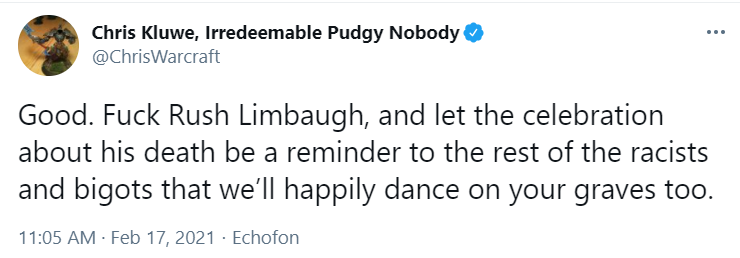
Shall we do a thread of Blue Checks spewing hatred towards Rush Limbaugh and the rest of us on the Right?
https://t.co/eXLNam2gv4
https://t.co/eXLNam2gv4
Good. Fuck Rush Limbaugh, and let the celebration about his death be a reminder to the rest of the racists and bigots that we\u2019ll happily dance on your graves too.
— Chris Kluwe, Irredeemable Pudgy Nobody (@ChrisWarcraft) February 17, 2021

Like most movements, I have learned that the definition of feminism has expanded to include simply treating women like human beings.
(A thread for whoever feels like reading)
I have observed feminists on Twitter advocating for rape victims to be heard, rapists to be held accountable, for people to address the misogyny that is deeply rooted in our culture, and for women to be treated with respect.
To me, very easy things to get behind.
And the amount of pushback they receive for those very basic requests is appalling. I see men trip over themselves to defend rape and rapists and misogyny every chance they get. Some accounts are completely dedicated to harassing women on this site. It’s unhealthy.
Furthermore, I have observed how dedicated these misogynists are by how they treat other men that do not immediately side with them. There is an entire lexicon they have created for men who do not openly treat women with disrespect.
Ex: simp, cuck, white knight, beta
All examples of terms they use to demean a man who respects women.
To paraphrase what a wise man on this app said:
Some men hate women so much, they hate men who don’t hate women
(A thread for whoever feels like reading)
Neighborhood gents, what\u2019s something you\u2019ve learned about feminism (or gained a better understanding of) that you think other men should know?
— feminist next door (@emrazz) February 19, 2021
Note - the quoted is a friendly/good faith replier. https://t.co/048kuxxX6q
I have observed feminists on Twitter advocating for rape victims to be heard, rapists to be held accountable, for people to address the misogyny that is deeply rooted in our culture, and for women to be treated with respect.
To me, very easy things to get behind.
And the amount of pushback they receive for those very basic requests is appalling. I see men trip over themselves to defend rape and rapists and misogyny every chance they get. Some accounts are completely dedicated to harassing women on this site. It’s unhealthy.
Furthermore, I have observed how dedicated these misogynists are by how they treat other men that do not immediately side with them. There is an entire lexicon they have created for men who do not openly treat women with disrespect.
Ex: simp, cuck, white knight, beta
All examples of terms they use to demean a man who respects women.
To paraphrase what a wise man on this app said:
Some men hate women so much, they hate men who don’t hate women


