It's a secret recipe 😋
But I can give you some pointers-
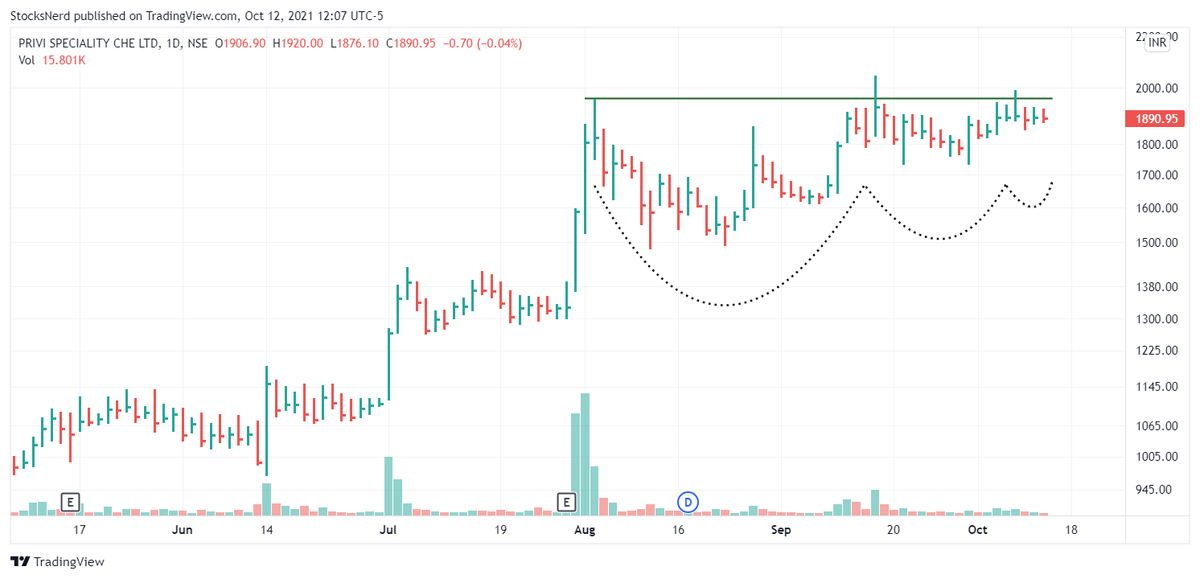
1) Choose stocks in Stage 2 with RS > 75
2) Identify these setups - Cup with Handle, High Tight Flag, Rectangle, VCP, Squat, Low Cheat, 3-C.
2) Wait for the significant contraction in daily range, volatility & Volume.
How do u screen stocks???
— \u2206bhishek Jain (@AbhishekTMM) August 6, 2021
More from Ravi Sharma
I use 4 scanners:
1) Volatility, Volume & daily range compression scanner
2) Punch-Drunk-Love
3) GE Ratio - to track fundamentally strong stocks
4) Recently created one to track Power Play setups.
I get around 150-200 stocks daily & choose the ones with the most potential.
1) Volatility, Volume & daily range compression scanner
2) Punch-Drunk-Love
3) GE Ratio - to track fundamentally strong stocks
4) Recently created one to track Power Play setups.
I get around 150-200 stocks daily & choose the ones with the most potential.
Sir, How do u find a set up - Do you track chart of each stock daily ? Or do u have filters , that lead you to a number of stocks , after which you scan them.
— AKASH GUPTA (@lockdownmurti) August 25, 2021
Read everything written on Wyckoff, Livermore and written by Wyckoff, Livermore.
You would find the roots of all patterns, especially the trend/momentum following ones in their methods.
Once you get the dynamics of Price/Volume, any good book on chart patterns will do.
You would find the roots of all patterns, especially the trend/momentum following ones in their methods.
Once you get the dynamics of Price/Volume, any good book on chart patterns will do.
Any book in which we can read such patterns and the knowledge you have?
— Krish (@MasculinityMon1) August 13, 2021
More from Screeners

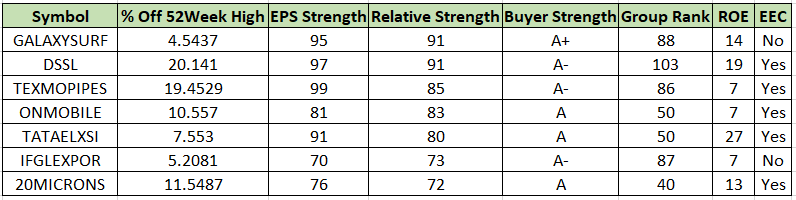
This scan will give you linear/smooth/non-choppy trends which are great for pullback trades for working people.
#BroTip
#BroTip
If you want to trade only stocks with established trend/momentum, then you can look for stocks which have never(or barely did) closed below a certain MA (say 50MA) in the last say 50 days.
— Manas Arora (@iManasArora) November 8, 2021
There are countless ways to run scans. Just have to get creative. #BroTip