
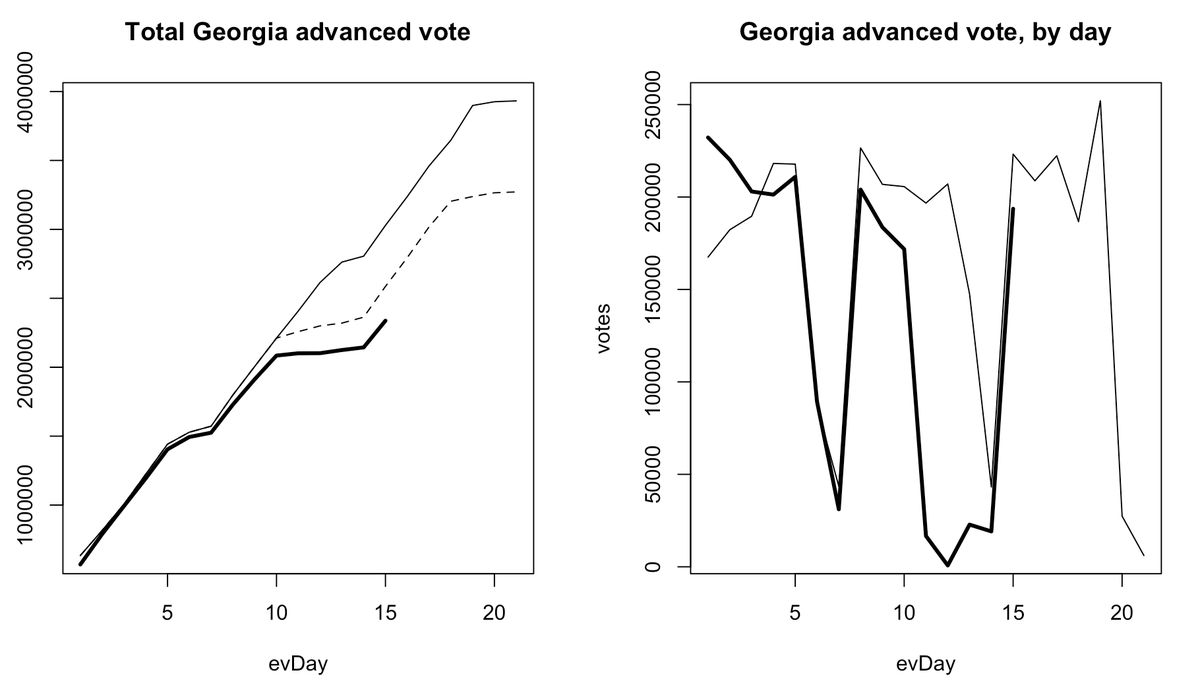
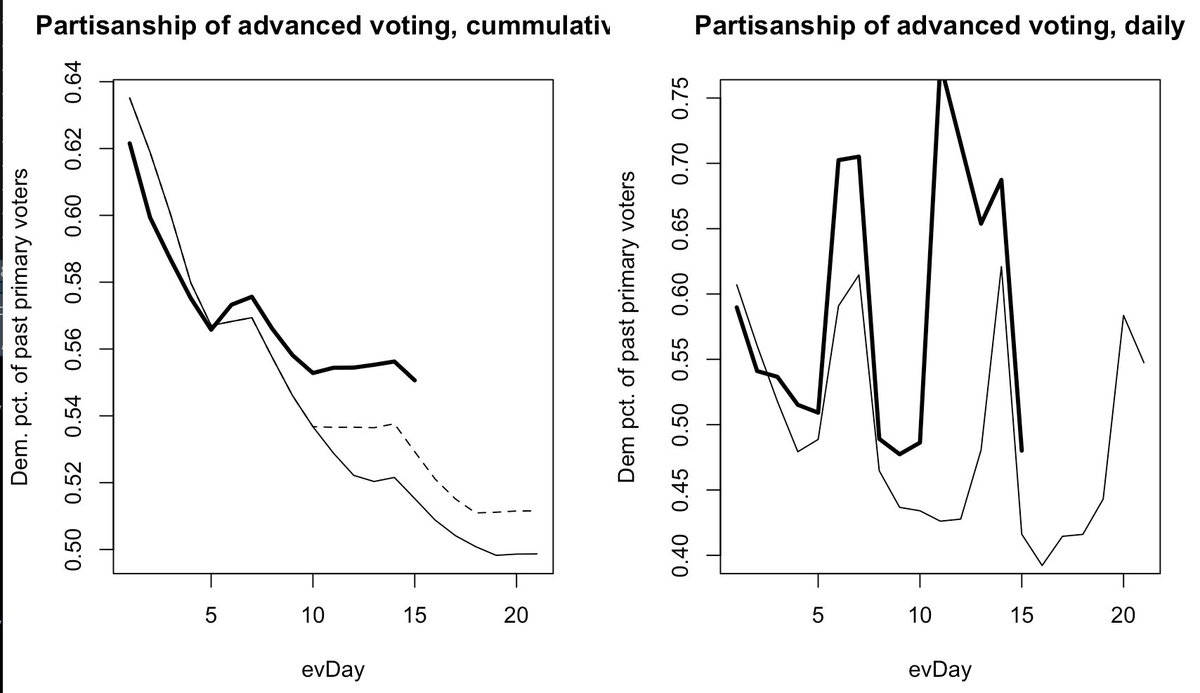
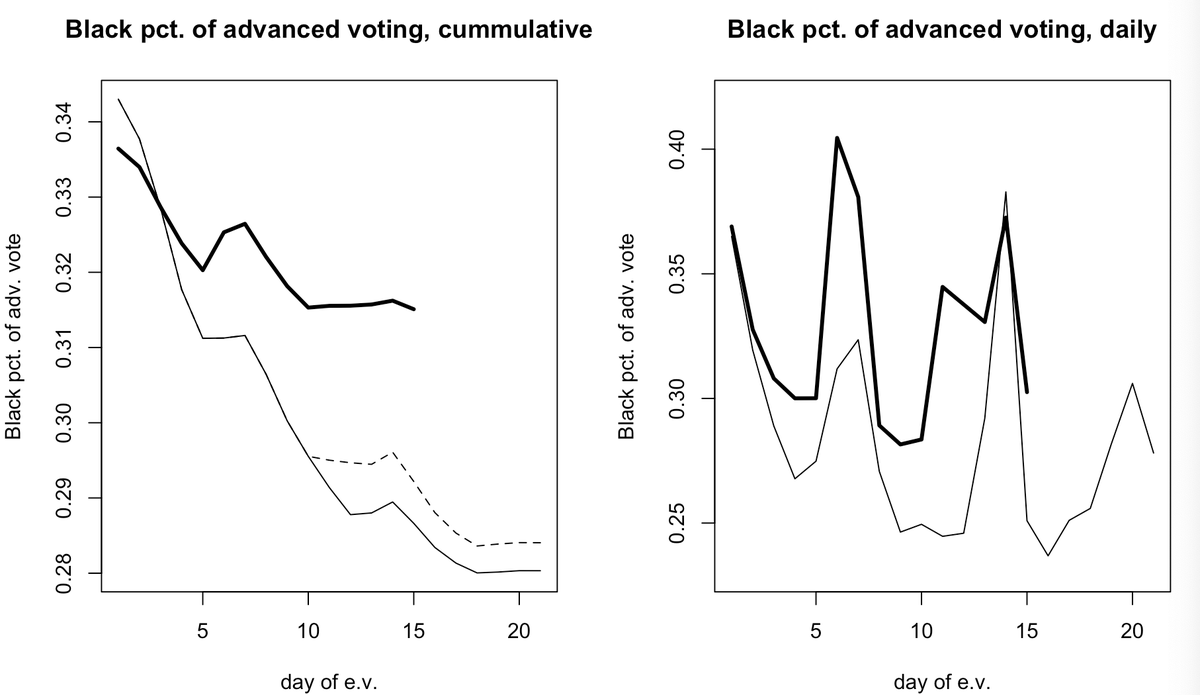
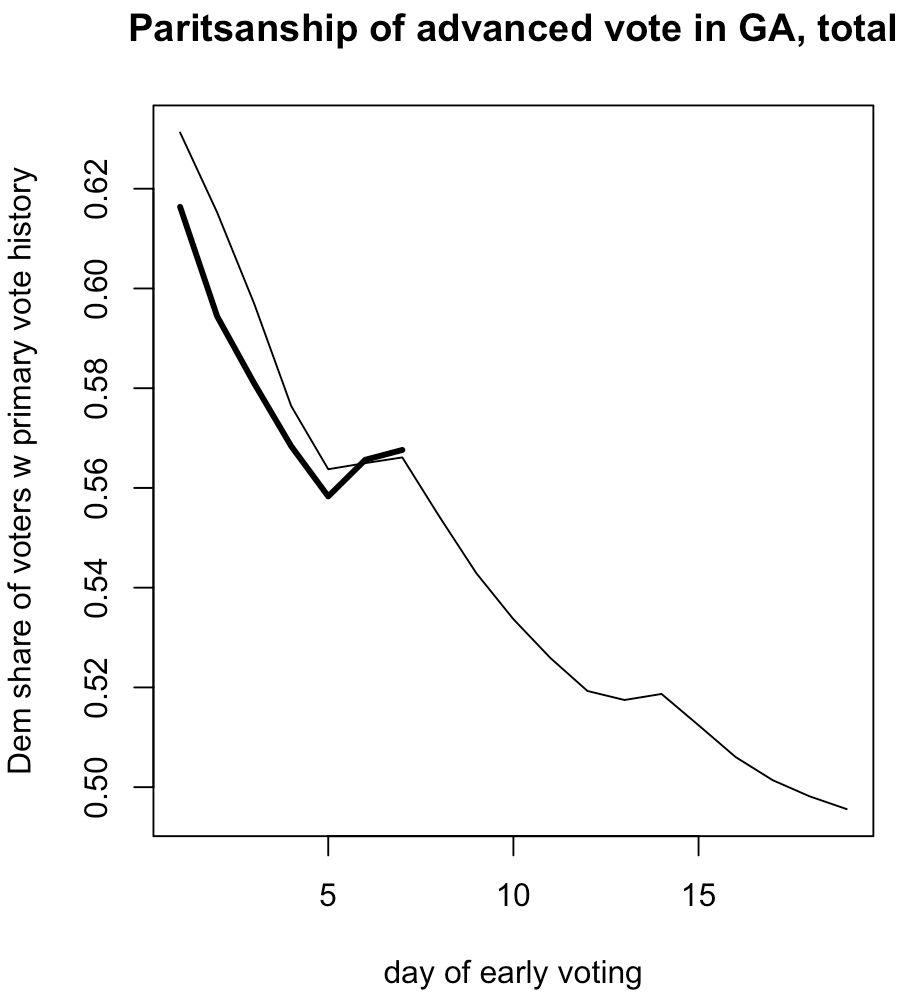
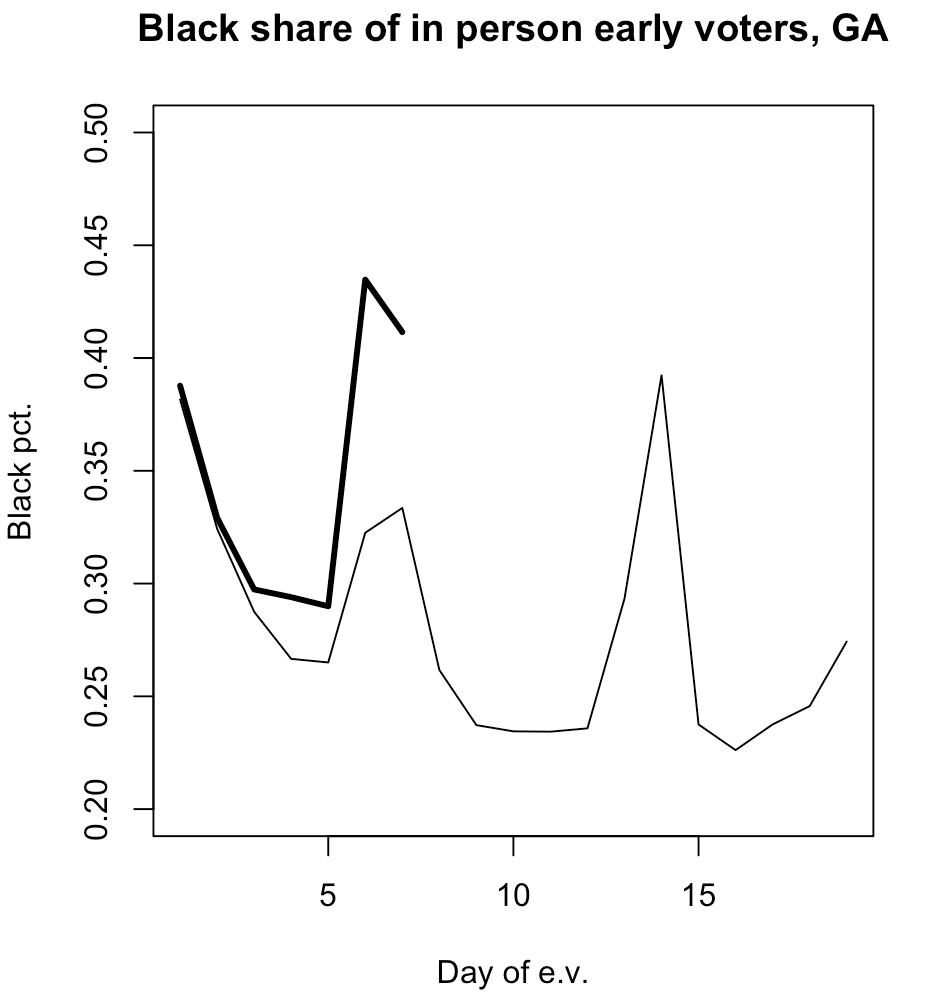
Day 11-13 were fairly good days for the GOP in Oct.; they run farther behind without those days, but we have no reason to think that's for a meaningful reason
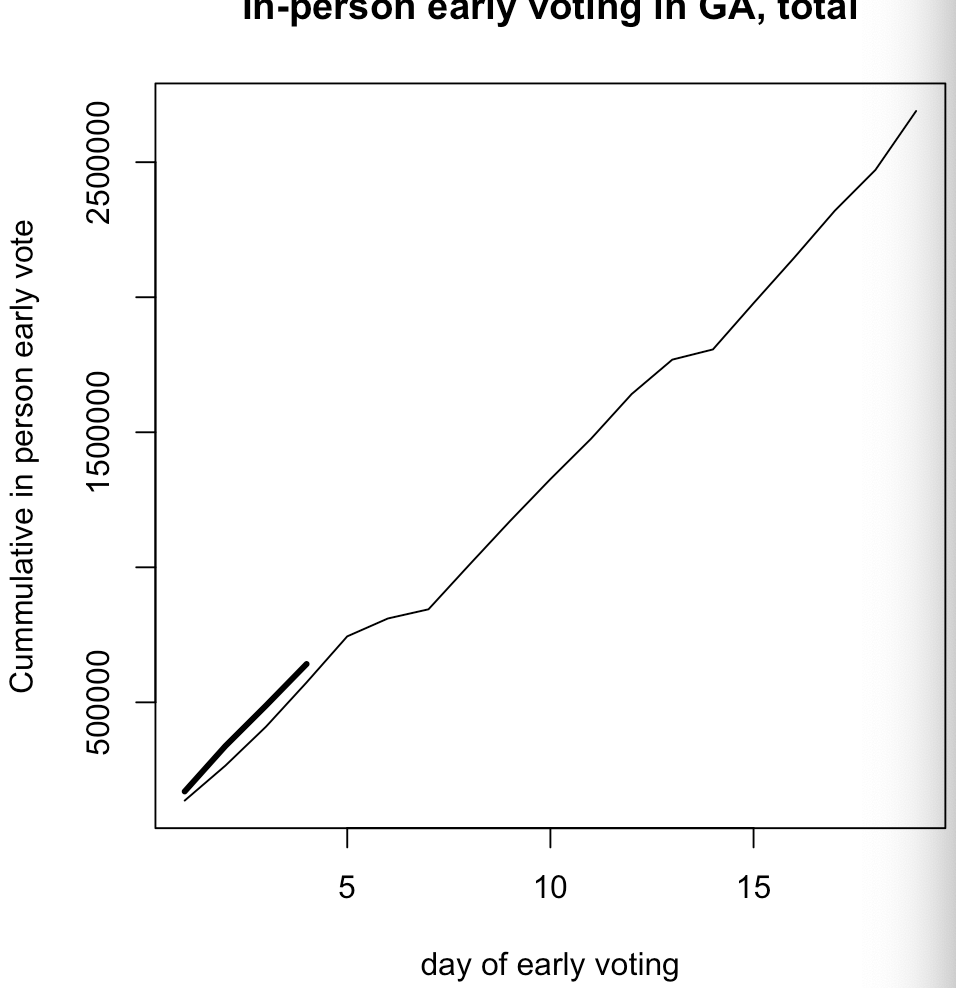
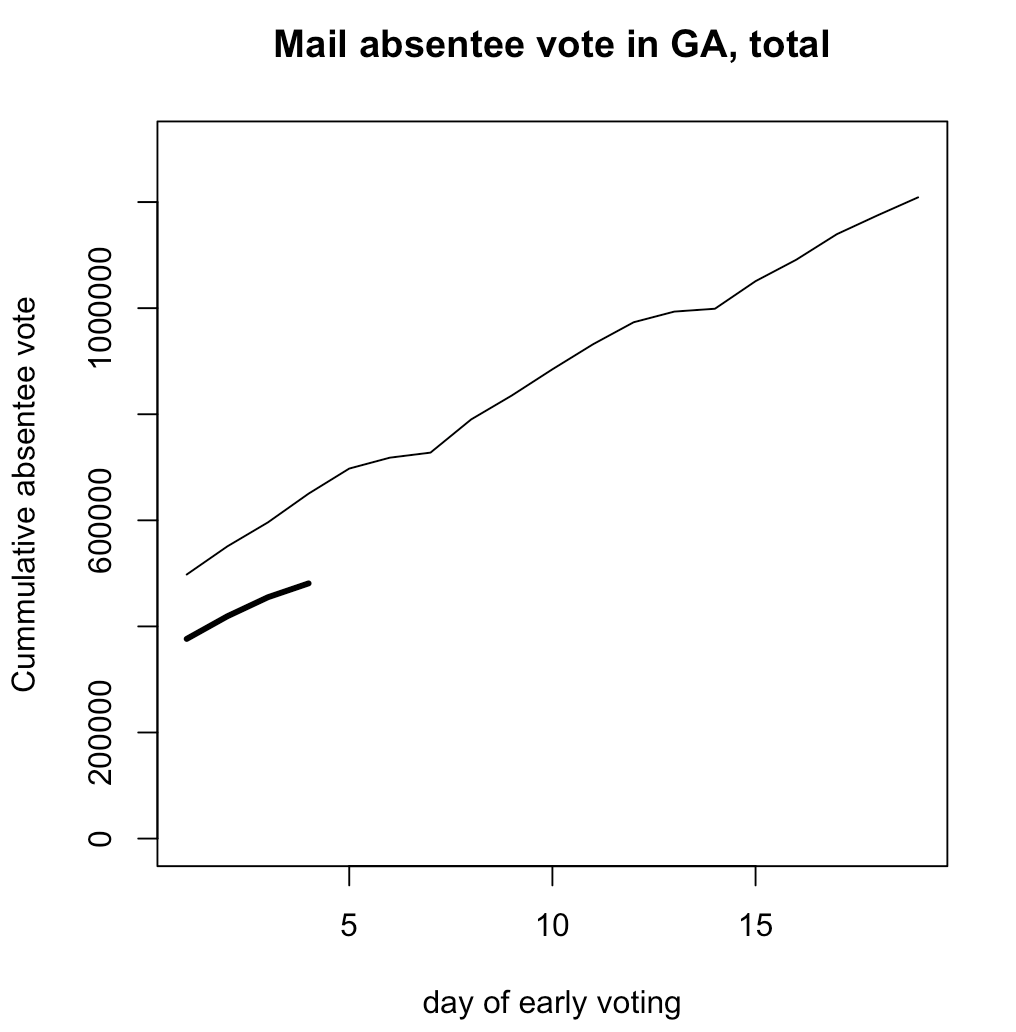
Georgia early voting took a few days off over the holidays, like most everything else, but it was back near general election levels on Monday
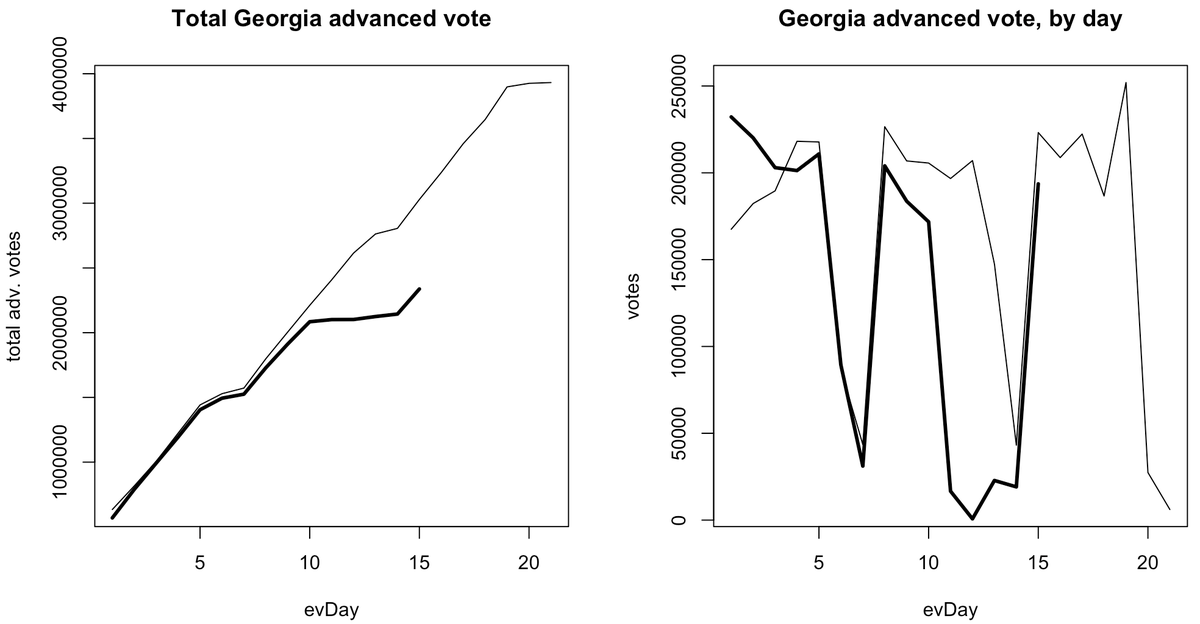
Day 11-13 were fairly good days for the GOP in Oct.; they run farther behind without those days, but we have no reason to think that's for a meaningful reason
This isn't perfect: one could imagine, for ex., that someone who would have voted on day 12 will now vote on day 18, boosting later tallies. But still useful context
More from Nate Cohn
One question I keep getting about the Georgia early voting is about age: isn't the electorate older, and how much does it hurt the Democrats?
So far the answer is 'not really' and 'not at all.'
The first question is easy enough. As of today, youth turnout is basically keeping pace with the general, controlling for the slightly reduced opportunities to vote. This augurs for an unusually young
The second question is more interesting: are the Democrats hurt by lower youth turnout? So far the answer is no, and there are two reasons.
One reason: there's not a *huge* gen. gap. Maybe young voters are D+20 while >65 are R+15. You need a big gap for modest changes to matter.
The second reason is maybe more interesting: the young voters who have voted are just a lot more Democratic than the young voters who turned out at this stage of the general election
By party primary vote history, the 18-29 year olds who have voted so far are D 38, R 12. They were D 33, R 14 in the general at this stage.
So far the answer is 'not really' and 'not at all.'
The first question is easy enough. As of today, youth turnout is basically keeping pace with the general, controlling for the slightly reduced opportunities to vote. This augurs for an unusually young
it's not a very material difference pic.twitter.com/ygdD3hb8b7
— Nate Cohn (@Nate_Cohn) December 29, 2020
The second question is more interesting: are the Democrats hurt by lower youth turnout? So far the answer is no, and there are two reasons.
One reason: there's not a *huge* gen. gap. Maybe young voters are D+20 while >65 are R+15. You need a big gap for modest changes to matter.
The second reason is maybe more interesting: the young voters who have voted are just a lot more Democratic than the young voters who turned out at this stage of the general election
By party primary vote history, the 18-29 year olds who have voted so far are D 38, R 12. They were D 33, R 14 in the general at this stage.
More from Politics

Funny, before the election I recall lefties muttering the caravan must have been a Trump setup because it made the open borders crowd look so bad. Why would the pro-migrant crowd engineer a crisis that played into Trump's hands? THIS is why. THESE are the "optics" they wanted.
This media manipulation effort was inspired by the success of the "kids in cages" freakout, a 100% Stalinist propaganda drive that required people to forget about Obama putting migrant children in cells. It worked, so now they want pics of Trump "gassing children on the border."
There's a heavy air of Pallywood around the whole thing as well. If the Palestinians can stage huge theatrical performances of victimhood with the willing cooperation of Western media, why shouldn't the migrant caravan organizers expect the same?
It's business as usual for Anarchy, Inc. - the worldwide shredding of national sovereignty to increase the power of transnational organizations and left-wing ideology. Many in the media are true believers. Others just cannot resist the narrative of "change" and "social justice."
The product sold by Anarchy, Inc. is victimhood. It always boils down to the same formula: once the existing order can be painted as oppressors and children as their victims, chaos wins and order loses. Look at the lefties shrieking in unison about "Trump gassing children" today.
Funny there are those who think these migrant caravans were a FANTASTIC idea that's going to take the immigration issue away from you.
— Brian Cates (@drawandstrike) November 26, 2018
Like several weeks watching a rampaging horde storm the fences & throw rocks at our border patrol agents & getting gassed = great optics!
This media manipulation effort was inspired by the success of the "kids in cages" freakout, a 100% Stalinist propaganda drive that required people to forget about Obama putting migrant children in cells. It worked, so now they want pics of Trump "gassing children on the border."
There's a heavy air of Pallywood around the whole thing as well. If the Palestinians can stage huge theatrical performances of victimhood with the willing cooperation of Western media, why shouldn't the migrant caravan organizers expect the same?
It's business as usual for Anarchy, Inc. - the worldwide shredding of national sovereignty to increase the power of transnational organizations and left-wing ideology. Many in the media are true believers. Others just cannot resist the narrative of "change" and "social justice."
The product sold by Anarchy, Inc. is victimhood. It always boils down to the same formula: once the existing order can be painted as oppressors and children as their victims, chaos wins and order loses. Look at the lefties shrieking in unison about "Trump gassing children" today.





You May Also Like






Following @BAUDEGS I have experienced hateful and propagandist tweets time after time. I have been shocked that an academic community would be so reckless with their publications. So I did some research.
The question is:
Is this an official account for Bahcesehir Uni (Bau)?

Bahcesehir Uni, BAU has an official website https://t.co/ztzX6uj34V which links to their social media, leading to their Twitter account @Bahcesehir
BAU’s official Twitter account

BAU has many departments, which all have separate accounts. Nowhere among them did I find @BAUDEGS
@BAUOrganization @ApplyBAU @adayBAU @BAUAlumniCenter @bahcesehirfbe @baufens @CyprusBau @bauiisbf @bauglobal @bahcesehirebe @BAUintBatumi @BAUiletisim @BAUSaglik @bauebf @TIPBAU
Nowhere among them was @BAUDEGS to find

The question is:
Is this an official account for Bahcesehir Uni (Bau)?
Bahcesehir Uni, BAU has an official website https://t.co/ztzX6uj34V which links to their social media, leading to their Twitter account @Bahcesehir
BAU’s official Twitter account
BAU has many departments, which all have separate accounts. Nowhere among them did I find @BAUDEGS
@BAUOrganization @ApplyBAU @adayBAU @BAUAlumniCenter @bahcesehirfbe @baufens @CyprusBau @bauiisbf @bauglobal @bahcesehirebe @BAUintBatumi @BAUiletisim @BAUSaglik @bauebf @TIPBAU
Nowhere among them was @BAUDEGS to find