This is how abuse works.
They're talking about a military coup right now and if it doesn't happen we're going to be told the best way to heal is pretending it never happened.
This is how abuse works.
This is how abuse works.
This is how abuse works.
This is how abuse works.
It's abuse.
We need to stop this deadly unreasonable practice of expecting people to accept unacceptable things in order to be thought reasonable.
Anything less is just pretending it didn't happen. It's how abuse works.
Enablement of abuse is abuse.
It's appropriate to be angry when you're told that, because that is enablement.
Enablement of abuse is abuse.
It's appropriate to be angry, because making people pay the cost of their own trauma is enablement.
Enablement of abuse is abuse.
Refuse to pay their tax of abuse.
Abusive people and their enablers dislike evidence.
Evidence leads to conviction.
Conviction, to consequence.
Reject the enabling notion that abuse is an unfortunate necessity, changing it is unrealistic, and demanding better is immature or divisive.
Refuse to pay the tax of abuse.
*Your anger demonizes abusers.
*Your anger leaves no room for them to be redeemed.
*Your anger makes abusers angry.
*It's forcing them to be abusive.
All this is how enablement of abuse works.
Enablement is abuse.
More from A.R. Moxon
The reality is very simple: The Republican Party is no longer participating in democracy. They're running a series of ops against every election cycle, predicated on the notion that only their power is legitimate.
This isn't a failed coup. This is a *continuous* coup that stretches back years. It includes Gingrich's scorched earth methods, Bush v Gore, the politicizing of the Bush DoJ, the judicial obstructionism and nullification of the McConnell Senate, and the entire Trump presidency.
It includes decades of tortured racist gerrymandering and disenfranchisement, Citizens United, the dismantling of the Voting Rights Act, PACs, and deliberately colluding with foreign powers.
This isn't a failed coup. This is a *continuous* coup that stretches back years.
The Republican Party is not participating in democracy. They are quite obviously an organization dedicated to the destruction and overthrow of the government of the U.S. as we know it, and should be treated as such.
There are no legitimate Republican office-holders.
I think there's a distinction to be made. Democrats are often weak/ineffective, and many are complicit because they're those things by choice—but institutionally they aren't authoritarian, and they aren't fascist. They're a corporatist conservative party.
As many as 140 House Republicans and at least one GOP Senator will object to Biden's electors.
— Greg Sargent (@ThePlumLineGS) January 1, 2021
As @ChrisMurphyCT told me, it's only a matter of time until Rs steal an election.
\u201cThis party has a whole bunch of enemies of democracy inside its top ranks."https://t.co/FlhH0F1SXH
This isn't a failed coup. This is a *continuous* coup that stretches back years. It includes Gingrich's scorched earth methods, Bush v Gore, the politicizing of the Bush DoJ, the judicial obstructionism and nullification of the McConnell Senate, and the entire Trump presidency.
It includes decades of tortured racist gerrymandering and disenfranchisement, Citizens United, the dismantling of the Voting Rights Act, PACs, and deliberately colluding with foreign powers.
This isn't a failed coup. This is a *continuous* coup that stretches back years.
The Republican Party is not participating in democracy. They are quite obviously an organization dedicated to the destruction and overthrow of the government of the U.S. as we know it, and should be treated as such.
There are no legitimate Republican office-holders.
I think there's a distinction to be made. Democrats are often weak/ineffective, and many are complicit because they're those things by choice—but institutionally they aren't authoritarian, and they aren't fascist. They're a corporatist conservative party.
To what extent is the legitimacy of Democratic leadership also questionable? If I have a friend who tells me he\u2019ll help protect me from a bully we both identify, and then steps out of the way of every punch headed for me, don\u2019t I just have two bullies with extra steps?
— Duke \u201cthiiirdperson\u201d Greene (@DukeGreene) January 1, 2021

If you ever want to consider how committed our society is to the foundational lie that life must be earned, and those who fail to earn it must die, consider that the proposition “giving everyone money to spend would be bad for the economy” is widely accepted as truth.
“Giving money to people in poverty solves poverty” is an obvious truth, which needs (another) study for proof, for the same reason that this finding will be ignored (again).
We don’t want to fix poverty, even if doing so helps everyone—not if it means life for the “undeserving.”
It’s not about saving money.
There's a great fear in this country that a single dollar might go to someone who might not deserve it; or that a single given dollar might be spent on something we deem unworthy.
We'll spend five dollars to prevent the waste of that one dollar.
The manifestations are everywhere. From the overt, gleefully cruel hostility of conservatism toward people in poverty, of course. But also hidden in almost everyone's assumptions.
Our use of charity as a way of controlling who gets helped, for example.
Even the reversal—a desire to prevent aid from going to "undeserving" wealthy who don't need it (true)—leads us to create obstacles to aid people in poverty often can't overcome, but wealthy people can.
Which is why wealthy people like means
A new study found that giving low-income workers money upfront in their work period helped alleviate the mental burden of their financial problems and allowed them to be more productive \u2014 echoing other findings on the psychological impacts of poverty.https://t.co/zdxItTLDLZ
— NPR (@NPR) February 3, 2021
“Giving money to people in poverty solves poverty” is an obvious truth, which needs (another) study for proof, for the same reason that this finding will be ignored (again).
We don’t want to fix poverty, even if doing so helps everyone—not if it means life for the “undeserving.”
It’s not about saving money.
There's a great fear in this country that a single dollar might go to someone who might not deserve it; or that a single given dollar might be spent on something we deem unworthy.
We'll spend five dollars to prevent the waste of that one dollar.
The manifestations are everywhere. From the overt, gleefully cruel hostility of conservatism toward people in poverty, of course. But also hidden in almost everyone's assumptions.
Our use of charity as a way of controlling who gets helped, for example.
Charity isn't primarily an act.
— A.R. Moxon (@JuliusGoat) November 10, 2019
Before the act comes an alignment.
Charity is the natural fruit of a deep alignment with the virtue of generosity.
It sure shouldn't be a delivery mechanism for one's own beliefs about worthiness.
Even the reversal—a desire to prevent aid from going to "undeserving" wealthy who don't need it (true)—leads us to create obstacles to aid people in poverty often can't overcome, but wealthy people can.
Which is why wealthy people like means
Whenever someone proposes a means-testing solution, it's an indication they've internalized the lie, foundational to the United States, that some people deserve life and others don't.
— A.R. Moxon (@JuliusGoat) December 18, 2020
It's an expensive lie.
Pundits: The fact that Ossoff and Warnock are unlikely to both win their elections means Joe Biden needs to court Republican votes rather than push a much-needed progressive agenda
*Ossoff and Warnock win handily*
Pundits: Ah. Nevertheless,
The only way political reporting in this country makes sense is if you understand that the almost universal, almost subconscious default assumption: that conservative white people are the protagonists of any story that's being told, no matter the facts of the story.
Just do the obvious and necessary good things and let the horrid evil people who hate good things squeal and cry about it forever.
I really need Democrats who will state the clear and obvious truth, which is that Republicans are our enemies, because they insist on attacking the very idea of a shared society and are more than happy to use violence to do it, which is the very definition of an enemy.
You can't make people who want to kill you not be your enemies even if you wish they'd be your friend.
They can stop trying to kill you, but until that happens they are your enemy, and acknowledging that fact isn't what makes that fact true.
*Ossoff and Warnock win handily*
Pundits: Ah. Nevertheless,
Congressional Republicans balk at Joe Biden\u2019s $1.9 trillion relief plan, complicating push for quick passage https://t.co/npXogXvBHM
— The Washington Post (@washingtonpost) January 15, 2021
The only way political reporting in this country makes sense is if you understand that the almost universal, almost subconscious default assumption: that conservative white people are the protagonists of any story that's being told, no matter the facts of the story.
Just do the obvious and necessary good things and let the horrid evil people who hate good things squeal and cry about it forever.
I really need Democrats who will state the clear and obvious truth, which is that Republicans are our enemies, because they insist on attacking the very idea of a shared society and are more than happy to use violence to do it, which is the very definition of an enemy.
You can't make people who want to kill you not be your enemies even if you wish they'd be your friend.
They can stop trying to kill you, but until that happens they are your enemy, and acknowledging that fact isn't what makes that fact true.
More from Government


The Manatee-Sarasota area has many connections to the horrific scene of insurrection in Washington DC yesterday. Want to see? Buckle up for this thread: /1
The Manatee GOP expressed support for Josh Hawley’s objections to certification of the electoral college vote. /2
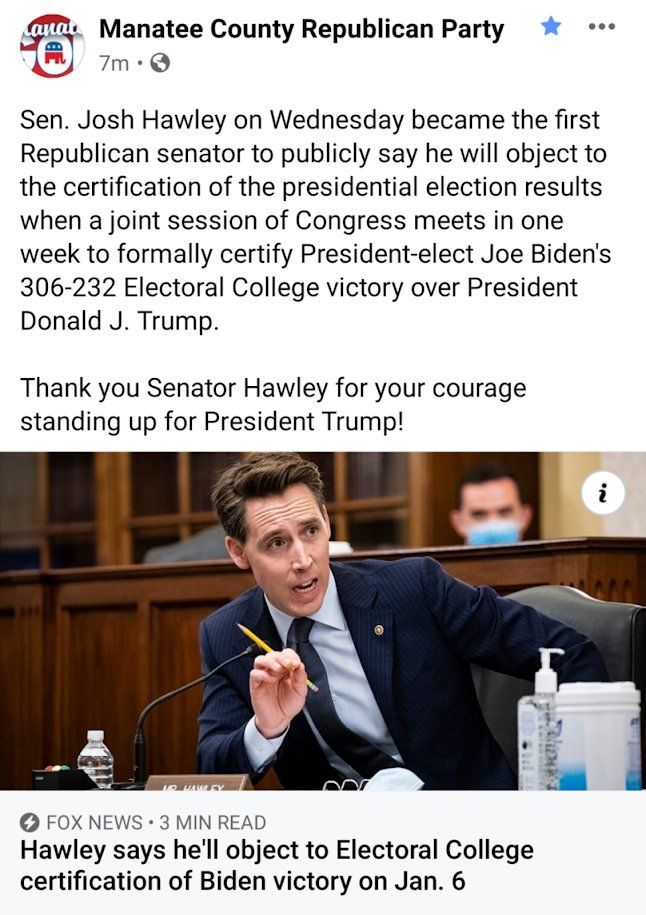
Josh Hawley’s home-state newspaper says Hawley has blood on his hands for a “Capitol coup attempt.” This is who the Manatee GOP cheered on.
Florida GOP Vice Chair & Sarasota County Commissioner Christian Ziegler was at the protest, as described in this @HeraldTribune article.
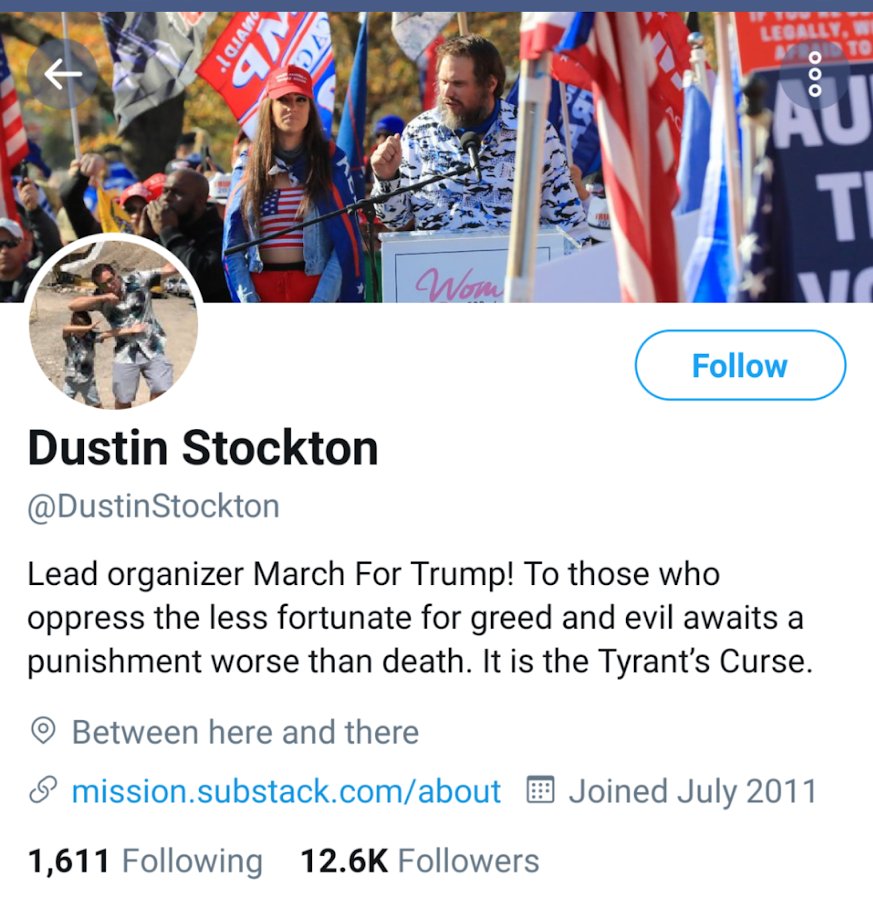
The protest was led by the same people connected to Ziegler who were filming outside the Vern Buchanan town hall at the Van Wezel in Sarasota in 2017, namely Dustin Stockton. Stockton was also part of Steve Bannon's border wall group. /5
https://t.co/NbOxVqbtO4
The Manatee GOP expressed support for Josh Hawley’s objections to certification of the electoral college vote. /2
Josh Hawley’s home-state newspaper says Hawley has blood on his hands for a “Capitol coup attempt.” This is who the Manatee GOP cheered on.
Florida GOP Vice Chair & Sarasota County Commissioner Christian Ziegler was at the protest, as described in this @HeraldTribune article.
The protest was led by the same people connected to Ziegler who were filming outside the Vern Buchanan town hall at the Van Wezel in Sarasota in 2017, namely Dustin Stockton. Stockton was also part of Steve Bannon's border wall group. /5
https://t.co/NbOxVqbtO4


Typically excellent piece from @dsquareddigest The exponential insight is especially neat. Think of it a little like fishing...today you can’t export oysters to the EU (because you simply aren’t allowed to), tomorrow you don’t have a fish exporting business (to the EU).
The extremely small minority of people who known anything about this who think that Brexit will be good for the City make a number of arguments which I shall address in turn...
1. They need us more than we need them. This is a variant of the German carmakers argument. And we know how that went...Business will follow the profit opportunity and if that has moved then so will the business...
And what do we mean by us / we. We’re not talking about massed ranks of Euro investing / trading etc blue blooded British institutions.
Au contraire. We’re talking about the London based subs of US, Asian and indeed European capital markets players...As soon as they think the profit opportunity has moved then so will they...it’s a market innit...
London's status as a financial centre isn't as secure as some might think | Dan Davies https://t.co/q9SU7ra4oF
— The Guardian (@guardian) February 13, 2021
The extremely small minority of people who known anything about this who think that Brexit will be good for the City make a number of arguments which I shall address in turn...
1. They need us more than we need them. This is a variant of the German carmakers argument. And we know how that went...Business will follow the profit opportunity and if that has moved then so will the business...
And what do we mean by us / we. We’re not talking about massed ranks of Euro investing / trading etc blue blooded British institutions.
Au contraire. We’re talking about the London based subs of US, Asian and indeed European capital markets players...As soon as they think the profit opportunity has moved then so will they...it’s a market innit...