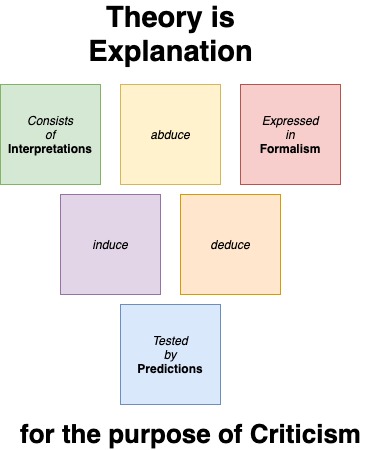
A good theory of consciousness is one that predicts behavior that is unexplained by other current theories of consciousness. Einstein's General Theory was given credence because it predicted the bending of light.

More from Carlos E. Perez

More from For later read

Moderna's mRNA-1273 & Pfizer's BNT162b2 consist of mRNA 3821 nucleotides long encoding *all* 1273 amino acids of the Spike including a 2 Proline-stabilized RBD. This is a plain English Description of the code:
https://t.co/w7koHyMJjL
The article mentions a “10 nucleotide linker” (GCAUAUGACU) in the poly-A tail. This is described in the patent link below (Modification of RNA, producing an increased transcript stability and translation
Here is a link to the full mRNA code if you wish to download it, blast it or make up a batch in your garage
An overview of the encoded spike
Initial mouse
https://t.co/w7koHyMJjL
The article mentions a “10 nucleotide linker” (GCAUAUGACU) in the poly-A tail. This is described in the patent link below (Modification of RNA, producing an increased transcript stability and translation
Here is a link to the full mRNA code if you wish to download it, blast it or make up a batch in your garage
The mRNA sequences used for Moderna mRNA-1273 & Pfizer BNT162b2 mRNA vaccines for COVID-19 (Direct link in Word Format). WHO International Nonproprietary Name Program # 11889 "Messenger RNA encoding the full-length SARS-CoV-2 spike glycoprotein"https://t.co/zTb7B0Apic pic.twitter.com/8tZxAZWI5S
— Roland Baker (@RolandBakerIII) December 24, 2020
An overview of the encoded spike
Moderna's mRNA-1273 & Pfizer's BNT162b2 consist of mRNA 3821 nucleotides long encoding *all* 1273 amino acids of the Spike including a 2 Proline-stabilized RBD and this includes the NTD (blue in monomer, dark gray in trimer attached to antibodies). AA 64, 66, 187, 213, 214 red. pic.twitter.com/4MX1ByAsrR
— Roland Baker (@RolandBakerIII) December 19, 2020
Initial mouse
News: NIH-Moderna investigational COVID-19 vaccine shows promise in mouse studies https://t.co/7JYuUyZT45
— NIH (@NIH) August 5, 2020


I’ve been frustrated by the tweets I’ve seen of this as a Canadian. Because the facts are being misrepresented.
We’re not under some sort of major persecution. That’s not what this is. A thread. 1/8
This church was fined for breaking health orders in Dec. They continued to break them. So the pastor was arrested and released on conditions of... you guessed it, not breaking health orders. And then they broke the health orders. 2/8
So then he was arrested and told he couldn’t hold church services in person if he was to be released. He refused. He’s still in custody.
Here is my frustration as a Christian in Canada:
1. They were able to gather, with some conditions. They didn’t like those. 3/8
2. He is not actually unable to preach. He is just unable to hold church services because they broke the conditions given by the public health office in Alberta. He says he can’t in good conscience do that, so they are keeping him in jail (because he will break the law). 4/8
3. This is the 1st article of The Canadian Charter of Rights and Freedoms: “guarantees the rights and freedoms set out in it subject only to such reasonable limits prescribed by law as can be demonstrably justified in a free and democratic society.” 5/8
We’re not under some sort of major persecution. That’s not what this is. A thread. 1/8
BREAKING: Pastor James Coates of GraceLife Church of Edmonton was just carried off to jail in hand and ankle cuffs. The condition of his release is that he cannot preach. His wife/kids are not allowed to see him.
— Jeremy (on Theology) (@TheologyJeremy) February 17, 2021
The 1st Canadian pastor to be jailed for holding a church service pic.twitter.com/AKMPVWgFXw
This church was fined for breaking health orders in Dec. They continued to break them. So the pastor was arrested and released on conditions of... you guessed it, not breaking health orders. And then they broke the health orders. 2/8
So then he was arrested and told he couldn’t hold church services in person if he was to be released. He refused. He’s still in custody.
Here is my frustration as a Christian in Canada:
1. They were able to gather, with some conditions. They didn’t like those. 3/8
2. He is not actually unable to preach. He is just unable to hold church services because they broke the conditions given by the public health office in Alberta. He says he can’t in good conscience do that, so they are keeping him in jail (because he will break the law). 4/8
3. This is the 1st article of The Canadian Charter of Rights and Freedoms: “guarantees the rights and freedoms set out in it subject only to such reasonable limits prescribed by law as can be demonstrably justified in a free and democratic society.” 5/8


You May Also Like

**Thread on Bravery of Sikhs**
(I am forced to do this due to continuous hounding of Sikh Extremists since yesterday)
Rani Jindan Kaur, wife of Maharaja Ranjit Singh had illegitimate relations with Lal Singh (PM of Ranjit Singh). Along with Lal Singh, she attacked Jammu, burnt - https://t.co/EfjAq59AyI

Hindu villages of Jasrota, caused rebellion in Jammu, attacked Kishtwar.
Ancestors of Raja Ranjit Singh, The Sansi Tribe used to give daughters as concubines to Jahangir.

The Ludhiana Political Agency (Later NW Fronties Prov) was formed by less than 4000 British soldiers who advanced from Delhi and reached Ludhiana, receiving submissions of all sikh chiefs along the way. The submission of the troops of Raja of Lahore (Ranjit Singh) at Ambala.
Dabistan a contemporary book on Sikh History tells us that Guru Hargobind broke Naina devi Idol Same source describes Guru Hargobind serving a eunuch
YarKhan. (ref was proudly shared by a sikh on twitter)
Gobind Singh followed Bahadur Shah to Deccan to fight for him.

In Zafarnama, Guru Gobind Singh states that the reason he was in conflict with the Hill Rajas was that while they were worshiping idols, while he was an idol-breaker.
And idiot Hindus place him along Maharana, Prithviraj and Shivaji as saviours of Dharma.

(I am forced to do this due to continuous hounding of Sikh Extremists since yesterday)
Rani Jindan Kaur, wife of Maharaja Ranjit Singh had illegitimate relations with Lal Singh (PM of Ranjit Singh). Along with Lal Singh, she attacked Jammu, burnt - https://t.co/EfjAq59AyI
Tomorrow again same thing happens bcoz fudus like you are creating a narrative oh Khalistan. when farmers are asking MSP. (RSS ki tatti khane wale Kerni sena ke kutte).
— Ancient Economist (@_stock_tips) December 5, 2020
U kill sikhs in 1984 just politics. To BC low IQ fudu Saale entire history was politics.
Hindu villages of Jasrota, caused rebellion in Jammu, attacked Kishtwar.
Ancestors of Raja Ranjit Singh, The Sansi Tribe used to give daughters as concubines to Jahangir.
The Ludhiana Political Agency (Later NW Fronties Prov) was formed by less than 4000 British soldiers who advanced from Delhi and reached Ludhiana, receiving submissions of all sikh chiefs along the way. The submission of the troops of Raja of Lahore (Ranjit Singh) at Ambala.
Dabistan a contemporary book on Sikh History tells us that Guru Hargobind broke Naina devi Idol Same source describes Guru Hargobind serving a eunuch
YarKhan. (ref was proudly shared by a sikh on twitter)
Gobind Singh followed Bahadur Shah to Deccan to fight for him.
In Zafarnama, Guru Gobind Singh states that the reason he was in conflict with the Hill Rajas was that while they were worshiping idols, while he was an idol-breaker.
And idiot Hindus place him along Maharana, Prithviraj and Shivaji as saviours of Dharma.