Categories Economy
7 days
30 days
All time
Recent
Popular



What a year: 203 essays about degrowth in English since the beginning of March. Here is a selection of some of my favourites. Thank you @fem_degrowth, @beth_stratford, @thedownshifters, @corbinkbarthold, @degrowth_info for these brilliant texts.
THREAD/
https://t.co/1lFaJM52RX
https://t.co/i5HOfZ19r7
https://t.co/DuPSrrqnzz
https://t.co/0ANveWdvFO
THREAD/
https://t.co/1lFaJM52RX
https://t.co/i5HOfZ19r7
https://t.co/DuPSrrqnzz
https://t.co/0ANveWdvFO

1/ To add a little texture to @NickHanauer's thread, it's important to recognize that there's a good reason why orthodox economists (& economic cosplayers) so vehemently oppose a $15 min wage:
The min wage is a wedge that threatens to undermine all of orthodox economic theory.
2/ Orthodox economics is grounded in two fundamental models: a systems model that describes the market as a closed equilibrium system, and a behavioral model that describes humans as rational, self-interested utility-maximizers. The modern min wage debate undermines both models.
3/ The assertion that a min wage kills jobs is so central to orthodox economics that it is often used as the textbook example of the Supply/Demand curve. Raise the cost of labor and businesses will buy less of it. It's literally Econ 101!
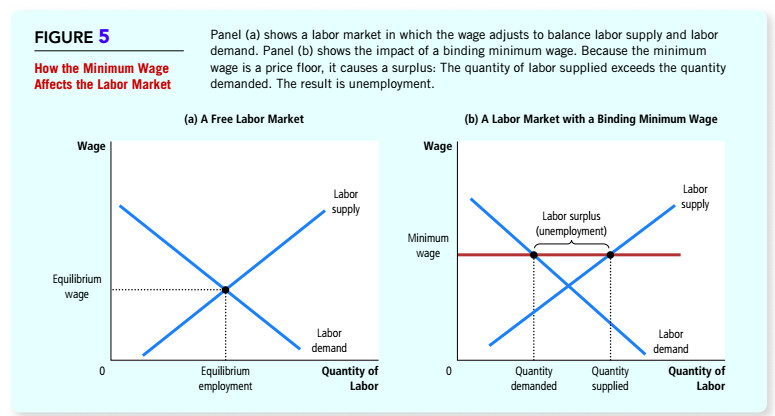
4/ Econ 101 insists that markets automatically set an efficient "equilibrium price" for labor & everything else. Mess with this price and bad things happen. Yet decades of empirical research has persuaded a majority of economists that this just isn't
5/ How can this be? Well, either the market is not a closed equilibrium system in which if you raise the price of labor employers automatically purchase less of it... OR the market is not automatically setting an efficient and fair equilibrium wage. Or maybe both. #FAIL
The min wage is a wedge that threatens to undermine all of orthodox economic theory.
1/4 Most people, especially academic economists, think that the controversy over the minimum wage is a contest over facts. It's not. It's a contest over power, status, and wealth. It is just like the contest over racial and gender justice.
— Nick Hanauer (@NickHanauer) January 17, 2021
2/ Orthodox economics is grounded in two fundamental models: a systems model that describes the market as a closed equilibrium system, and a behavioral model that describes humans as rational, self-interested utility-maximizers. The modern min wage debate undermines both models.
3/ The assertion that a min wage kills jobs is so central to orthodox economics that it is often used as the textbook example of the Supply/Demand curve. Raise the cost of labor and businesses will buy less of it. It's literally Econ 101!
4/ Econ 101 insists that markets automatically set an efficient "equilibrium price" for labor & everything else. Mess with this price and bad things happen. Yet decades of empirical research has persuaded a majority of economists that this just isn't
5/ How can this be? Well, either the market is not a closed equilibrium system in which if you raise the price of labor employers automatically purchase less of it... OR the market is not automatically setting an efficient and fair equilibrium wage. Or maybe both. #FAIL


One of the hardest problems post-pandemic will be how to revive so-called "left behind" places.
Post-industrial towns, run-down suburbs, coastal communities - these places were already struggling before the crisis and have fared worst in the last year.
What should we do?
Today, @ukonward sets out the beginning of a plan to repair our social fabric. It follows our extensive research over the last year, expertly chaired by @jamesosh, and funded by @jrf_uk, @Shelter and @peoplesbiz.
https://t.co/d3T5uPwG9N

Before I get into recommendations, some findings from previous Onward research.
In 2018, we found 71% of people believe "community has declined in my lifetime"
In 2019, we found 65% would rather live in “a society that focuses on giving people more security” vs 35% for freedom

This was the basis for our identification of 'Workington Man' as the archetypal swing voter in 2019, and led us to predict (correctly) that large numbers of Red Wall seats could fall. A key driver was a desire for security, belonging and pride in place.

There is also a key regional dimension to this. We also tested people's affinity with the UK's direction of travel, across both cultural and economic dimensions - revealing the extraordinary spread below: London vs. the Rest.
https://t.co/HrorW4xaLp

Post-industrial towns, run-down suburbs, coastal communities - these places were already struggling before the crisis and have fared worst in the last year.
What should we do?
Today, @ukonward sets out the beginning of a plan to repair our social fabric. It follows our extensive research over the last year, expertly chaired by @jamesosh, and funded by @jrf_uk, @Shelter and @peoplesbiz.
https://t.co/d3T5uPwG9N
Before I get into recommendations, some findings from previous Onward research.
In 2018, we found 71% of people believe "community has declined in my lifetime"
In 2019, we found 65% would rather live in “a society that focuses on giving people more security” vs 35% for freedom
This was the basis for our identification of 'Workington Man' as the archetypal swing voter in 2019, and led us to predict (correctly) that large numbers of Red Wall seats could fall. A key driver was a desire for security, belonging and pride in place.
There is also a key regional dimension to this. We also tested people's affinity with the UK's direction of travel, across both cultural and economic dimensions - revealing the extraordinary spread below: London vs. the Rest.
https://t.co/HrorW4xaLp


Interesting thread, but I don't think ecosocialists or degrowthers are arguing that if German socialists had come to power the world would be green by now. Socialism is not automatically green. Eco-socialism is what it says - a green version of socialism - to be tested /1
The historical counterfactual also in not totally convincing. So let's assume Germany and Europe went socialist. The world economy would have evolved exactly the same way it did? 🤔 I doubt it, this is too deterministic. Examples: /2
We do not know if the transition from coal to oil would have taken place when it took place, the way it did. From Timothy Mitchell we know that oil was a fix for capitalism to bypass the labour strikes of coal workers. One would think that socialists would treat workers better /3
We also do not know if socialist governments would strong arm the Middle East the way capitalists did, starting wars to secure cheap oil, and setting up puppet governments. One would want to think that Rosa Luxembourg would not go down that path..../4
We also do not know if they would have continued colonial unequal exchange, extracting raw materials as cheap as possible from the rest of the world. Without cheap oil and cheap materials, it is anyone's guess if GDP and CO2 would be where it is now. /5
You get the impression from the eco-socialists and degrowthers that humanity wouldn\u2019t face the threat of climate change or biodiversity loss if it weren\u2019t for capitalism (or rather, if it weren\u2019t for capitalist modernity).
— Leigh Phillips (@Leigh_Phillips) February 2, 2021
But I see no evidence to suggest this is the case.
The historical counterfactual also in not totally convincing. So let's assume Germany and Europe went socialist. The world economy would have evolved exactly the same way it did? 🤔 I doubt it, this is too deterministic. Examples: /2
We do not know if the transition from coal to oil would have taken place when it took place, the way it did. From Timothy Mitchell we know that oil was a fix for capitalism to bypass the labour strikes of coal workers. One would think that socialists would treat workers better /3
We also do not know if socialist governments would strong arm the Middle East the way capitalists did, starting wars to secure cheap oil, and setting up puppet governments. One would want to think that Rosa Luxembourg would not go down that path..../4
We also do not know if they would have continued colonial unequal exchange, extracting raw materials as cheap as possible from the rest of the world. Without cheap oil and cheap materials, it is anyone's guess if GDP and CO2 would be where it is now. /5

Don't pay R2000 to register your small business. It is only R175 to do it yourself.
Easy as ABC. How to do it.
[THREAD]⚠️
#LockdownLevel3
#Bushiri
#RamaphosaChallenge
Go online to the website of CIPC and register a new company for R175, registration is R125 and the name is R50.
Go to https://t.co/RJcCHvdgCl which is the easiest website vision for CIPC.
Easy as ABC. How to do it.
[THREAD]⚠️
#LockdownLevel3
#Bushiri
#RamaphosaChallenge
Go online to the website of CIPC and register a new company for R175, registration is R125 and the name is R50.
Go to https://t.co/RJcCHvdgCl which is the easiest website vision for CIPC.

Long rant: This @WSJ article bemoaning the decline of price theory is really worth highlighting. The economic theories and so called "laws of economics" that the WSJ consistently and religiously defends, are the source of their authority, power and privilege.
So called economic "theories" like "you get paid exactly what you are worth" and "markets are perfectly efficient" and "when wages rise, jobs fall" and "raising taxes on the rich kills jobs and growth" and "increasing justice decreases economic efficiency" and...
"Government intervention in markets always creates more harm than good" and "any regulation that constrains corporations kills growth and productivity", etc etc are effectively a protection racket for the rich. It is a set of internally consistent and mathematized conjectures...
That are all demonstrably nonsense. But getting people to accept these "theories" as laws of nature and immutable, timeless truths is the most effective way our current economic elites have found to maintain and enhance the status of the powerful and persuade the weak and poor...
to shut the fuck up and accept their lot in life. Now, FINALLY, some economists- are actually beginning to look at the real world evidence to determine whether these propositions actually describe anything real here on planet earth. Let me save you some time. The answer is NO.
Hilarious. The WSJ editorial page bemoans the waning influence of The neoliberal priesthood, and hence their own. https://t.co/pQT8Dstg8I
— Nick Hanauer (@NickHanauer) January 28, 2021
So called economic "theories" like "you get paid exactly what you are worth" and "markets are perfectly efficient" and "when wages rise, jobs fall" and "raising taxes on the rich kills jobs and growth" and "increasing justice decreases economic efficiency" and...
"Government intervention in markets always creates more harm than good" and "any regulation that constrains corporations kills growth and productivity", etc etc are effectively a protection racket for the rich. It is a set of internally consistent and mathematized conjectures...
That are all demonstrably nonsense. But getting people to accept these "theories" as laws of nature and immutable, timeless truths is the most effective way our current economic elites have found to maintain and enhance the status of the powerful and persuade the weak and poor...
to shut the fuck up and accept their lot in life. Now, FINALLY, some economists- are actually beginning to look at the real world evidence to determine whether these propositions actually describe anything real here on planet earth. Let me save you some time. The answer is NO.