Some people want us to believe there's not enough solar energy available to cover our worldwide energy needs

They often use EROI (Energy Return On Investment) as their metric

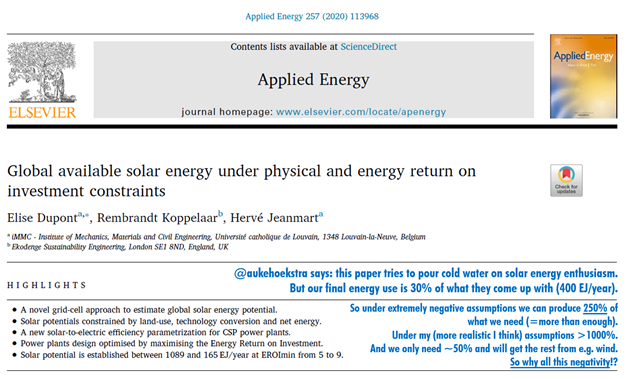
This is a rant against these EROI people misinforming the debate, based on a rebuttal of a 2020 paper

In essence the approach of the paper is straightforward:

1) Discard water and 96% of land because it's supposedly unavailable

2) Assume solar cells on just 1/5th of the remaining 4%

3) Complain that production of solar panels takes a lot of energy
https://t.co/tQUHLEHFnw
About 1) (available land)

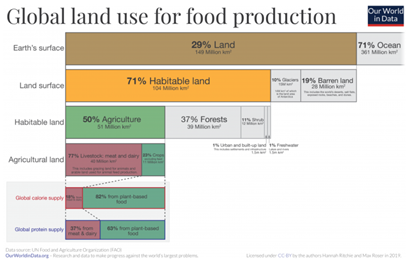
Discarding 96% of land seems pretty extreme:
30% of the world's land is barren
40% of the world's land is used for meat

I think we could find more than 4% if we tried
(but we don't have to: we need less than 1%)
https://t.co/rJZiNWcu7F
About 2) (using 1/5th of available land)

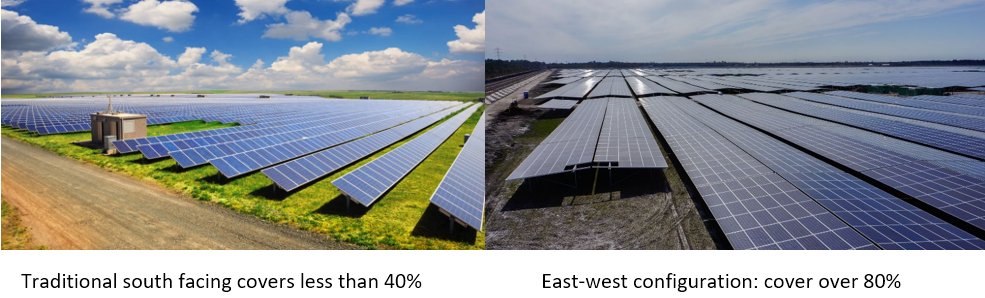
If cells are expensive and land is dirt cheap, covering 20% with solar cells is logical

But with cheap cells you maximize land use: 80% is easily possible

New paper headline:
"Global available solar energy over 10 times what we need"
About 3) (20% of energy is needed for production)

This is something @MLiebreich and I often complain about:
If you get more energy out than you put it, that's FINE
If you get five times more energy out, that's GREAT

EROI is a USELESS metric. Let's STOP using it. At all.
I think the energy production numbers are very conservative (predicting 2030 and beyond based on 2013 Chinese production numbers?? - no learning curves??) but I won't go into that because EROI is a USELESS metric
I think that use of EROI stems from the misconception (still held by many) that the second law of thermodynamics implies that have limited energy here on earth

What they forget is that the massive influx of solar energy invalidates that argument
https://t.co/wiM76rNq2b
Of course there are other constraints. Like costs (but solar is cheap) and raw materials

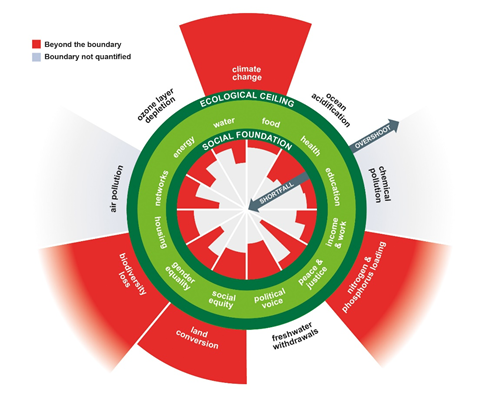
Most sensible people have heard about planetary constraints. And of @KateRaworth and Doughnut Economics

So let's use THOSE and STOP using EROI
Because it's a USELESS metric
The EROI paper also suggest that it might be a good idea to add wind to the mix and to do more research into storage needed on an hourly basis. You think??

People like @mzjacobson, @ChristianOnRE, @nworbmot (and me: https://t.co/9A5qlC8nIS) have been doing that for ages
WAKE UP!
Anyhow, let's take heart from knowing that even EROI pessimists cannot make solar energy a limited resource

So let's get to work because there are many problems to be solved. But let's stop polluting the debate with irrelevant metrics conceived based on a misconception

Imho/end

More from Economy

$600/wk Unemployment Insurance cannot deliver the benefits of a $600/wk Job Guarantee. From the outset, I should say JG is not a replacement for UI, no matter what you may have heard. I’ll get to this later, but read this long 🧶 w/ that in mind.


Automatic stabilization: Both $600/wk UI and JG will provide counter cyclical spending. But UI will be weaker. Counter-cyclical stabilization is not just about the absence of income. It is also about the transmission and structure of economy

Firms don't like to hire the unemployed. Mass and long-term unemployment make the problem worse. JG would recover labor markets much faster than a UI of the same amount, both b/c of the higher direct, induced & tertiary employment effects & b/c of private firm hiring preferences.

JG stabilizes spending patterns better. Uncertain job prospects may mean more cautious spending from the unemployed compared to those w/ guaranteed jobs.
UI is temporary, which makes matters worse. Even if it were permanent, it still won't resolve the problem of job scarcity.

Nations who once achieved tight full employment through active labor market policies demonstrate that unemployment does NOT fluctuate the same way it does w/o them. Direct employment, ELR type policies diminish drastically/even eliminate these amplitudes (eg postwar Japan/Sweden)
One of the hardest problems post-pandemic will be how to revive so-called "left behind" places.

Post-industrial towns, run-down suburbs, coastal communities - these places were already struggling before the crisis and have fared worst in the last year.

What should we do?

Today, @ukonward sets out the beginning of a plan to repair our social fabric. It follows our extensive research over the last year, expertly chaired by @jamesosh, and funded by @jrf_uk, @Shelter and @peoplesbiz.

https://t.co/d3T5uPwG9N


Before I get into recommendations, some findings from previous Onward research.

In 2018, we found 71% of people believe "community has declined in my lifetime"

In 2019, we found 65% would rather live in “a society that focuses on giving people more security” vs 35% for freedom


This was the basis for our identification of 'Workington Man' as the archetypal swing voter in 2019, and led us to predict (correctly) that large numbers of Red Wall seats could fall. A key driver was a desire for security, belonging and pride in place.


There is also a key regional dimension to this. We also tested people's affinity with the UK's direction of travel, across both cultural and economic dimensions - revealing the extraordinary spread below: London vs. the Rest.
https://t.co/HrorW4xaLp

You May Also Like

1

From today, we will memorize the names of 27 Nakshatras in Vedic Jyotish to never forget in life.

I will write 4 names. Repeat them in SAME sequence twice in morning, noon, evening. Each day, revise new names + recall all previously learnt names.

Pls RT if you are in.

2

Today's Nakshatras are:-

1. Ashwini - अश्विनी

2. Bharani - भरणी

3. Krittika - कृत्तिका

4. Rohini - रोहिणी

Ashwini - अश्विनी is the FIRST Nakshatra.

Repeat these names TWICE now, tomorrow morning, noon and evening. Like this tweet if you have revised 8 times as told.

3

Today's Nakshatras are:-

5. Mrigashira - मृगशिरा

6. Ardra - आर्द्रा

7. Punarvasu - पुनर्वसु

8. Pushya - पुष्य

First recall previously learnt Nakshatras twice. Then recite these TWICE now, tomorrow morning, noon & evening in SAME order. Like this tweet only after doing so.

4

Today's Nakshatras are:-

9. Ashlesha - अश्लेषा

10. Magha - मघा

11. Purvaphalguni - पूर्वाफाल्गुनी

12. Uttaraphalguni - उत्तराफाल्गुनी

Purva means that comes before (P se Purva, P se pehele), and Uttara comes later.

Read next tweet too.

5

Purva, Uttara prefixes come in other Nakshatras too. Purva= pehele wala. Remember.

First recall previously learnt 8 Nakshatras twice. Then recite those in Tweet #4 TWICE now, tomorrow morning, noon & evening in SAME order. Like this tweet if you have read Tweets #4 & 5, both.
This is NONSENSE. The people who take photos with their books on instagram are known to be voracious readers who graciously take time to review books and recommend them to their followers. Part of their medium is to take elaborate, beautiful photos of books. Die mad, Guardian.


THEY DO READ THEM, YOU JUDGY, RACOON-PICKED TRASH BIN


If you come for Bookstagram, i will fight you.

In appreciation, here are some of my favourite bookstagrams of my books: (photos by lit_nerd37, mybookacademy, bookswrotemystory, and scorpio_books)