
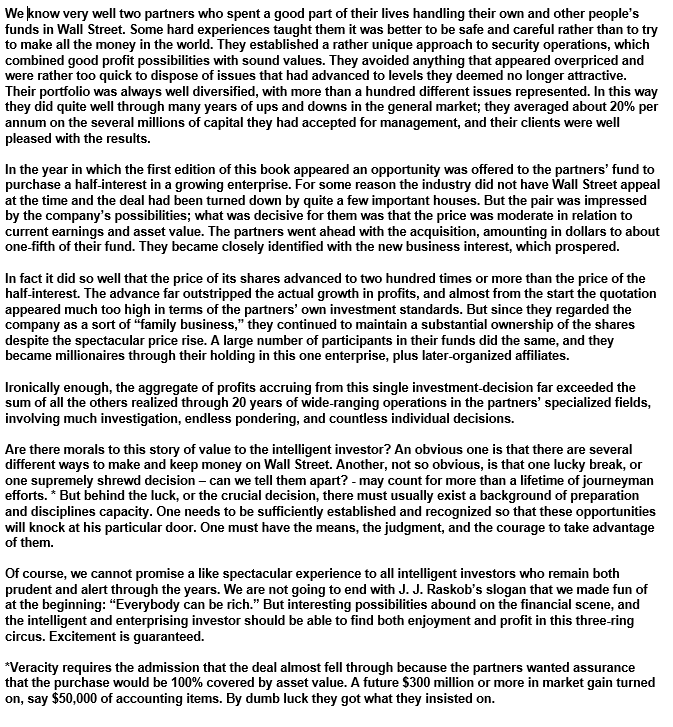
This investment did so well that the price of its shares advanced to two hundred times or more than the price of the half-interest by 1971/1972 2/
Ben Graham managed to compound money at 20%/year for 20 years at his partnership following a value investing strategy
In 1948 he acquired 50% stake in GEICO. It had to be distributed to his investors
They almost didn't make the investment due to some accounting questions 1/
This investment did so well that the price of its shares advanced to two hundred times or more than the price of the half-interest by 1971/1972 2/
An obvious one is that there are several different ways to make and keep money on Wall Street 4/
But behind the luck, or the crucial decision, there must usually exist a background of preparation and disciplines capacity. 5/
More from Dividend Growth Investor
A financial advisor that charges an annual fee of 1% on assets under management
Essentially takes 50% of your dividend income, if your portfolio yields 2%
That's substantially worse than the highest rate on qualified dividends of 23.80% today
Few understand this
I agree with this
Essentially takes 50% of your dividend income, if your portfolio yields 2%
That's substantially worse than the highest rate on qualified dividends of 23.80% today
Few understand this
I agree with this
After 34 years in the business, I just can\u2019t get my head around how an adviser can justify charging a client any more that $2,000 per year for financial advice, and 0.25% per year for asset management if needed. There may be outliers that cost more, but those are the expectation.
— Rick Ferri (@Rick_Ferri) June 15, 2021

More from Economy




Latest @SouledOutWorld articles:
(Article Thread)
All in one convenient location to access.

https://t.co/TuyltZTyW0
https://t.co/XJJRvpLRQE
https://t.co/NeeFCfMkP2
https://t.co/yFtbIgqzzm
(Article Thread)
All in one convenient location to access.
https://t.co/TuyltZTyW0
True State of the Nation
— Secret SoSHHiety (@SouledOutWorld) December 19, 2020
You think you know what's coming... but you don't...https://t.co/MVoIuxgaWX pic.twitter.com/DtF2Q53HrT
https://t.co/XJJRvpLRQE
Truth About Antarctica
— Secret SoSHHiety (@SouledOutWorld) December 19, 2020
Why? Scalar EM Antennas are kept at Antarctica; Scalar EM weaponry is the anonymous weapon to be used by the White Horse of Rev 6.https://t.co/7CDzmQfLSX pic.twitter.com/0400oCN8io
https://t.co/NeeFCfMkP2
The Finger (fuck you/fuck the world)
— Secret SoSHHiety (@SouledOutWorld) December 18, 2020
The middle finger is the Saturn finger.https://t.co/BsrsBE3f5h pic.twitter.com/ZJqZll8lU1
https://t.co/yFtbIgqzzm
Bread and Circuses
— Secret SoSHHiety (@SouledOutWorld) December 18, 2020
Bring in the clowns & the fast food...https://t.co/SZAlfkqTI3 pic.twitter.com/gLys0mNMIq


