
8 March 1679 - The date on which 300 saffron clad warriors gave their life to protect temples from mugal army. Thread➡️
Aurangzeb's huge army, which was adorned with artillery, elephant and horses, under the leadership of Commander Darab Khan had marched to punish the ruler of/1

But some Shekhawat warriors did not like this as they knew that the royal army would not leave a single temple located in Shekhawati unbroken./3
Sujan Singh Shekhawat, the young thakur of Chhapoli, was coming back from his wedding when he heard about the imperial army from Shepherds./4
कुल में है तो आव सुजाण, फोज देवरे आई ||
if you are born in your glorious clan, then come, the army have come to destroy temple. /5
sending his newlywed bride home with the promise of returning to her after the battle./6

When the Mughal army arrived to destroy the temple, they met into these warriors, /7
He was also terrified since he had witnessed the rajputs fight and heard stories about their last Stands. He was well aware that these were the best hindu warriors./8

but Sujjan Singh replied that not a single brick of the temple would be damaged until he had his head over his body./9
देवलियो ढेया सीस ढेसी।।
temple will only fall after the head is fallen
if temple will fall the head will fall.
With this, the struggle began. Rajput soldiers battled valiantly and wreaked havoc on their foes.
One lion was battling about ten hyenas./10
With time, all but Sujjan Singh, perished, yet he fought alone against endless foes until he, too, was defeated, struck, & his head fell, but his body fought on,
his 1 promise completed, & now it was his turn to accomplish the 2nd /11

she became sati there with his body. /12


More from All












You May Also Like

A brief analysis and comparison of the CSS for Twitter's PWA vs Twitter's legacy desktop website. The difference is dramatic and I'll touch on some reasons why.
Legacy site *downloads* ~630 KB CSS per theme and writing direction.
6,769 rules
9,252 selectors
16.7k declarations
3,370 unique declarations
44 media queries
36 unique colors
50 unique background colors
46 unique font sizes
39 unique z-indices
https://t.co/qyl4Bt1i5x

PWA *incrementally generates* ~30 KB CSS that handles all themes and writing directions.
735 rules
740 selectors
757 declarations
730 unique declarations
0 media queries
11 unique colors
32 unique background colors
15 unique font sizes
7 unique z-indices
https://t.co/w7oNG5KUkJ

The legacy site's CSS is what happens when hundreds of people directly write CSS over many years. Specificity wars, redundancy, a house of cards that can't be fixed. The result is extremely inefficient and error-prone styling that punishes users and developers.
The PWA's CSS is generated on-demand by a JS framework that manages styles and outputs "atomic CSS". The framework can enforce strict constraints and perform optimisations, which is why the CSS is so much smaller and safer. Style conflicts and unbounded CSS growth are avoided.
Legacy site *downloads* ~630 KB CSS per theme and writing direction.
6,769 rules
9,252 selectors
16.7k declarations
3,370 unique declarations
44 media queries
36 unique colors
50 unique background colors
46 unique font sizes
39 unique z-indices
https://t.co/qyl4Bt1i5x
PWA *incrementally generates* ~30 KB CSS that handles all themes and writing directions.
735 rules
740 selectors
757 declarations
730 unique declarations
0 media queries
11 unique colors
32 unique background colors
15 unique font sizes
7 unique z-indices
https://t.co/w7oNG5KUkJ
The legacy site's CSS is what happens when hundreds of people directly write CSS over many years. Specificity wars, redundancy, a house of cards that can't be fixed. The result is extremely inefficient and error-prone styling that punishes users and developers.
The PWA's CSS is generated on-demand by a JS framework that manages styles and outputs "atomic CSS". The framework can enforce strict constraints and perform optimisations, which is why the CSS is so much smaller and safer. Style conflicts and unbounded CSS growth are avoided.


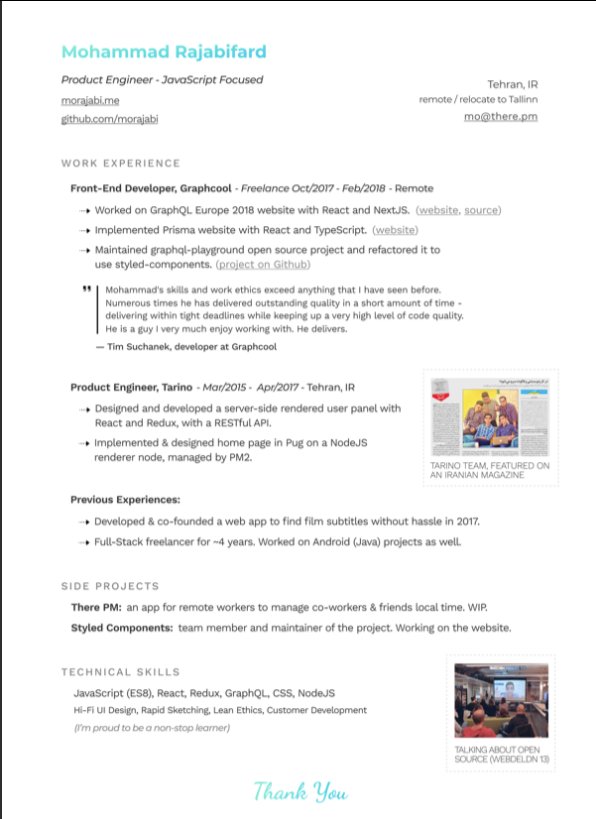
👨💻 Last resume I sent to a startup one year ago, sharing with you to get ideas:
- Forget what you don't have, make your strength bold
- Pick one work experience and explain what you did in detail w/ bullet points
- Write it towards the role you apply
- Give social proof
/thread
"But I got no work experience..."
Make a open source lib, make a small side project for yourself, do freelance work, ask friends to work with them, no friends? Find friends on Github, and Twitter.
Bonus points:
- Show you care about the company: I used the company's brand font and gradient for in the resume for my name and "Thank You" note.
- Don't list 15 things and libraries you worked with, pick the most related ones to the role you're applying.
-🙅♂️"copy cover letter"
"I got no firends, no work"
One practical way is to reach out to conferences and offer to make their website for free. But make sure to do it good. You'll get:
- a project for portfolio
- new friends
- work experience
- learnt new stuff
- new thing for Twitter bio
If you don't even have the skills yet, why not try your chance for @LambdaSchool? No? @freeCodeCamp. Still not? Pick something from here and learn https://t.co/7NPS1zbLTi
You'll feel very overwhelmed, no escape, just acknowledge it and keep pushing.
- Forget what you don't have, make your strength bold
- Pick one work experience and explain what you did in detail w/ bullet points
- Write it towards the role you apply
- Give social proof
/thread
"But I got no work experience..."
Make a open source lib, make a small side project for yourself, do freelance work, ask friends to work with them, no friends? Find friends on Github, and Twitter.
Bonus points:
- Show you care about the company: I used the company's brand font and gradient for in the resume for my name and "Thank You" note.
- Don't list 15 things and libraries you worked with, pick the most related ones to the role you're applying.
-🙅♂️"copy cover letter"
"I got no firends, no work"
One practical way is to reach out to conferences and offer to make their website for free. But make sure to do it good. You'll get:
- a project for portfolio
- new friends
- work experience
- learnt new stuff
- new thing for Twitter bio
If you don't even have the skills yet, why not try your chance for @LambdaSchool? No? @freeCodeCamp. Still not? Pick something from here and learn https://t.co/7NPS1zbLTi
You'll feel very overwhelmed, no escape, just acknowledge it and keep pushing.


"I lied about my basic beliefs in order to keep a prestigious job. Now that it will be zero-cost to me, I have a few things to say."
We know that elite institutions like the one Flier was in (partial) charge of rely on irrelevant status markers like private school education, whiteness, legacy, and ability to charm an old white guy at an interview.
Harvard's discriminatory policies are becoming increasingly well known, across the political spectrum (see, e.g., the recent lawsuit on discrimination against East Asian applications.)
It's refreshing to hear a senior administrator admits to personally opposing policies that attempt to remedy these basic flaws. These are flaws that harm his institution's ability to do cutting-edge research and to serve the public.
Harvard is being eclipsed by institutions that have different ideas about how to run a 21st Century institution. Stanford, for one; the UC system; the "public Ivys".
As a dean of a major academic institution, I could not have said this. But I will now. Requiring such statements in applications for appointments and promotions is an affront to academic freedom, and diminishes the true value of diversity, equity of inclusion by trivializing it. https://t.co/NfcI5VLODi
— Jeffrey Flier (@jflier) November 10, 2018
We know that elite institutions like the one Flier was in (partial) charge of rely on irrelevant status markers like private school education, whiteness, legacy, and ability to charm an old white guy at an interview.
Harvard's discriminatory policies are becoming increasingly well known, across the political spectrum (see, e.g., the recent lawsuit on discrimination against East Asian applications.)
It's refreshing to hear a senior administrator admits to personally opposing policies that attempt to remedy these basic flaws. These are flaws that harm his institution's ability to do cutting-edge research and to serve the public.
Harvard is being eclipsed by institutions that have different ideas about how to run a 21st Century institution. Stanford, for one; the UC system; the "public Ivys".