Mollyycolllinss Categories For later read







Had PanQuake been in the mix, what could it have done?
The answer is *a LOT*.
I'm going to explain below.
qq that\u2019s a bit of a tangent - i\u2019m sure you\u2019d be interested in these sort of ideas!
— brew (@DrewDiezel) January 28, 2021
we can wage class war on wall st w collective knowledge like that subreddit , so how can we use a platform like @Pan_Quake to further leverage that power? https://t.co/wAAr1NEa4c
Nevermind corporate PR campaigns, digital marketing companies or advertising - NOTHING spreads information faster or more effectively than word of mouth
PanQuake has designed a brand new first-time-ever set of amplification tools that takes word of mouth and puts it on steroids
Example #1: PanQuakes
PanQuakes would have let #wallstreetbets fans, in a series of swift clicks, select the best commentary/info about WSB (either their own messages or others or a combination thereof) & in one click convert them into a single link shareable anywhere on the net
Anyone who clicks on the link (called a PanQuake, the function for which we named the platform) would be taken to a web page with a custom timeline populated with the messages the user had selected to be displayed
ie. no more big tech choosing what we see - now we get to choose!
Example #2: ThunderQuakes
Ppl who were really excited about what #wallstreetbets was doing could choose to expend ThunderQuakes on it. Either by gifting ThunderQuakes points to key WSB accounts, to help them better amplify their messages, or by crafting TQ messages of their own


#Christmas #Wagner #Tristan #Walkure #TwitterCultural

Yesterday (all my troubles seemed...). No, seriously. Yesterday, I made a discovery that blew my mind and I am so happy to share it with you. Let's start by listening to Act 2, Scene 5 of 'Die Walküre' in a superb performance by Böhm in
The scene begins with the 'Fate' leitmotif, which was already presented in the thread below ⬇️Note that harmony goes from a minor chord to a dominant chord just 1 semitone
#WednesdayWagner Hoiho my friends! You wanted the best, you got the best ... another small talk on yours trully composition proccesses\xa0:) Today: The FATE throughout the Ring (and beyond)#TwitterCultural #StayHome #TeamWagner #COVID19 pic.twitter.com/KK5ktqghvw
— Richard Wagner 2.0 (@Wagner2_0) May 13, 2020
This sequence of chords are used in different keys, with different configurations, even as the closing part of the 'Annunciation of Death' motive (this can be listened to at 0.33 in the link above ⬆️)
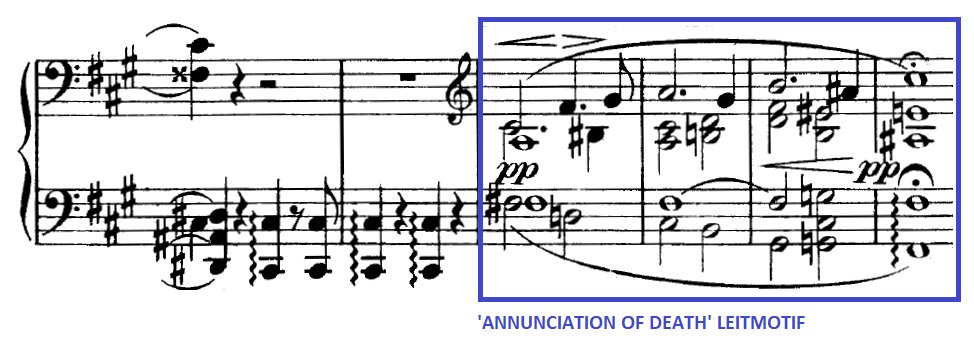
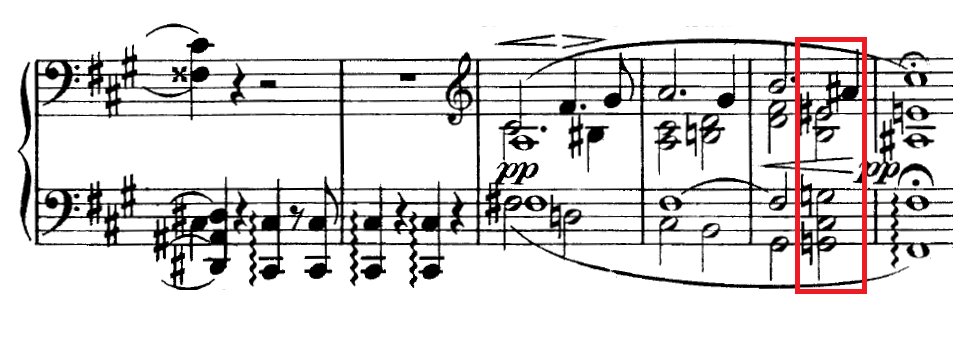
The last bars of this 'Annunciation of Death' contains the 'Fate' motive with a slight variation of harmony. Notice that we can almost hear the Tristan Chord there (marked in red in the figure below).

FYI, #UBCLite was coined by Tom Ddumba after NBS consistently became a state mouthpiece. The "adjective" fits like a glove 0/13
After posting this thread, i got a detailed anonymous narrative from an insider at NBS on what transpired on that day and I will drop another thread later today. The truth is out there
— #ExplodingNoema (@henryshaykins) January 21, 2021
1/13 Take note that prior and during the elections the EC repeatedly announced that Absolutely NO ONE was allowed to have a tally center, not even the candidates. But somehow NBS was able to ignore those directives and implement what appeared to be a live tally center. Why? How?
2/13
Now the station reportedly have Monday staff meetings. On the Monday of the election week, staff were notified about an election tally center going to be hosted at their station by a selected few (the special ones)- you know these people, they stick out like a sore thumb
3/13 On 15/1/21, when Canary took us through the infamous tour of the "command center", showing us their agents, and how their tally system was using phone calls to aggregate results, it was meant to build confidence in what they wanted to announce. They primed us for fake news
4/13 Interestingly, NBS actually had real staff deployed across the country to collect & relay actual tallies from districts. They collected results & called them in using phones, so on the 15th the teams down stairs were busy working out totals for different districts

Probably you have heard it while having an interview?
It has lots of use cases and one of its usage is middleware implementation in its kernel.
I'm going to write about pipelines and its design pattern.
thread 🧵
1/8
First of all Pipelines in Laravel are implemented based on chain of responsibility design pattern.
In chain of responsibility which is a behavioral design pattern we pass data to receivers and this receivers implement a specific interface that has a handler method.
2/8
Handler methods may deal with the passed argument and pass it to the next handler.
read more about the design pattern here :
https://t.co/XrJKXecyTv
Let's go for the main part :
3/8
Imagine we want to implement a twitter bot that gets some tweets around the trends and filter the words that we don't wanna show finally send as a new tweet from our bot.
About the filtering part, if it was me, I would implement it with pipelines.
Why?!
4/8
Currently I know exactly what words should be filtered but what about the future?! What if I want to add more filters, I will have to modify the source code and add more switch, if else statements, etc.
I want my code to be robust and maintainable keeping SOLID principles.

A loooong thread with maps (and no memes☹️).
So can we do sub-classification?
Many people say “no”, like André Basset’s famous quote: “cette langue s’éparpille directement ou à peu près en une poussière de parlers de 4 à 5 mille peut être” (1952:1) and Alfred Willms (1980). Others are a bit more nuanced.
For example, the fantastic studies by Lafkioui (https://t.co/hHKMgEPjK2) give a synchronic classification of Tarifiyt dialects. To cut a very long story irresponsibly short: all variables are counted the same.
However, we should ask ourselves: Does this continuum hide a more discontinuous past? Has there never been major disruption, or has much of it been smoothed out by later convergence?
In order to study this, one has to classify variables and their isoglosses. Some variables are continuous and can be assigned to the latest convergence period. Others are clustered in a group unrelated to the continuum. Still others are scattered.





from Reuters:
— John Harwood (@JohnJHarwood) January 12, 2021
\u201cSecretary of State Mike Pompeo cancelled his Europe trip at the last minute on Tuesday after Luxembourg's foreign minister and top European Union officials declined to meet him, European diplomats and other people familiar with the matter said\u201d
He has a law degree from Harvard. He was the editor of the Harvard Law Review. Went to DC and joined a blue-chip firm. Also made a fortune in private enterprise. America gave the grandson of dirt-poor immigrants the opportunity to do all of that.
He knows *damned well* what the Constitution says.
He's also seen enough of the world to know *damned well* how lucky he was to grow up in a country at peace, governed by that Constitution--and to know *damned well* what happens to a country in a civil war
--which is exactly the brink to which Trump has taken the United States, only recently the inarguable leader of the free world. We now have a GOP that thinks, "storming the capitol in an attempt to assassinate our elected leaders" is somewhere between "great" and "no biggie."
He knows *damned well* what the world thinks of us now, and how endangered we are because of it--and not just us, our generation, physically, but the idea of government of the people, by the people, for the people. It could, truly, perish from this earth-

A few years ago I was called into a boardroom and asked: \u201cHow do we turn around the headlines for our team?\u201d \u201cWin games,\u201d was my answer. Hugely simplistic and it doesn\u2019t solve deep rooted problems that require greater surgery and strategy from creative brains, but it helps.
— Lee Clayton (@LeeClayton_) January 30, 2021
“Win more” is the footballing solution of taking a painkiller for toothache. The pain goes away for a bit but ultimately you still need a painful root canal. And West Ham have needed that for a long time. This current limited success is *despite* the Board, not because of them.
Lest we forget, Moyes did a fine job first time around and was let go so we could pursue a bigger name, waste tens of millions and undo his good work. They’re lucky he was still available and willing to work for them again. They don’t deserve him.
But winning is helpful because a lot of the time, fans struggle to articulate what needs changing. So if the team is doing well it’s easy for the media to say “You’re fourth - what more do these West Ham fans want!” and for fans not to have an easily digestible answer.
But we know that a losing streak will arrive, we’ll suffer some bad luck and some injuries and then it won’t seem so rosy. And at that point we’ll be accused of being fickle, when the reality is that the underlying problems have been present for the entirety of the GSB reign:




We are exclusively focused on the *supply chain*. We neglect the *demand* for this content.
The truth is that people searched for an excuse, or opening, to be radicalized.
Keep in mind: Hitler launched the campaign of lies and evil that brought the Holocaust in an age when the Internet was yet to be even dreamed of.
— Brent Staples (@BrentNYT) January 11, 2021
I find the comparison to drugs and addiction helpful here, and it is one that I do carefully.
100 people to to the doctor and get an opioid after a procedure. About 95 will never use again.
A lot of us are exposed to extremist content. Most of us don’t get radicalized.
So while the supply and exposure played a role in both addiction and radicalization, it is not magic. It doesn’t just take over people. It taps into demand.
So maybe the question is less about how they got the supply and more why they find it so appealing.
That’s tougher.
It is much easier to imagine an immediate policy solution to Trump’s twitter account or YouTube’s auto play than to the coercive impact of 401 years of America apartheid and racist myth making.
But again drugs suggest that those quick supply cuts don’t work.
A century of drug busts made the problem worse. This observation led to the iron law of prohibition: the harder the enforcement, the harder the drugs.
When you cut supply, people who want drugs *will* find drugs — and often more dangerous drugs.
This is where my insight ends.