Categories Trading
7 days
30 days
All time
Recent
Popular
I wasn’t planning to do the year-end collection of writings thread, but I would like to bury all the rather unpleasant notifications coming in from my critique of Stock, so...
I did not *write* much this year, but I was lucky to have a few things published anyway:
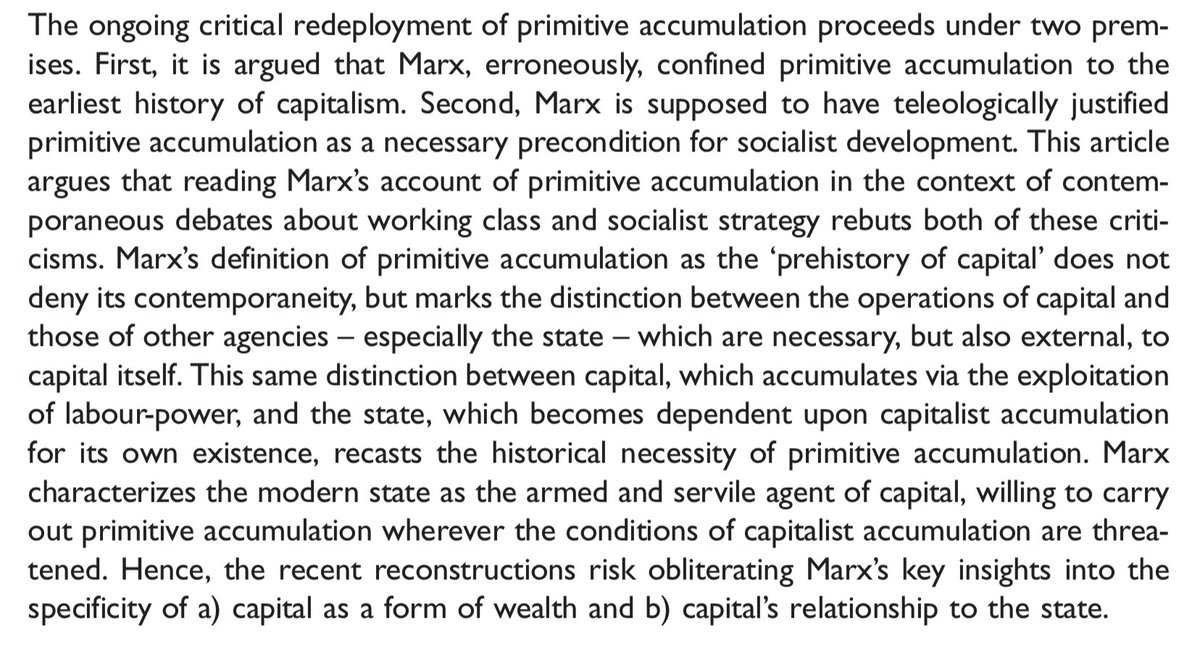
1. My essay “What *was* primitive accumulation?” — which has been online since 2017 — got its permanent published form in @EJPTheory vol. 19, issue 4:
The article argues against the recent revisionist accounts of primitive accumulation.
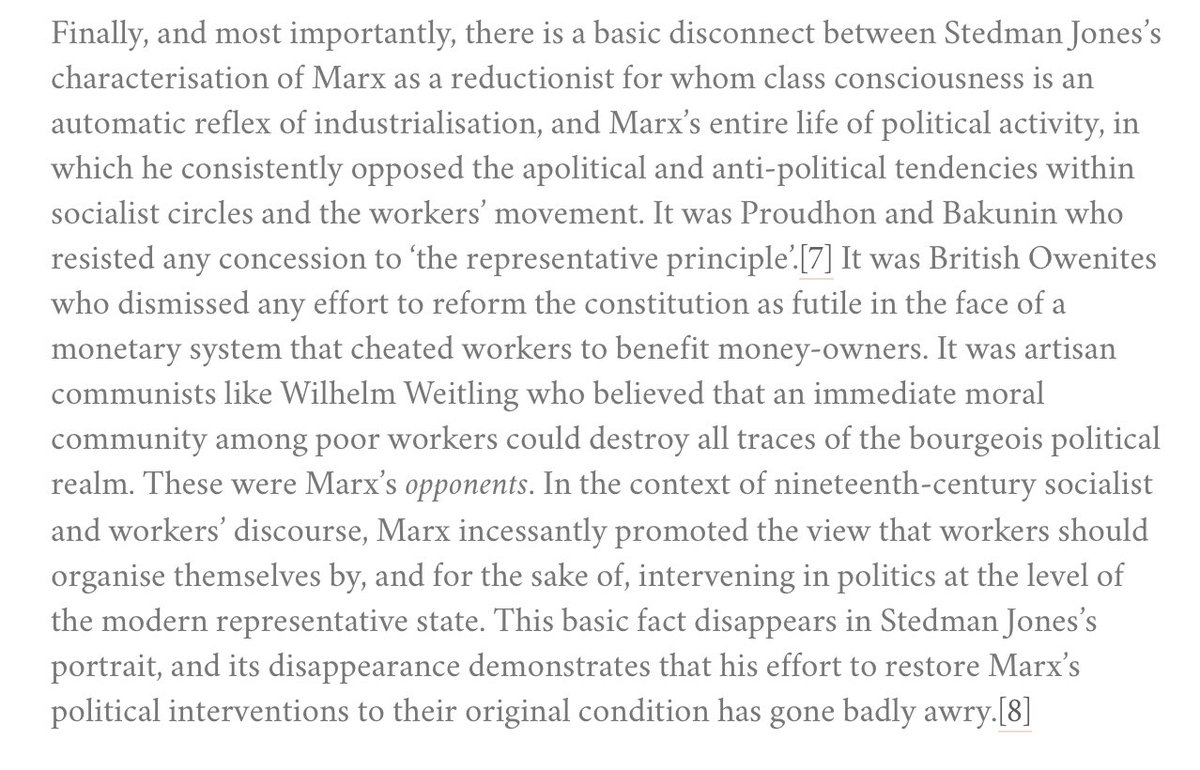
2. My highly critical review of Gareth Stedman Jones’s biography of Marx was published in Historical Materialism: https://t.co/tTh3FUaW1s An excerpt:
3. My engagement with @martinhaegglund’s This Life: Secular Faith and Spiritual Freedom appeared in @LAReviewofBooks, as part of a symposium on Hägglund’s book.
I did not *write* much this year, but I was lucky to have a few things published anyway:
1. My essay “What *was* primitive accumulation?” — which has been online since 2017 — got its permanent published form in @EJPTheory vol. 19, issue 4:
The article argues against the recent revisionist accounts of primitive accumulation.
2. My highly critical review of Gareth Stedman Jones’s biography of Marx was published in Historical Materialism: https://t.co/tTh3FUaW1s An excerpt:
3. My engagement with @martinhaegglund’s This Life: Secular Faith and Spiritual Freedom appeared in @LAReviewofBooks, as part of a symposium on Hägglund’s book.
1/ n As promised, a quick thread. Combination of my (non-PhD / layman's) dive into learning about Monoclonal Antibodies and how it's helped me uncover a few fun / interesting group of companies: $SDGR $ABCL $TWST $IPA (new QQQ uplist -formerly $IPATD) and most recently $LGND
Ok - first, a *quick* history lesson - in the last ~3 months, I have been increasingly obsessed w/ learning about monoclonal antibodies. It started as a simple pattern recognition that a lot of the biotechs I was investing in were in this space - $HGEN $PRVB $MGNX $ONCT etc.
Not to mention, all of these new COVID therapeutics ( $LLY $REGN ) were antibody based - what the heck exactly are these things? I found myself watching basic videos - like this simple 3 minute cartoon summary...
.. to this podcast on the history of monoclonal antibodies, like this Nature podcast: https://t.co/iXcq56RR5l And a bunch of more academic / scientific white papers and articles that are far too dry to share here
Probably a good time to add that I barely made it past high school biology - my academic and professional background is all based around finance / math / SaaS - so as much as I'm interested in biotechnology, it's all self-taught and I needed to start with the basics
Ok - first, a *quick* history lesson - in the last ~3 months, I have been increasingly obsessed w/ learning about monoclonal antibodies. It started as a simple pattern recognition that a lot of the biotechs I was investing in were in this space - $HGEN $PRVB $MGNX $ONCT etc.
Not to mention, all of these new COVID therapeutics ( $LLY $REGN ) were antibody based - what the heck exactly are these things? I found myself watching basic videos - like this simple 3 minute cartoon summary...
.. to this podcast on the history of monoclonal antibodies, like this Nature podcast: https://t.co/iXcq56RR5l And a bunch of more academic / scientific white papers and articles that are far too dry to share here
Probably a good time to add that I barely made it past high school biology - my academic and professional background is all based around finance / math / SaaS - so as much as I'm interested in biotechnology, it's all self-taught and I needed to start with the basics
Let's look again at the 2005-2008 two parabolic advances in $gold. first, read yesterday's thread if you haven't:
Today i want to look what some major miners did - between the 2 parabolic gold advances: how did they act?
Getting more historic context in the minds, will allow us to navigate calmer the stormy waters ahead, and HOW we want to manage them.
(2)
my basic framework is we will see a parabolic metal top mid 2021, followed by another parabolic metal top early 2023.
Now what did some miners do in a same situation: the 2006-2008 timeframe.
Notice the $GDX was launched exactly a few weeks after the 2006 top 😉
(3)
example 1 of 4 is Barrick
gold lines = 2 gold parabolic tops.
Barrick didn't advance much first, and as such had only a 23% retrace before setting a floor.
Not something you would have wanted to trade.
Even with the 50% gold parabola retrace, the metal floor was $150 higher
example 2 of 4 is Hecla
while Hecla corrected 42%, the correction was very fast in time. The new metal floor made it quickly rise back after.
Something we could have hedged with SLV puts for example.
Silver retraced 38% and traded in tandem with $gold
How high can #gold run during this next intermediate cycle?
— Gold Ventures (@TheLastDegree) January 1, 2021
my current target stands at $2440 by May
targets are not exit points: the combination of a lot of signals/ratio's are. we adapt along the way
(1) https://t.co/QjuekzVzw1
Today i want to look what some major miners did - between the 2 parabolic gold advances: how did they act?
Getting more historic context in the minds, will allow us to navigate calmer the stormy waters ahead, and HOW we want to manage them.
(2)
my basic framework is we will see a parabolic metal top mid 2021, followed by another parabolic metal top early 2023.
Now what did some miners do in a same situation: the 2006-2008 timeframe.
Notice the $GDX was launched exactly a few weeks after the 2006 top 😉
(3)
example 1 of 4 is Barrick
gold lines = 2 gold parabolic tops.
Barrick didn't advance much first, and as such had only a 23% retrace before setting a floor.
Not something you would have wanted to trade.
Even with the 50% gold parabola retrace, the metal floor was $150 higher
example 2 of 4 is Hecla
while Hecla corrected 42%, the correction was very fast in time. The new metal floor made it quickly rise back after.
Something we could have hedged with SLV puts for example.
Silver retraced 38% and traded in tandem with $gold
Some reflections on trading psychology...
1/
Trading is as simple as "do you think it will go up or do you think it will go down", yet this is one of the hardest jobs I've ever experienced and I've been lucky (or so I'm told) to have experienced a few - musician, pe associate, baker, biz owner, insurance underwriter.
2/
But with this simplistic binary proposition comes a tremendous amount of pitfalls which is well explained imv by Daniel Kahneman’s book “thinking fast and slow”, that illustrates a lot of why traders succumb to these pitfalls time and time again...
3/
And that is, Humans are innately horrible (horrible) traders. And it's no wonder why trading has an extremely low success rate. As I've come to realise from reading that book some years ago, we - Humans, tend be risk-averse when winning, that is to say...
4/
we tend to take our profits or whatever we have gained quickly; and tend to be risk-seeking when losing in that we tend to let our losses or whatever we may lose a chance (or give more risk) to recoup what we could end up losing.
5/
1/
Was out tonight - great cocktails whiskey wine, all alone and didn't indulge in the people or beautiful women around me, instead I jotted down some notes after reflecting on trading psychology quite a bit this past week. Will expand on this once I come out of my daze...
— DoejiStar (@DoejiStar) December 12, 2020
Trading is as simple as "do you think it will go up or do you think it will go down", yet this is one of the hardest jobs I've ever experienced and I've been lucky (or so I'm told) to have experienced a few - musician, pe associate, baker, biz owner, insurance underwriter.
2/
But with this simplistic binary proposition comes a tremendous amount of pitfalls which is well explained imv by Daniel Kahneman’s book “thinking fast and slow”, that illustrates a lot of why traders succumb to these pitfalls time and time again...
3/
And that is, Humans are innately horrible (horrible) traders. And it's no wonder why trading has an extremely low success rate. As I've come to realise from reading that book some years ago, we - Humans, tend be risk-averse when winning, that is to say...
4/
we tend to take our profits or whatever we have gained quickly; and tend to be risk-seeking when losing in that we tend to let our losses or whatever we may lose a chance (or give more risk) to recoup what we could end up losing.
5/