Coinbase is now a giant that's easy to hate on but started as an underdog just like every other startup.
@brian_armstrong launched it by himself in June 2012
I got curious after reading his Hacker News post (
https://t.co/t69Tz5E2Eb) and became one of the first users
Months earlier a
@fredwilson post (
https://t.co/wmu3WRuYCy) about BTC intrigued me and I made my first purchase by taking out cash from an ATM then going to a CVS to Moneygram it to Mt. Gox
Buying on
https://t.co/lvwtxPqm8B was a huge improvement from that initial experience
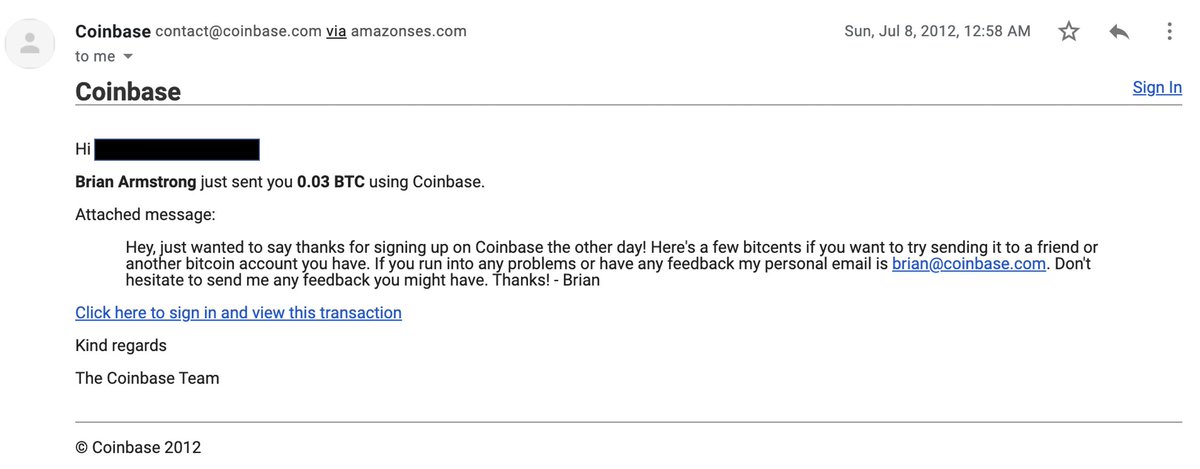
Bitcoin wasn’t in high demand then so Brian sent "bitcents" to users 😂
Down the rabbit hole I went
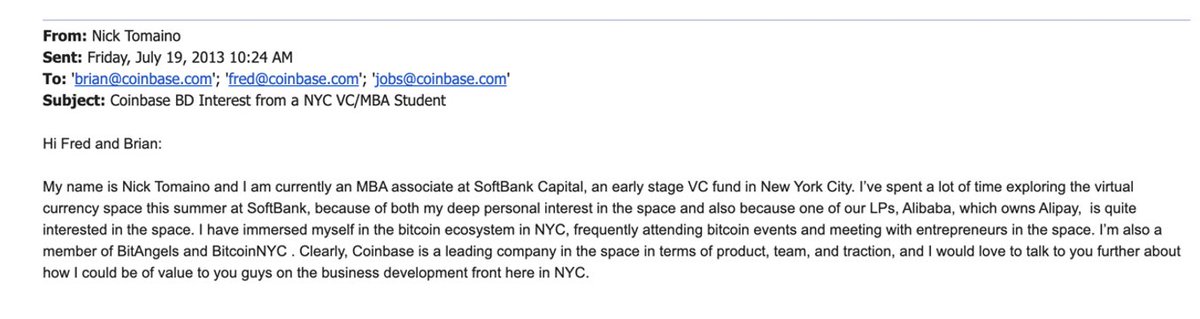
July 2013: Cold emails ftw (this was one of many)
Fall 2013: Reached out to merchants w/ my .edu email & relentlessly pitched them on adding BTC as a payment method
Before working for the company I proved I could contribute by convincing many to use Coinbase merchant tools (@fiverr
@fancy @treehouse @SJEarthquakes, etc)
Early 2014: Missed lots of class while also serving as Coinbase's east coast presence, left
@YaleSOM for SF
2014 - 2016: Many ups & downs
A phishing attack wiped out my entire BTC holdings (before 2FA on withdrawals) 🤬
Startups are volatile, crypto startups are extra volatile 😬
Helped Coinbase emerge as trusted brand 🚀
Launched new products that helped BTC adoption🌎
There was some momentum on bitcoin dev and merchant adoption then, but not a lot
The core buy/sell product was what moved the needle (still is)
I wrote a lot publicly on the Coinbase blog and my own blog
People like
@pmarca shared my work which helped a lot for "credibility" but more importantly for confidence e.g.
https://t.co/dY5PlyIjFo
We were mostly BTC maximalists early on
This was an obvious misstep - we focused too much on the yellow paper and what distributed systems PhDs were saying and not enough on the talent of the creators (@VitalikButerin and
@gavofyork). We quickly adjusted though
.@zxocw was the first I recall taking Ethereum seriously. I got conviction and wrote up a company memo on it after judging a
@coindesk hackathon in '15 where every dev was using it - wish i still had that memo
https://t.co/dsFHRYoYid cc/
@pete_rizzo_
This
@FEhrsam post was big for the culture "Ethereum is the Forefront of Digital Currency"
https://t.co/HhlklejWC6
2017: Ethereum ecosystem emerged, innovation accelerated. I started
@1confirmation First investors:
@Andrebliznyuk @jgut @mcuban @pmarca @cdixon @peterthiel
May 2017: Digital Currency's "Netscape Moment" at the Inaugural Token Summit w/
@wmougayar: https://t.co/wwjOXGuk73
2018 - Present: Ethereum ecosystem thrives, innovation accelerates, institutions want more crypto exposure
The Coinbase public listing will be a nice milestone for the industry when it happens but it's just the first inning
So far crypto has enriched an exclusive few, but It’s lasting impact will be empowering the billions who’ve been excluded & exploited by institutions who are happy to maintain status quo
This is not a platitude, it’s already started & will happen on massive scale this decade
Takeaway(s):
Ignore uninformed opinions from extroverts around you
It’s easy to have a short-term view that sounds good to other people, much harder and more rewarding to have quiet conviction long-term and be right
Most people overvalue institutional constructs IRL & undervalue new ideas online
You don’t have to have special talent or be in Silicon Valley to benefit from new ideas online, you can be anyone with curiosity & hustle anywhere
Cold emails and DMs are your friend