Imagine what you want in a company, codify it in the form of filters, create a screen. Example below:
A lot of people ask: how do you find companies to invest in? very good question.
How did you find RACL, Pix?
Creating this ad-hoc thread to share my process.
if you like it, please RT to benefit maximum investors. 🙏
Imagine what you want in a company, codify it in the form of filters, create a screen. Example below:
AND
Market Capitalization < 3000
AND
((Average return on capital employed 5Years > 25 AND
Price to Earning < 20) OR
(Average return on capital employed 5Years > 15 AND
Price to Earning < 10))
AND
Sales growth 5Years > 10
AND
...
Operating cash flow 5years /5 < Operating cash flow 3years /3
AND
Operating cash flow 7years /7 < Operating cash flow 3years /3"
smallcaps with a min mcap,
which have a bare minimum average ROCE & valuation accordance to the unit economics
which are also growing topline
and where operating cash flows are also increasing, on an average basis

One first needs to have a thought about what one is looking for, then one can codify it in screener. Another type of cos i look for are turn-arounds.
AND
(short term sales growth > 7 OR medium term sales growth > 7)
AND
(short term opm growth > 10 OR medium term opm growth > 10)
AND
Market Capitalization < 2000
AND
medium term ocf profit ratio > 0.3
AND
ROIC > 12
2. looking through PF of & tracking super-investors.
For funds/people with sizable PF sizes like @LuckyInvest_AK sir & @SunilBSinghania sir
I track trendlyne portfolios to generate ideas.
1. Study https://t.co/3jeqlXO0QH thread for the company
2. Study company's conference calls, investor presentations
3. Study industry structure through industry reports, webinars on YT
4. Study company's annual report
6. Estimate future growth rates for industry and company's competitive positioning
7. Assign a fair value range for the company
(i) there is significant discount to fair value
& (ii) significant sales & profit growth visibility & triggers
& (iii) Sources of durable competitive advantages which act as the 'moat' around the profit growth and market shares.

More from Sahil Sharma
Given the immense interest in this #investment #process thread about how to get investment ideas, thought of creating a logical follow-up 🧵
Given that I have an idea & some sense for valuation & growth, how do i construct a portfolio?
If you like the thread, plz RT.
First thing worth mentioning is that I am only describing my own process. Others can follow a different process which could work for them.
Opposite of a good idea can also be a good idea
Before understanding the process itself, it is important to understand the problems the process is being designed to solve for. What are the key hurdles or troubles I have faced in designing my PF.
Hurdles
1. At any given point in time (in the past) i have only known deeply about 5% of the listed universe in India, or lower. When I say know deeply I mean read an annual report, an investor presentation, a concall, understood why the business is how it is.
2. I only started my corporate life 4 years ago, so my pf size is small compared to yearly savings. This means that I need to deploy large incremental capital every year at least for next few years. This cant be a buy & track pf, this is a keep buying & tracking for a few yrs pf
Given that I have an idea & some sense for valuation & growth, how do i construct a portfolio?
If you like the thread, plz RT.
A lot of people ask: how do you find companies to invest in? very good question.
— Sahil Sharma (@sahil_vi) July 6, 2021
How did you find RACL, Pix?
Creating this ad-hoc thread to share my process.
if you like it, please RT to benefit maximum investors. \U0001f64f
First thing worth mentioning is that I am only describing my own process. Others can follow a different process which could work for them.
Opposite of a good idea can also be a good idea
Before understanding the process itself, it is important to understand the problems the process is being designed to solve for. What are the key hurdles or troubles I have faced in designing my PF.
Hurdles
1. At any given point in time (in the past) i have only known deeply about 5% of the listed universe in India, or lower. When I say know deeply I mean read an annual report, an investor presentation, a concall, understood why the business is how it is.
2. I only started my corporate life 4 years ago, so my pf size is small compared to yearly savings. This means that I need to deploy large incremental capital every year at least for next few years. This cant be a buy & track pf, this is a keep buying & tracking for a few yrs pf
#neulandlab 🌋🌋 read on to understand this company and its story of transformation. On twitter, 🌋 has become synonymous with neuland, and this is how i will use it throughout the thread. If you like the thread, plz retweet & help fellow investors learn

Starting with a simple primer on the Pharma industry. They make medicines for all of us. The part of the medicine which gives it its potency against the ailment it cures is called API: Active Pharmaceutical
(here is a reference few people will get, but have to make it since I love it :D):
If Guardians of the globe (https://t.co/vH2C1TDbPy) were a medicine, Omniman (https://t.co/0DGb1MAtXN) is the API.
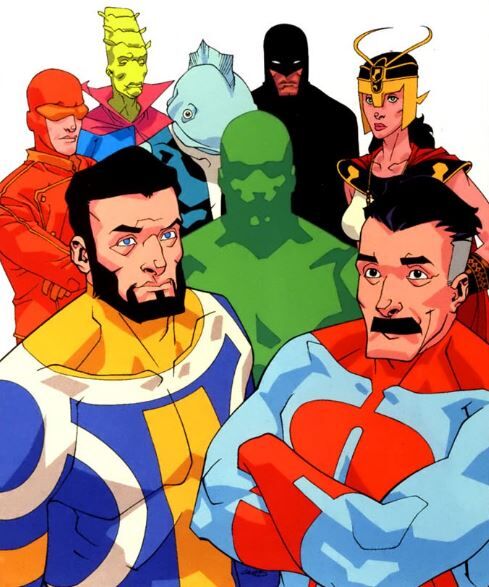
Back to 🌋. There are pharma companies which sell APIs as well as the finished medicine (FDF: Finished Dosage Formulation). Neuland are pureplay API manufacturers. This provides them some advantage since they don't compete with their clients (the FDF makers).
Medicine is diverse. There are medicine which were first discovered in 1920s (https://t.co/6DXNrhOK46), to those being created now (https://t.co/tcr7dAexmO). Naturally then, some of this involves very complex chemistry to manufacture, others are relatively easier to manufacture.
Starting with a simple primer on the Pharma industry. They make medicines for all of us. The part of the medicine which gives it its potency against the ailment it cures is called API: Active Pharmaceutical
(here is a reference few people will get, but have to make it since I love it :D):
If Guardians of the globe (https://t.co/vH2C1TDbPy) were a medicine, Omniman (https://t.co/0DGb1MAtXN) is the API.
Back to 🌋. There are pharma companies which sell APIs as well as the finished medicine (FDF: Finished Dosage Formulation). Neuland are pureplay API manufacturers. This provides them some advantage since they don't compete with their clients (the FDF makers).
Medicine is diverse. There are medicine which were first discovered in 1920s (https://t.co/6DXNrhOK46), to those being created now (https://t.co/tcr7dAexmO). Naturally then, some of this involves very complex chemistry to manufacture, others are relatively easier to manufacture.


More from Stocks





You May Also Like

First thread of the year because I have time during MCO. As requested, a thread on the gods and spirits of Malay folk religion. Some are indigenous, some are of Indian origin, some have Islamic
Before I begin, it might be worth explaining the Malay conception of the spirit world. At its deepest level, Malay religious belief is animist. All living beings and even certain objects are said to have a soul. Natural phenomena are either controlled by or personified as spirits
Although these beings had to be respected, not all of them were powerful enough to be considered gods. Offerings would be made to the spirits that had greater influence on human life. Spells and incantations would invoke their
Two known examples of such elemental spirits that had god-like status are Raja Angin (king of the wind) and Mambang Tali Arus (spirit of river currents). There were undoubtedly many more which have been lost to time
Contact with ancient India brought the influence of Hinduism and Buddhism to SEA. What we now call Hinduism similarly developed in India out of native animism and the more formal Vedic tradition. This can be seen in the multitude of sacred animals and location-specific Hindu gods
i wonder if you can make a thread bout witchcraft in malaysia.. or list of our own local gods/deites..
— r a y a \U0001f319 (@lcvelylilith) February 20, 2020
Before I begin, it might be worth explaining the Malay conception of the spirit world. At its deepest level, Malay religious belief is animist. All living beings and even certain objects are said to have a soul. Natural phenomena are either controlled by or personified as spirits
Although these beings had to be respected, not all of them were powerful enough to be considered gods. Offerings would be made to the spirits that had greater influence on human life. Spells and incantations would invoke their
Animist ceremonies of a religious or magical nature were normally held for the purpose of divination or making a request. This would either be done at a keramat or at a shrine similar to the Thai spirit houses or Chinese roadside shrines pic.twitter.com/I1hliyi0x3
— \u2745\u1710\u170b\u1713\u170e (@uglyluhan) June 16, 2019
Two known examples of such elemental spirits that had god-like status are Raja Angin (king of the wind) and Mambang Tali Arus (spirit of river currents). There were undoubtedly many more which have been lost to time
Contact with ancient India brought the influence of Hinduism and Buddhism to SEA. What we now call Hinduism similarly developed in India out of native animism and the more formal Vedic tradition. This can be seen in the multitude of sacred animals and location-specific Hindu gods