
https://t.co/nbXUsXvcmW
CritRats!
I think AI risk is a real existential concern, and I claim that the CritRat counterarguments that I've heard so far (keywords: universality, person, moral knowledge, education, etc.) don't hold up.
Anyone want to hash this out with
In general, I am super up for short (1 to 10 hour) adversarial collaborations.
— Eli Tyre (@EpistemicHope) December 23, 2020
If you think I'm wrong about something, and want to dig into the topic with me to find out what's up / prove me wrong, DM me.
https://t.co/nbXUsXvcmW
We don't yet know how to reliably build AGI systems _without_ "perverse emotions." It seems like that might be pretty hard to avoid.)
I would love to dig into this with someone who thinks that AI is not a serious existential risk for reasons related to the above, and together try and answer the question of how these AI is most likely to go.
1. I change my mind about AI risk, in some way
2. I understand some new-to-me argument that I need to think about in depth
3. I viscerally "get" what I'm missing from the CritRat frame
4. There's a public refutation of the arguments that turn out to be flawed
https://t.co/N3S5mER8Z9
Crit rats!
— Lulie \U0001f384 (@reasonisfun) September 2, 2020
Eli\u2019s very nice to chat with (Bayesian/CFAR background) \u2014 curious, sharp and kind, would recommend: https://t.co/lNToaqOusr
@DorfGinger @ks445599 @jchalupa_ @RealtimeAI @JimiSommer @chuggfest
Feel free to share with whoever is most likely to be interested.
More from Eli Tyre
My catch all thread for this discussion of AI risk in relation to Critical Rationalism, to summarize what's happened so far and how to go forward, from here.
I started by simply stating that I thought that the arguments that I had heard so far don't hold up, and seeing if anyone was interested in going into it in depth with
So far, a few people have engaged pretty extensively with me, for instance, scheduling video calls to talk about some of the stuff, or long private chats.
(Links to some of those that are public at the bottom of the thread.)
But in addition to that, there has been a much more sprawling conversation happening on twitter, involving a much larger number of people.
Having talked to a number of people, I then offered a paraphrase of the basic counter that I was hearing from people of the Crit Rat persuasion.
I started by simply stating that I thought that the arguments that I had heard so far don't hold up, and seeing if anyone was interested in going into it in depth with
CritRats!
— Eli Tyre (@EpistemicHope) December 26, 2020
I think AI risk is a real existential concern, and I claim that the CritRat counterarguments that I've heard so far (keywords: universality, person, moral knowledge, education, etc.) don't hold up.
Anyone want to hash this out with me?https://t.co/Sdm4SSfQZv
So far, a few people have engaged pretty extensively with me, for instance, scheduling video calls to talk about some of the stuff, or long private chats.
(Links to some of those that are public at the bottom of the thread.)
But in addition to that, there has been a much more sprawling conversation happening on twitter, involving a much larger number of people.
Having talked to a number of people, I then offered a paraphrase of the basic counter that I was hearing from people of the Crit Rat persuasion.
ELI'S PARAPHRASE OF THE CRIT RAT STORY ABOUT AGI AND AI RISK
— Eli Tyre (@EpistemicHope) January 5, 2021
There are two things that you might call "AI".
The first is non-general AI, which is a program that follows some pre-set algorithm to solve a pre-set problem. This includes modern ML.
More from Society


The UN just voted to condemn Israel 9 times, and the rest of the world 0.
View the resolutions and voting results here:
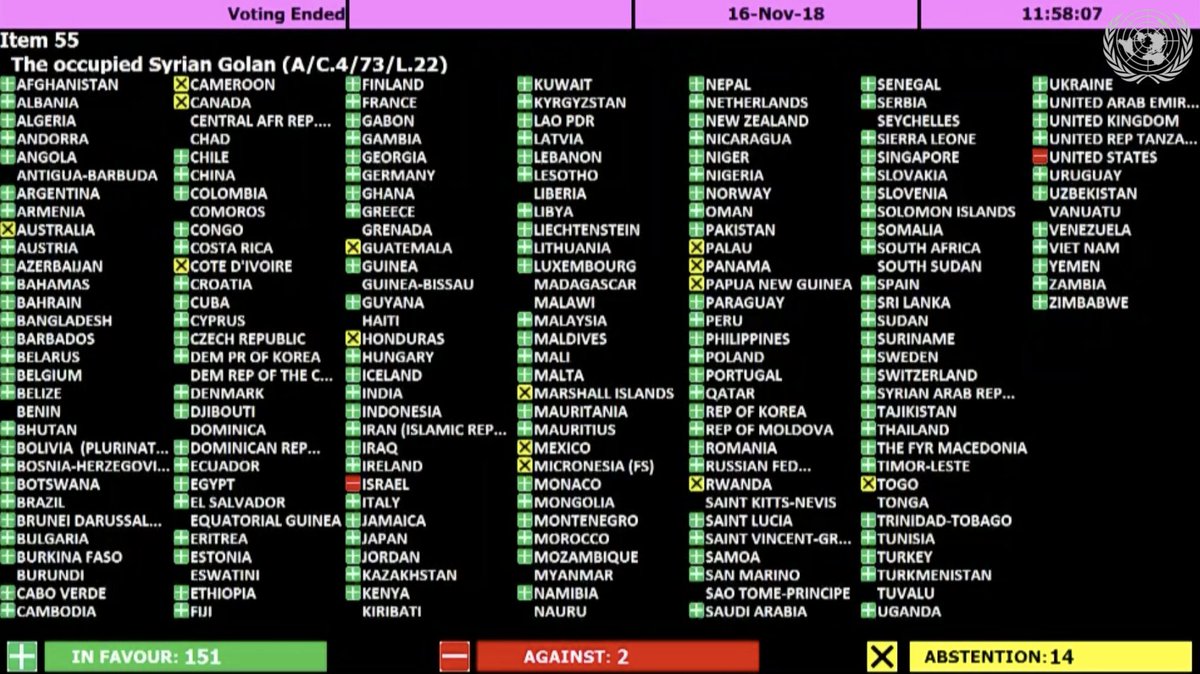
The resolution titled "The occupied Syrian Golan," which condemns Israel for "repressive measures" against Syrian citizens in the Golan Heights, was adopted by a vote of 151 - 2 - 14.
Israel and the U.S. voted 'No' https://t.co/HoO7oz0dwr
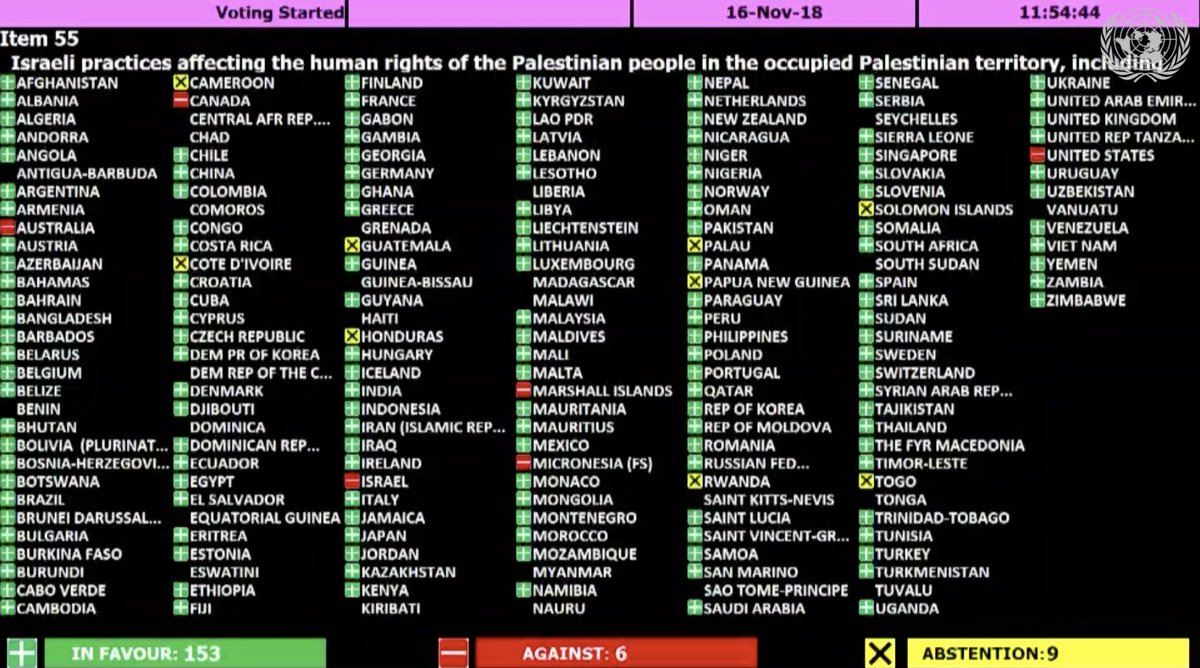
The resolution titled "Israeli practices affecting the human rights of the Palestinian people..." was adopted by a vote of 153 - 6 - 9.
Australia, Canada, Israel, Marshall Islands, Micronesia, and the U.S. voted 'No' https://t.co/1Ntpi7Vqab
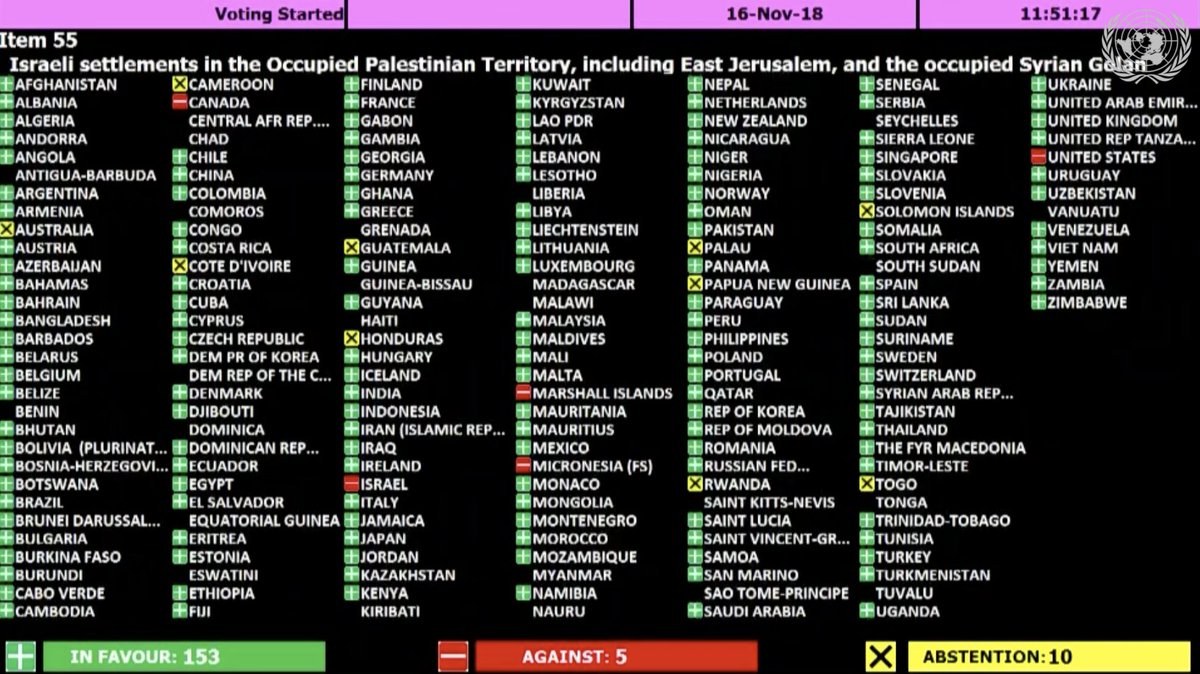
The resolution titled "Israeli settlements in the Occupied Palestinian Territory, including East Jerusalem, and the occupied Syrian Golan" was adopted by a vote of 153 – 5 – 10.
Canada, Israel, Marshall Islands, Micronesia, and the U.S. voted 'No'
https://t.co/REumYgyRuF
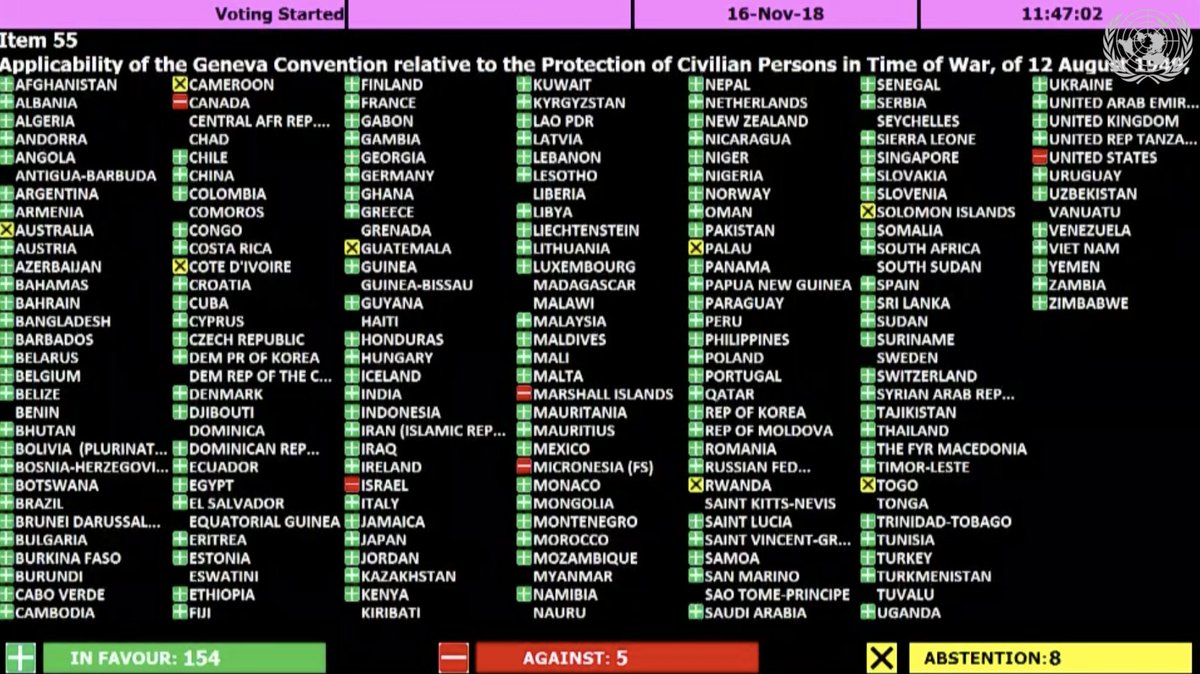
The resolution titled "Applicability of the Geneva Convention... to the
Occupied Palestinian Territory..." was adopted by a vote of 154 - 5 - 8.
Canada, Israel, Marshall Islands, Micronesia, and the U.S. voted 'No'
https://t.co/xDAeS9K1kW
View the resolutions and voting results here:
The resolution titled "The occupied Syrian Golan," which condemns Israel for "repressive measures" against Syrian citizens in the Golan Heights, was adopted by a vote of 151 - 2 - 14.
Israel and the U.S. voted 'No' https://t.co/HoO7oz0dwr
The resolution titled "Israeli practices affecting the human rights of the Palestinian people..." was adopted by a vote of 153 - 6 - 9.
Australia, Canada, Israel, Marshall Islands, Micronesia, and the U.S. voted 'No' https://t.co/1Ntpi7Vqab
The resolution titled "Israeli settlements in the Occupied Palestinian Territory, including East Jerusalem, and the occupied Syrian Golan" was adopted by a vote of 153 – 5 – 10.
Canada, Israel, Marshall Islands, Micronesia, and the U.S. voted 'No'
https://t.co/REumYgyRuF
The resolution titled "Applicability of the Geneva Convention... to the
Occupied Palestinian Territory..." was adopted by a vote of 154 - 5 - 8.
Canada, Israel, Marshall Islands, Micronesia, and the U.S. voted 'No'
https://t.co/xDAeS9K1kW

Shall we do a thread of Blue Checks spewing hatred towards Rush Limbaugh and the rest of us on the Right?
https://t.co/eXLNam2gv4
https://t.co/eXLNam2gv4
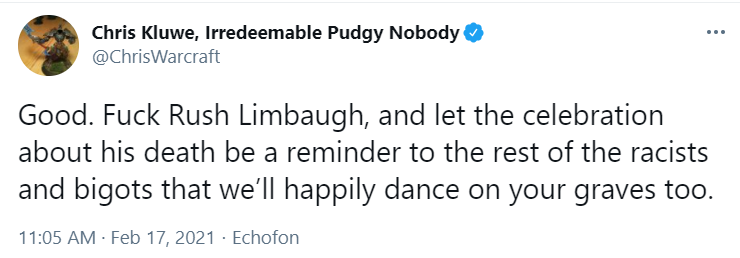
Good. Fuck Rush Limbaugh, and let the celebration about his death be a reminder to the rest of the racists and bigots that we\u2019ll happily dance on your graves too.
— Chris Kluwe, Irredeemable Pudgy Nobody (@ChrisWarcraft) February 17, 2021

You May Also Like





Tip from the Monkey
Pangolins, September 2019 and PLA are the key to this mystery
Stay Tuned!
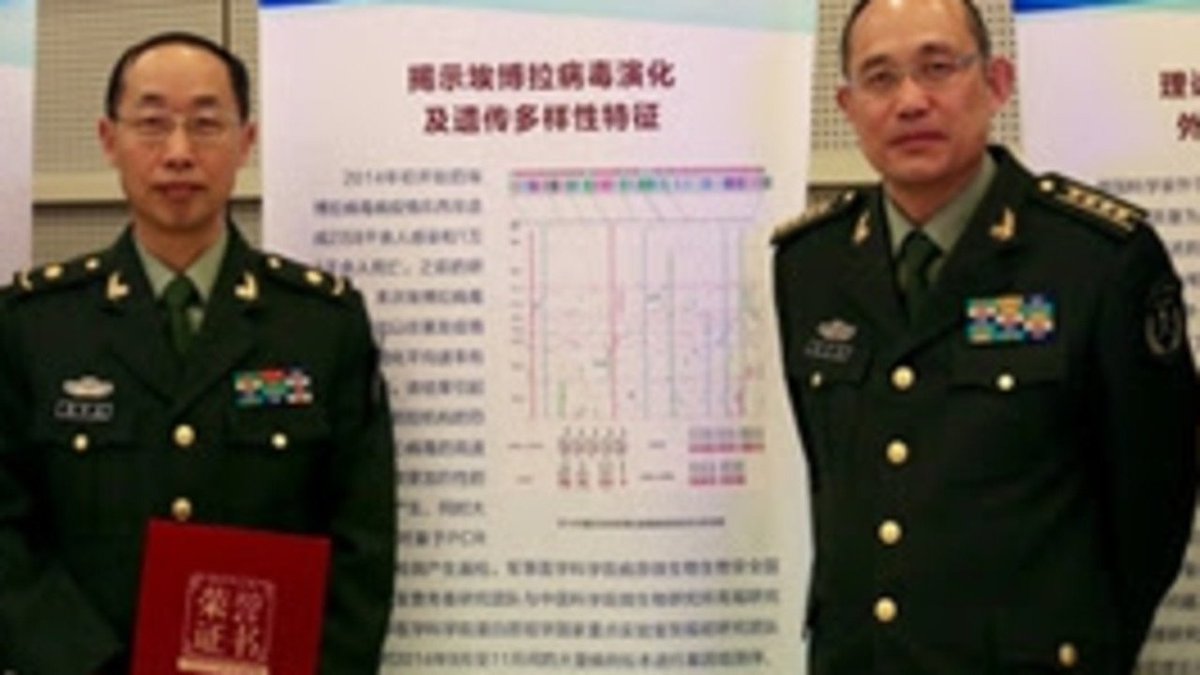
1. Yang
2. A jacobin capuchin dangling a flagellin pangolin on a javelin while playing a mandolin and strangling a mannequin on a paladin's palanquin, said Saladin
More to come tomorrow!

3. Yigang Tong
https://t.co/CYtqYorhzH
Archived: https://t.co/ncz5ruwE2W

4. YT Interview
Some bats & pangolins carry viruses related with SARS-CoV-2, found in SE Asia and in Yunnan, & the pangolins carrying SARS-CoV-2 related viruses were smuggled from SE Asia, so there is a possibility that SARS-CoV-2 were coming from
Pangolins, September 2019 and PLA are the key to this mystery
Stay Tuned!
1. Yang
Meet Yang Ruifu, CCP's biological weapons expert https://t.co/JjB9TLEO95 via @Gnews202064
— Billy Bostickson \U0001f3f4\U0001f441&\U0001f441 \U0001f193 (@BillyBostickson) October 11, 2020
Interesting expose of China's top bioweapons expert who oversaw fake pangolin research
Paper 1: https://t.co/TrXESKLYmJ
Paper 2:https://t.co/9LSJTNCn3l
Pangolinhttps://t.co/2FUAzWyOcv pic.twitter.com/I2QMXgnkBJ
2. A jacobin capuchin dangling a flagellin pangolin on a javelin while playing a mandolin and strangling a mannequin on a paladin's palanquin, said Saladin
More to come tomorrow!
3. Yigang Tong
https://t.co/CYtqYorhzH
Archived: https://t.co/ncz5ruwE2W
4. YT Interview
Some bats & pangolins carry viruses related with SARS-CoV-2, found in SE Asia and in Yunnan, & the pangolins carrying SARS-CoV-2 related viruses were smuggled from SE Asia, so there is a possibility that SARS-CoV-2 were coming from
