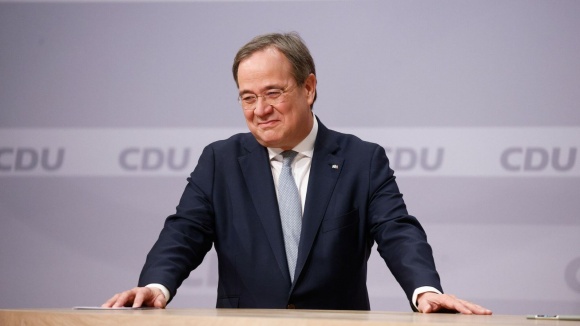
OK, so it's a fortnight away - the "Digital Party Conference" of the CDU to decide who the next party leader will be

And whoever wins this is going to have a good chance of being Chancellor, succeeding Merkel after the election in September this year

There are three main candidates in the running - all middle aged men from Nordrhein Westfalen
- Friedrich Merz
- Armin Laschet
- Norbert Röttgen
So who's going to win?

For ages it looked like Laschet was the clear front runner. Prime Minister of Nordrhein Westfalen (NRW), and with a kind of folksy-beergarten manner, it looked good for him.
But then came COVID, and in the first wave it looked like NRW was pushing to open up too early, and questions started to be raised as to whether he would be up to the job...

Laschet's star is falling
The candidate profiting is Merz. The comeback kid at 65 years of age would take the CDU more to the right - which seems to be what a slew of the 1001 delegates (esp those from the states of eastern Germany) want. That despite the pragmatic line of Merkel being +popular than ever.
The problem is that while the party faithful might like him, does anyone else? The CDU might find it hard to find coalition partners were it to go for Merz, and the SPD would be rubbing its hands with glee were he to win.
Röttgen is both more pragmatic and more centrist than Merz, and a much more compelling character than Laschet. But hasn't got a chance. Such is party politics...
A couple of news stories in German trying to make sense of the discussion currently - this today from Bild
https://t.co/24tiw4EaTm

And this trying to assess delegate intentions
https://t.co/DOWldt6u6G
How this pans out is going to have a major impact on both Germany and Europe... A victory for Merz is both a scary prospect, but also opens up the opportunity for a German government without the CDU in it for the first time since 2005
I'll have a close eye on this over the next fortnight - and beyond!

/ends

More from Jon Worth

To those saying that those who have got their public health advice wrong earlier in the pandemic should put up their hands and apologise... a little cautionary lesson from another sector

A short 🧵

1/

Public health is not my thing

But Brexit is

And throughout 2019 and 2020 I have been trying to make predictions as to what will happen in that story. Lives do not depend on this, only my professional reputation (marginally) does

2/12

The three series of #BrexitDiagram I made in 2019 were extraordinarily accurate

Series 1/2
https://t.co/wOSzIXxJ2M

Series 3
https://t.co/E4fKeGoa5n

Series 4
https://t.co/yRsQ8mLGj1

Each series got that stage of Brexit right

3/12

The 2020 series was nowhere near as good - at one stage I had No Deal Brexit at 78% chance in early December - and that was not what

I own this error - I was wrong

I know *why* I was wrong - I thought the European Parliament would fight more on Provisional Application, and I thought agreeing everything in a week wouldn't work. I wasn't right

The Manston crisis / borders closing changed something too

5/12

More from Politics

My piece in the NY Times today: "the Trump administration is denying applications submitted to the United States Citizenship and Immigration Services at a rate 37 percent higher than the Obama administration did in 2016."

Based on this analysis: "Denials for immigration benefits—travel documents, work permits, green cards, worker petitions, etc.—increased 37 percent since FY 2016. On an absolute basis, FY 2018 will see more than about 155,000 more denials than FY 2016."
https://t.co/Bl0naOO0sh


"This increase in denials cannot be credited to an overall rise in applications. In fact, the total number of applications so far this year is 2 percent lower than in 2016. It could be that the higher denial rate is also discouraging some people from applying at all.."

Thanks to @gsiskind for his insightful comments. The increase in denials, he said, is “significant enough to make one think that Congress must have passed legislation changing the requirements. But we know they have not.”

My conclusion:

You May Also Like

1/“What would need to be true for you to….X”

Why is this the most powerful question you can ask when attempting to reach an agreement with another human being or organization?

A thread, co-written by @deanmbrody:


2/ First, “X” could be lots of things. Examples: What would need to be true for you to

- “Feel it's in our best interest for me to be CMO"
- “Feel that we’re in a good place as a company”
- “Feel that we’re on the same page”
- “Feel that we both got what we wanted from this deal

3/ Normally, we aren’t that direct. Example from startup/VC land:

Founders leave VC meetings thinking that every VC will invest, but they rarely do.

Worse over, the founders don’t know what they need to do in order to be fundable.

4/ So why should you ask the magic Q?

To get clarity.

You want to know where you stand, and what it takes to get what you want in a way that also gets them what they want.

It also holds them (mentally) accountable once the thing they need becomes true.

5/ Staying in the context of soliciting investors, the question is “what would need to be true for you to want to invest (or partner with us on this journey, etc)?”

Multiple responses to this question are likely to deliver a positive result.