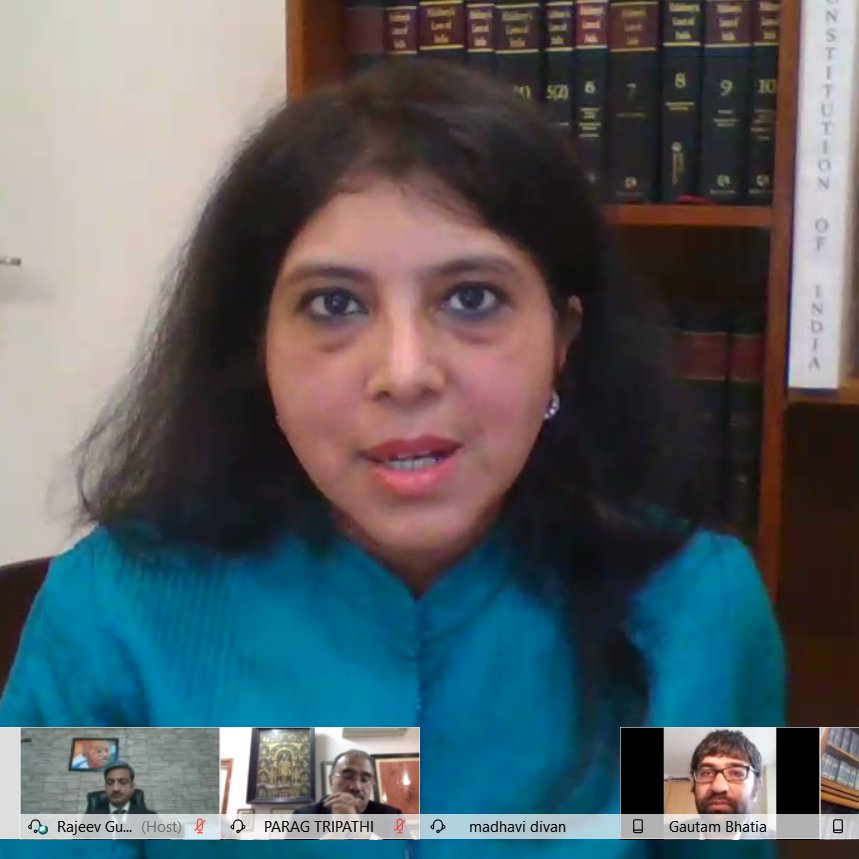
Vidhi Centre for Law and Policy will be organizing a talk on "Free Speech and its (Un)Lawful Restriction" shortly.

@Vidhi_India
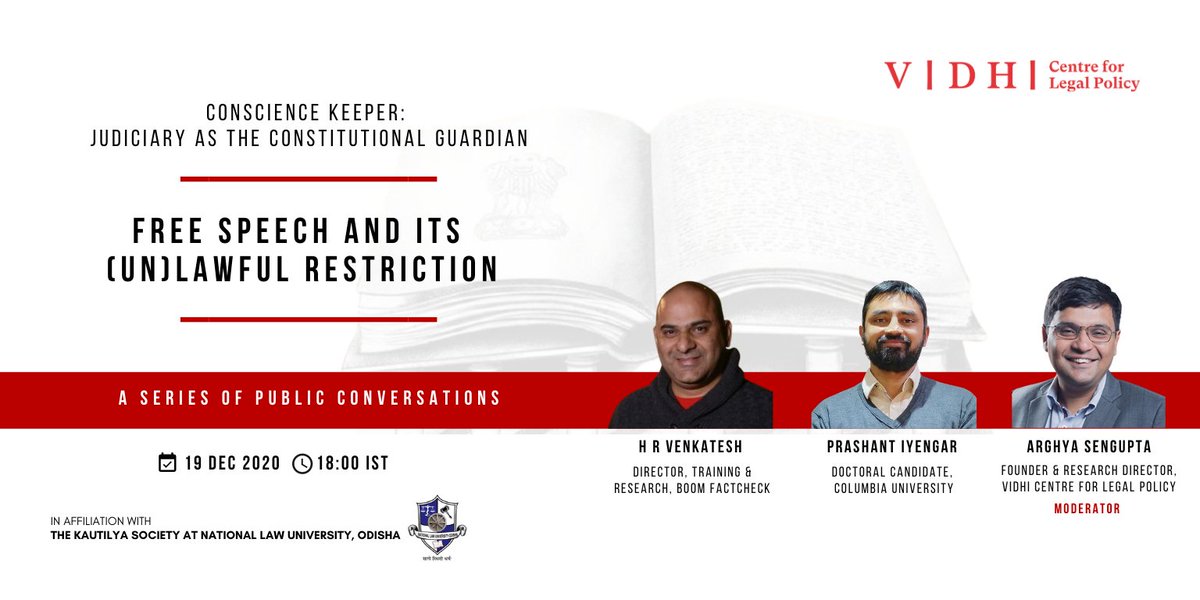
The event begins.
HR Venkatesh: We dont think too about about Supreme Court or censorship. You dont worry about contempt or so.

Journalism in the digital space is a little freer compared print media, in the past few years.
Venkatesh: We feel that entire atmosphere in Judiciary for journalism is bit restrictive. We are little "hemmed"

Off late, the restriction is spreading to the digital space as well.

@Vidhi_India
Prashant Iyengar: What do we make of digital speech and the law?

The Supreme Court has the image of being completely neutral. This is untrue. It has an extremely reactionary attitude. This is true for all Courts in the world.
Iyengar: Whatever you tweet immediately goes out to million followers. Communication itself has changed in character. You cannot apply the old regime now.

This is person - who has a private conversation. Is this publication? All Courts are trying to figure out this.
Should Courts continue to be a conscience keeper?

Iyengar: To punish people for contempt of Court is bad way to do that. The SC has been flattered by press and others by the terms such as "Conscience keeper", "People's Court", "Guardian of the Constitution".
Iyengar: The Court is taking is too seriously. When the framers called SC the Guardian of the Constitution, I dont think it wanted the Court to chase after people.
Venkatesh: When we think of the SC, as journalists, we regard it in two ways

- Guardian of the Constitution and other institutions.
- It is staffed with people who are regular, who are buoyant to the political winds. Are Courts being too politicized now?
Venkatesh: Media likes a narrative. A hero vs villain narrative. So if the Judge is pronouncing a judgment, there will be a similar narrative.
Iyengar: I think you were right when you said that the Court has a patchy record.

Art 19 is a very curious article in terms of the way it has been drafted. The Framers are doing something extremely surprising with Art 19.
It's hard to imagine people who witnessed censorship back then, framed something stricter. During our freedom struggle, there were many seditious speeches made.

They (Framers of Consti) used the ladder to climb towards independence, then they threw it away, Iyengar.
Venkatesh speaks on the First Amendment Act - restrictions to free speech.
I do believe that there many threats to the freedom of speech in India, which includes freedom of press, Venkatesh
Question of free speech should be looked at, not just legally but also politically and culturally, Venkatesh
Venkatesh: We have noted that social media companies and other tech companies are the gate keepers now - they decide what people see, using algorithm. There is algorithm bias.
Iyengar: Private capital has always had a huge say in governing/shaping the public sphere. Few huge companies like Twitter, Facebook etc are shaping with respect to the internet

We dont have as much freedom as we had 20 years ago, in the internet right now.
Right to protest is increasingly getting curtailed. In India, you cant protest right before the Rashtrapathi Bhavan, but in the US, you can.

What happened to the CAA protests?
Farmers protesting in Delhi is bright sport but I need to see more..., Venkatesh.
Iyengar: Right to protest, I share that anxiety. Govt is ready to incarcerate people from the middle class and upper middle class as well. Who is this Govt accountable to? This is concerning
The event ends.

More from Bar & Bench

More from Law

One of the judges this story mentions is William Cassidy, who was promoted from an Atlanta IJ position to a BIA member position in 2019 by the Trump DOJ. Cassidy has an awful history that has been well-documented, but I'm still enraged reading this reporting.


The story notes that the EOIR Director served as an ICE attorney in Atlanta and practiced before Cassidy for years. And it points to FOIA records unearthed by Bryan Johnson showing they remain friendly.

A trove of complaints against Cassidy was published by AILA in 2019 after FOIA litigation. They generally show misconduct, substantiated in the record, followed by "written counseling" etc.

One way Cassidy could avoid discipline is by turning off the recording device during the hearing. If he made a lewd or offensive comment off the record, all the EOIR would do is listen to the recording. If it's not there, the complaint is "unsubstantiated" https://t.co/wUeBPEEbpV


In that case, Cassidy joked about a detained immigrant saying he missed his wife. The complaint was dismissed because the ACIJ found "no levity or joking" in the comment.
I’ve been reading lots recently about the interaction between First Amendment law and free speech principles with respect to online services in light of the events of the last few weeks.

And I have thoughts (MY OWN). So, I’m sorry ... a thread 1/25

One of the main reasons I think users are best served by a recognition that social media services have 1st Amendment rights to curate the content on their sites is because many users want filtered content, either by topic, or by behavior, or other. 2/

So online services should have the right to do this filtering, and to give their users the tools to do so too. For more detail see our Prager U amicus brief
https://t.co/73PswB9Q7Q 3/

So, I disagree with my friends (and others) who say that every online service should apply First Amendment rules, even though they cannot be required to do so. There are both practical and policy reasons why I don’t like this. 4/

Most obviously, the 1st Amendment reflects only one national legal system when this is inherently an international issue. So it’s politically messy, even if you think a 1st Amendment-based policy will be most speech-protective (though probably only non-sexual speakers). 5/

You May Also Like