[Thread: Wife Beating & Islam]
Opinions of famous classical Muslim scholars.

Imam Al-Desouki:
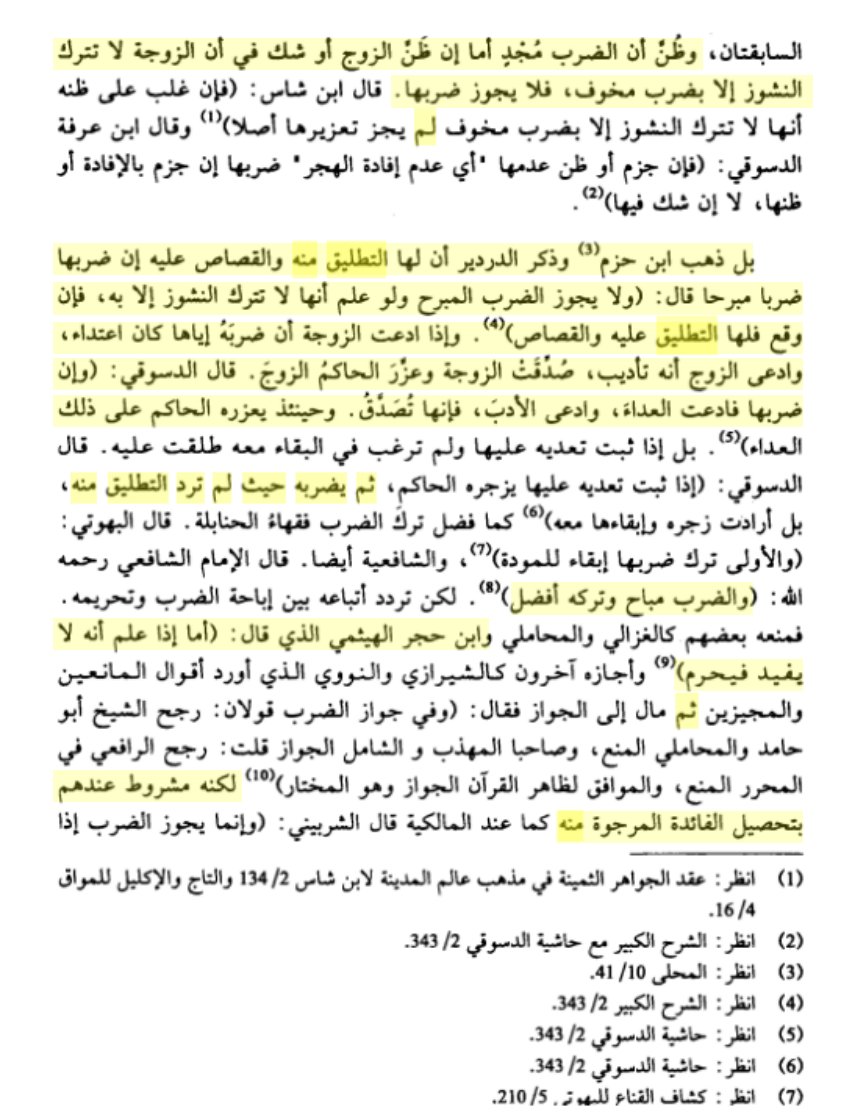
If the wife claims she has been beaten in transgression and the husband claims otherwise, then the wife is to be believed and the husband is to be reprehended (rebuked, …) by the judge

Imam Al-Desouki:
And if proof for transgression is shown and the wife wants to remain with him, then the judge is to beat the husband.
Imam Al-Desouki:
If the husband believes that his wife will not stop rebelling except by beating, then he’s not allowed to beat her.
Ibn Hajar Al Haithami:
If a husband knows that beating isn't helpful, then it becomes haram.

Al-Shafi‘i:
Beating is allowed, but avoiding it is better.

Maliki opinion:
Beating is allowed ONLY if it delivers the benefit intended from it. If it doesn't, then it's haram.
Ibn Hazm:
A wife has the right to divorce herself and right to retribution (or retaliation) if her husband beats her violently.

He is not allowed to beat his wife violently even if he knows she won’t stop rebelling by no other means and...
...and if he does beat her violently then she has the right to divorce him and the right for retribution.
Imam Al-Desouqi:
If the judge has been shown proof that the husband harms his wife even 1ce, then the wife is given the right to choose whether to remain with him or divorce herself with one talaq because of the Hadith “There should be neither harming nor reciprocating harm.”
Imam Nawawi:
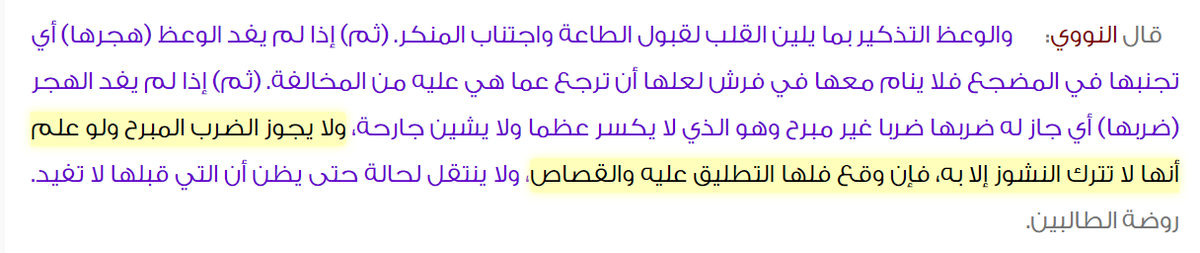
Violent beating isn't allowed even if the husband believes his wife won't stop rebelling otherwise.

And if he does that, then she is given the right to divorce him and Qisas (retribution) as well.
Aisha (RA):
The Prophet ﷺ never hit with his hand neither a servant nor a woman but of course, he did fight in the Cause of Allah. He never took revenge upon anyone for the wrong done to him, but of course, he exacted retribution for the sake of Allah...
https://t.co/yGdgwkqW6v
About wife beating, Ibn Hajar al-Haytami (Shafiʽi scholar, died 1566) said:

"But if it is known that it is not useful, then it is forbidden, because it is an indispensable punishment."

Reference:
Nihāyat al-muḥtāj ilá sharḥ al-Minhāj, Vol. 6 Page 391

More from Islam

You May Also Like

Rig Ved 1.36.7

To do a Namaskaar or bow before someone means that you are humble or without pride and ego. This means that we politely bow before you since you are better than me. Pranipaat(प्राणीपात) also means the same that we respect you without any vanity.

1/9


Surrendering False pride is Namaskaar. Even in devotion or bhakti we say the same thing. We want to convey to Ishwar that we have nothing to offer but we leave all our pride and offer you ourselves without any pride in our body. You destroy all our evil karma.

2/9

We bow before you so that you assimilate us and make us that capable. Destruction of our evils and surrender is Namaskaar. Therefore we pray same thing before and after any big rituals.

3/9

तं घे॑मि॒त्था न॑म॒स्विन॒ उप॑ स्व॒राज॑मासते ।
होत्रा॑भिर॒ग्निं मनु॑षः॒ समिं॑धते तिति॒र्वांसो॒ अति॒ स्रिधः॑॥

Translation :

नमस्विनः - To bow.

स्वराजम् - Self illuminating.

तम् - His.

घ ईम् - Yours.

इत्था - This way.

उप - Upaasana.

आसते - To do.

स्त्रिधः - For enemies.

4/9

अति तितिर्वांसः - To defeat fast.

मनुषः - Yajman.

होत्राभिः - In seven numbers.

अग्निम् - Agnidev.

समिन्धते - Illuminated on all sides.

Explanation : Yajmans bow(do Namaskaar) before self illuminating Agnidev by making the offerings of Havi.

5/9
Still wondering about this 🤔


save as q